
Ikpy
IKPy, an Universal Inverse Kinematics library
Install / Use
/learn @Phylliade/IkpyREADME
IKPy




Demo
Live demos of what IKPy can do (click on the image below to see the video):
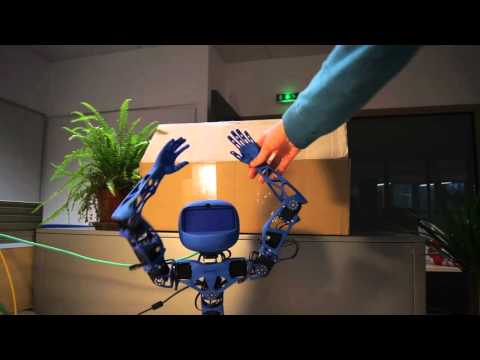
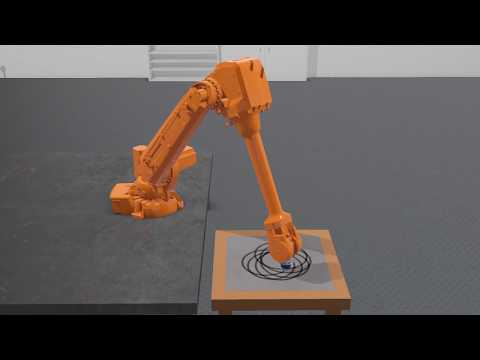
Also, a presentation of IKPy: Presentation.
Features
With IKPy, you can:
- Compute the Inverse Kinematics of every existing robot.
- Compute the Inverse Kinematics in position, orientation, or both
- Define your kinematic chain using arbitrary representations: DH (Denavit–Hartenberg), URDF, custom...
- Automatically import a kinematic chain from a URDF file.
- Support for arbitrary joint types:
revolute,prismaticand more to come in the future - Use pre-configured robots, such as baxter or the poppy-torso
- IKPy is precise (up to 7 digits): the only limitation being your underlying model's precision, and fast: from 7 ms to 50 ms (depending on your precision) for a complete IK computation.
- Plot your kinematic chain: no need to use a real robot (or a simulator) to test your algorithms!
- Define your own Inverse Kinematics methods.
- Utils to parse and analyze URDF files:

Moreover, IKPy is a pure-Python library: the install is a matter of seconds, and no compiling is required.
Installation
You have three options:
-
From PyPI (recommended) - simply run:
pip install ikpyIf you intend to plot your robot, you can install the plotting dependencies (mainly
matplotlib):pip install 'ikpy[plot]' -
From source - first download and extract the archive, then run:
pip install ./NB: You must have the proper rights to execute this command
Quickstart
Follow this IPython notebook.
Guides and Tutorials
Go to the wiki. It should introduce you to the basic concepts of IKPy.
API Documentation
An extensive documentation of the API can be found here.
Dependencies and compatibility
Starting with IKPy v3.1, only Python 3 is supported. For versions before v3.1, the library can work with both versions of Python (2.7 and 3.x).
In terms of dependencies, it requires numpy and scipy.
sympy is highly recommended, for fast hybrid computations, that's why it is installed by default.
matplotlib is optional: it is used to plot your models (in 3D).
Contributing
IKPy is designed to be easily customisable: you can add your own IK methods or robot representations (such as DH-Parameters) using a dedicated developer API.
Contributions are welcome: if you have an awesome patented (but also open-source!) IK method, don't hesitate to propose adding it to the library!
Links
- If performance is your main concern,
aversive++has an inverse kinematics module written in C++, which works the same way IKPy does.
Citation
If you use IKPy as part of a publication, please use the Bibtex below as a citation:
@software{Manceron_IKPy,
author = {Manceron, Pierre},
doi = {10.5281/zenodo.6551105},
license = {Apache-2.0},
title = {{IKPy}},
url = {https://github.com/Phylliade/ikpy}
}
Related Skills
node-connect
331.2kDiagnose OpenClaw node connection and pairing failures for Android, iOS, and macOS companion apps
claude-opus-4-5-migration
81.5kMigrate prompts and code from Claude Sonnet 4.0, Sonnet 4.5, or Opus 4.1 to Opus 4.5
frontend-design
81.5kCreate distinctive, production-grade frontend interfaces with high design quality. Use this skill when the user asks to build web components, pages, or applications. Generates creative, polished code that avoids generic AI aesthetics.
model-usage
331.2kUse CodexBar CLI local cost usage to summarize per-model usage for Codex or Claude, including the current (most recent) model or a full model breakdown. Trigger when asked for model-level usage/cost data from codexbar, or when you need a scriptable per-model summary from codexbar cost JSON.
