
hevy-mcp
Manage your Hevy workouts, routines, folders, and exercise templates. Create and update sessions faster, organize plans, and search exercises to build workouts quickly. Stay synced with changes so your training log is always up to date.
Install / Use
claude mcp add chrisdoc -- npx -y github:chrisdoc/hevy-mcpIf the server publishes to npm under a different name, use that package instead — check the repo README.
MCP Server
Model Context Protocol server
Quality Score
Category
Development & EngineeringSupported Platforms
Tags
Skill content
View source on GitHubHevy MCP Server
<div align="center">Talk to your Hevy workout data from Claude, Cursor, Codex, and other MCP clients.







Connect to the hosted MCP · Use the Hevy CLI · Watch the 18-second demo · Explore all 22 tools
</div>Hevy CLI
Prefer the terminal? The separate
@chrisdoc/hevy-cli
package reads workouts, routines, exercises, and body measurements directly
from the Hevy API, and can create or update those resources with explicit
confirmation. Deletion is not supported.
npm install -g @chrisdoc/hevy-cli
export HEVY_API_KEY=your-hevy-api-key

hevy workouts list --page-size 10
hevy summary --weeks 4
Add --json to any command for scripts and pipelines. The CLI is a standalone
Hevy API client, not an MCP wrapper. See
packages/cli/README.md for the full command
reference, pagination behavior, and exit codes.
hevy-mcp is an open-source Model Context Protocol (MCP)
server for the Hevy fitness and workout tracking
app. It lets AI assistants read, analyze, create, and update your Hevy workouts,
routines, exercise templates, and body measurements through authenticated Hevy
API requests.
The repository is organized as a private workspace with explicit runtime
boundaries: @hevy-mcp/hevy-client owns the web-safe Hevy client,
@hevy-mcp/core owns MCP tools and server construction, hevy-mcp is the
published Node.js stdio adapter, and @hevy-mcp/worker is the private
Cloudflare HTTP/OAuth adapter. Only the Node workspace is publishable.
A Hevy API key, available with Hevy PRO, is required.
See it in action
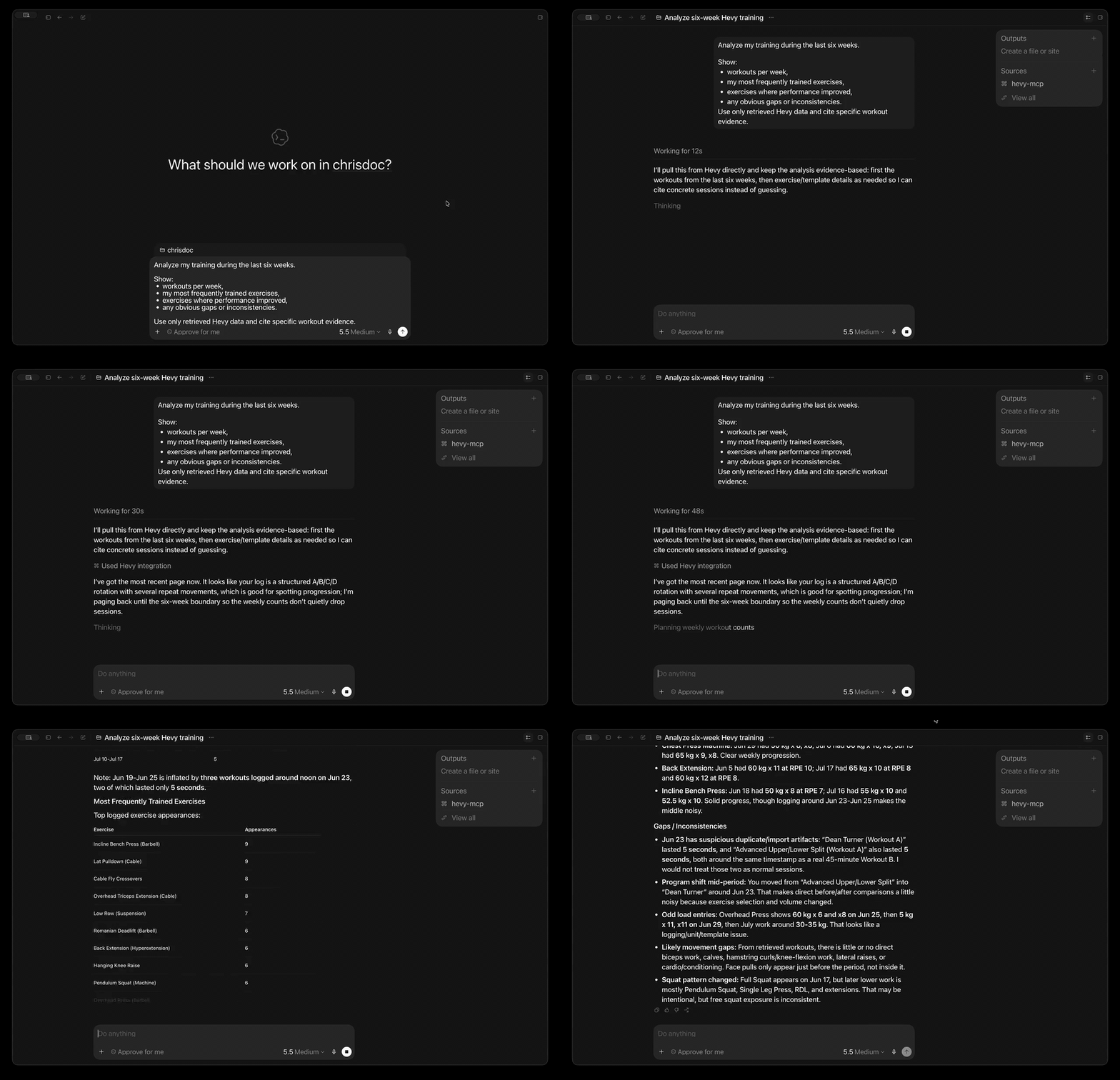
In the demo, the assistant retrieves real Hevy data and answers a multi-part training question with evidence from the user's workout history.
What can you do with it?
- Analyze training progress: summarize 1-12 weeks of workouts and body measurements in one tool call.
- Ask questions in plain language: find recent sessions, frequently trained exercises, consistency gaps, routine details, or exercise history.
- Plan and log training: create or update workouts, routines, routine folders, custom exercises, and body measurements.
- Search without huge responses: discover routines and exercise templates with compact, AI-friendly results.
- Connect from your preferred MCP client: use the hosted Streamable HTTP endpoint or run locally with Codex, Claude Desktop, Cursor, and other clients.
- Start without installing anything: connect directly to the production Cloudflare Worker—no Node.js, package download, or Docker container required.
- Keep local control when you want it: run the same server with
npx,bunx, or the official Docker image.
Try asking:
Analyze my training over the last six weeks. Show workouts per week, my most frequently trained exercises, any obvious gaps or inconsistencies, and cite the workout evidence you used.
Find my push-day routine and show its exercises and sets.
Compare my recent body measurements with my training consistency.
Create a completed workout from my saved routine. Ask me for any missing set results before writing it to Hevy.
Quick start
1. Get your Hevy API key
Create an API key in Hevy, then keep it somewhere secure. API access currently requires a Hevy PRO subscription.
2. Connect hevy-mcp to your client
The hosted Cloudflare endpoint is the fastest way to start. It runs remotely, so your client does not need Node.js, Bun, Docker, or a local server process.
Connect to the hosted endpoint
Production URL:
https://mcp.hevy-mcp.dev/mcp
The endpoint uses Streamable HTTP. Send your Hevy API key as a bearer token on every request.
Codex
Codex CLI, the Codex desktop app, and the IDE extension share the same MCP configuration. Make your Hevy API key available in the environment that starts Codex, then add the hosted server:
export HEVY_API_KEY=your-hevy-api-key
codex mcp add hevy \
  --url https://mcp.hevy-mcp.dev/mcp \
  --bearer-token-env-var HEVY_API_KEY
Codex stores the environment variable name, not the key itself, in its MCP
configuration. Restart Codex or begin a new session, then run codex mcp list
to verify the server is configured.
Other Streamable HTTP clients
Clients that accept a remote MCP URL and fixed headers commonly use this shape:
{
	"mcpServers": {
		"hevy": {
			"url": "https://mcp.hevy-mcp.dev/mcp",
			"headers": {
				"Authorization": "Bearer your-hevy-api-key"
			}
		}
	}
}
Exact configuration keys vary by client. The hosted server requires support for
Streamable HTTP and a fixed Authorization header.
[!IMPORTANT] Treat the bearer value like a password. The Worker validates it with Hevy for each request, does not store it, and forwards it to Hevy only as the required
api-keyheader.
Run locally instead
Choose local stdio if you prefer to run the server on your own machine or your client cannot attach a fixed authorization header to remote MCP requests.
Codex
codex mcp add hevy \
  --env HEVY_API_KEY=your-hevy-api-key \
  -- npx -y hevy-mcp
Claude Desktop or Cursor
Add this mcpServers entry to your client configuration:
{
	"mcpServers": {
		"hevy": {
			"command": "npx",
			"args": ["-y", "hevy-mcp"],
			"env": {
				"HEVY_API_KEY": "your-hevy-api-key"
			}
		}
	}
}
Google Antigravity
There are two ways to configure the Hevy MCP server for Google Antigravity (agy):
Option A: Automatic Plugin Installation (Recommended)
This utilizes the built-in plugin system:
-
Install the plugin:
agy plugin install https://github.com/chrisdoc/hevy-mcp -
Provide the
HEVY_API_KEYin your host shell environment so the CLI child process can inherit it:- Persistent: Save the environment variable
HEVY_API_KEYin your system/shell configurations:- macOS / Linux: Add it to your shell profile configurations (e.g.,
~/.zshrcor~/.bashrc):export HEVY_API_KEY="your-actual-api-key" - Windows: Add it to your User or System Environment Variables. In PowerShell, you can run:
[Environment]::SetEnvironmentVariable("HEVY_API_KEY", "your-actual-api-key", "User")
- macOS / Linux: Add it to your shell profile configurations (e.g.,
- Temporary (Session-only): If you do not want to persist the key, export it in your active terminal session before running
agy:export HEVY_API_KEY="your-actual-api-key"
- Persistent: Save the environment variable
Option B: Manual Configuration (No Plugin)
If you prefer configuring it statically via the global configuration file:
-
Open your global MCP configuration file:
- Location:
~/.gemini/config/mcp_config.json
- Location:
-
Add the
hevyconfiguration block under themcpServerskey. Make sure to merge this entry with any existing servers you have configured rather than replacing the entire file contents:{ "mcpServers": { "hevy": { "command": "npx", "args": ["-y", "hevy-mcp"], "env": { "HEVY_API_KEY": "your-actual-api-key" } } } }
Common local configuration locations:
- Claude Desktop on macOS:
~/Library/Application Support/Claude/claude_desktop_config.json - Claude Desktop on Windows:
%APPDATA%\Claude\claude_desktop_config.json - Cursor:
~/.cursor/mcp.json
Restart or reconnect the client after saving the file.
Any stdio MCP client
Configure your client to launch this command with HEVY_API_KEY in the child
process environment:
npx -y hevy-mcp
npx requires Node.js 20 or newer. Restart or reconnect your client after
saving its configuration.
Requires Bun:
{
	"mcpServers": {
		"hevy": {
			"command": "bunx",
			"args": ["hevy-mcp@latest"],
			"env": {
				"HEVY_API_KEY": "your-hevy-api-key"
			}
		}
	}
}
Official images support linux/amd64 and linux/arm64. Keep stdin open with
-i because the container runs the stdio MCP server:
export HEVY_API_KEY=your-hevy-api-key
docker run -i --rm -e HEVY_API_KEY ghcr.io/chrisdoc/hevy-mcp:latest
For an MCP client, store the key in a protected environment file and configure the client to launch Docker:
{
	"mcpServers": {
		"hevy": {
			"command": "docker",
			"args": [
				"run",
				"-i",
				"--rm",
				"--env-file",
				"/absolute/path/to/hevy-mcp.env",
				"ghcr.io/chrisdoc/hevy-mcp:latest"
			]
		}
	}
}
Pin an exact image tag such as ghcr.io/chrisdoc/hevy-mcp:X.Y.Z when you need
reproducible upgrades.
You can also add the npm server to supported clients with
add-mcp:
npx add-mcp hevy-mcp --env "HEVY_API_KEY=your-hevy-api-key"
3. Ask your first question
Try one of these after restarting or reconnecting your MCP client:
- “Give me a training summary for the last four weeks.”
- “What routines do I have saved on Hevy?”
- “Show my three most recent workouts.”
- “Find exercise templates containing squat.”
- “Which Hevy account is connected?”
Your assistant should ask for approval before mutation tools when the client supports tool confirmations.
How it works
Hosted:  Your AI assistant  →  Streamable HTTP  →  Cloudflare Worker  →  Hevy API
Local:   Your AI assistant  →  MCP over stdio   →  local hevy-mcp     →  Hevy API
The hosted endpoint creates a fresh MCP server and Hevy client for each request. It validates the supplied key with Hevy, keeps no shared user session, and does not persist the key. The local server follows the same tool contract but runs on your machine and receives the key through its child-process environment.
In either mode, read tools retrieve data; mutation tools create or replace data only when your assistant calls them.
Guided prompts
These server-provided MCP prompts coordinate common multi-step workflows:
| Prompt | Arguments | Workflow | | ----------------------------- | ------------------------------------------
Truncated for display — read the full file on GitHub.
Related Skills
Agent-Reach
84.4kGive your AI agent eyes to see the entire internet. Read & search Twitter, Reddit, YouTube, GitHub, Bilibili, XiaoHongShu — one CLI, zero API fees.
headroom
73.4kCompress tool outputs, logs, files, and RAG chunks before they reach the LLM. 20% fewer tokens for coding agents, 60-95% fewer tokens for JSON, same answers. Library, proxy, MCP server.
ruflo
73.0k🌊 The original agent harness. Deploy intelligent multi-player swarms, coordinate autonomous workflows, and build conversational AI systems. Features adaptive memory, self-learning intelligence, federation, vector RAG integration, and native Claude Code / Codex / Hermes and many more Integrated
career-ops
72.4kOpen-source AI job search: scan job portals, evaluate listings into a structured A-H report with a global 1-5 score, tailor your CV, track applications — runs locally in your AI coding CLI (Claude Code, Codex, OpenCode, Antigravity…)
