Astrobase
Python modules for light curve work and variable star astronomy
Install / Use
/learn @waqasbhatti/AstrobaseREADME

Astrobase is a Python package for analyzing light curves and finding variable stars. It includes implementations of several period-finding algorithms, batch work drivers for working on large collections of light curves, and a small web-app useful for reviewing and classifying light curves by stellar variability type.
Most functions in this package that deal with light curves usually require three
Numpy ndarrays as input: times, mags, and errs, so they should work with
any time-series data that can be represented in this form. If you have flux time
series measurements, most functions also take a magsarefluxes keyword argument
that makes them handle flux light curves correctly.
- Read the docs: https://astrobase.readthedocs.io/en/latest/
- Jupyter notebooks that demonstrate some of the functionality are available in the astrobase-notebooks repository.
- A overview of the modules and subpackages is provided below.
Install astrobase from the Python Package Index (PyPI):
$ pip install numpy # needed to set up Fortran wrappers
$ pip install astrobase
See the installation instructions below for details. This
package requires Python >= 3.5 as of version 0.5.0. Use pip install astrobase<0.5.0 for older Python versions.
Python 3.6:
Python 3.7:
Python 3.8:
Python 3.9:
Contents
-
astrokep: contains functions for dealing with Kepler and K2 Mission light curves from STScI MAST (reading the FITS files, consolidating light curves for objects over quarters), and some basic operations (converting fluxes to mags, decorrelation of light curves, filtering light curves, and fitting object centroids for eclipse analysis, etc.)
-
astrotess: contains functions for dealing with TESS 2-minute cadence light curves from STScI MAST (reading the FITS files, consolidating light curves for objects over sectors), and some basic operations (converting fluxes to mags, filtering light curves, etc.)
-
checkplot: contains functions to make checkplots: a grid of plots used to quickly decide if a period search for a possibly variable object was successful. Checkplots come in two forms:
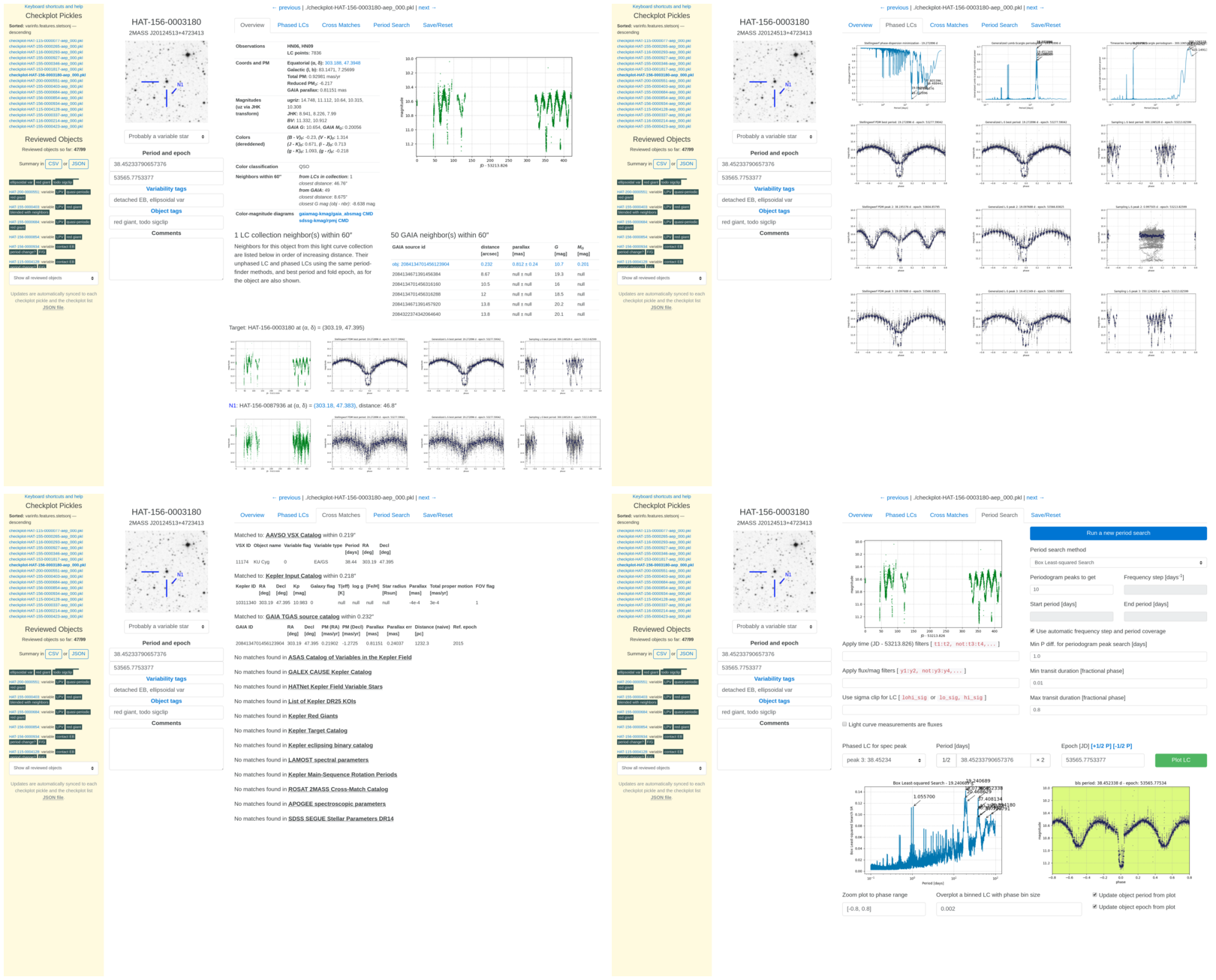
Python pickles: If you want to interactively browse through large numbers of checkplots (e.g., as part of a large variable star classification project), you can use the
checkplotserverwebapp that works on checkplot pickle files. This interface allows you to review all phased light curves from all period-finder methods applied, set and save variability tags, object type tags, best periods and epochs, and comments for each object using a browser-based UI (see below). The information entered can then be exported as CSV or JSON for the next stage of a variable star classification pipeline.The lightcurves-and-checkplots Jupyter notebook outlines how to do this. A more detailed example using light curves of an arbitrary format is available in the lc-collection-work notebook, which shows how to add in support for a custom LC format, add neighbor, cross-match, and color-mag diagram info to checkplots, and visualize these with the checkplotserver.
PNG images: Alternatively, if you want to simply glance through lots of checkplots (e.g. for an initial look at a collection of light curves), there's a
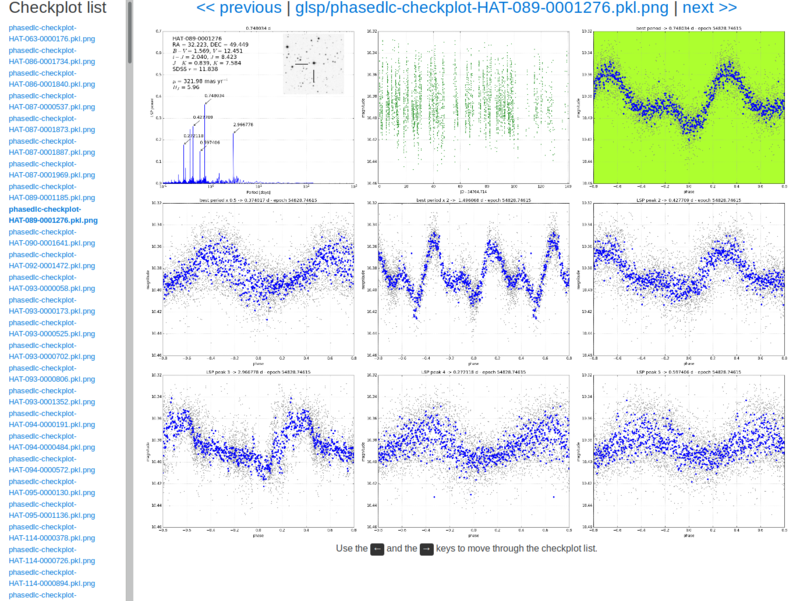
checkplot-viewerwebapp available that operates on checkplot PNG images. The lightcurve-work Jupyter notebook goes through an example of generating these checkplot PNGs for light curves. See the checkplot-viewer.js file for more instructions and checkplot-viewer.png for a screenshot. -
coordutils: functions for dealing with coordinates (conversions, distances, proper motion)
-
fakelcs: modules and functions to conduct an end-to-end variable star recovery simulation.
-
hatsurveys: modules to read, filter, and normalize light curves from various HAT surveys.
-
lcfit: functions for fitting light curve models to observations, including sinusoidal, trapezoidal and full Mandel-Agol planet transits, eclipses, and splines.
-
lcmath: functions for light curve operations such as phasing, normalization, binning (in time and phase), sigma-clipping, external parameter decorrelation (EPD), etc.
-
lcmodels: first order models for fast fitting (for the purposes of variable classification) to various periodic variable types, including sinusoidal variables, eclipsing binaries, transiting planets, and flares.
-
lcproc: driver functions for running an end-to-end pipeline including: (i) object selection from a collection of light curves by position, cross-matching to external catalogs, or light curve objectinfo keys, (ii) running variability feature calculation and detection, (iii) running period-finding, and (iv) object review using the checkplotserver webapp for variability classification.
-
periodbase: parallelized functions (using
multiprocessing.map) to run fast period searches on light curves, including: the generalized Lomb-Scargle algorithm from Zechmeister & Kurster (2008; periodbase.zgls), the phase dispersion minimization algorithm from Stellingwerf (1978, 2011; periodbase.spdm), the AoV and AoV-multiharmonic algorithms from Schwarzenberg-Czerny (1989, 1996; periodbase.saov, periodbase.smav), the BLS algorithm from Kovacs et al. (2002; periodbase.kbls and periodbase.abls), the similar TLS algorithm from Hippke & Heller (2019; periodbase.htls), and the ACF period-finding algorithm from McQuillan et al. (2013a, 2014; periodbase.macf). -
plotbase: functions to plot light curves, phased light curves, periodograms, and download Digitized Sky Survey cutouts from the NASA SkyView service.
-
services: modules and functions to query various astronomical catalogs and data services, including GAIA, SIMBAD, TRILEGAL, NASA SkyView, and 2MASS DUST.
-
timeutils: functions for converting from Julian dates to Baryocentric Julian dates, and precessing coordinates between equinoxes and due to proper motion; this will automatically download and save the JPL ephemerides de430.bsp from JPL upon first import.
-
varbase: functions for calculating auto-correlation features, masking and pre-whitenin
Related Skills
node-connect
342.0kDiagnose OpenClaw node connection and pairing failures for Android, iOS, and macOS companion apps
claude-opus-4-5-migration
84.7kMigrate prompts and code from Claude Sonnet 4.0, Sonnet 4.5, or Opus 4.1 to Opus 4.5
frontend-design
84.7kCreate distinctive, production-grade frontend interfaces with high design quality. Use this skill when the user asks to build web components, pages, or applications. Generates creative, polished code that avoids generic AI aesthetics.
model-usage
342.0kUse CodexBar CLI local cost usage to summarize per-model usage for Codex or Claude, including the current (most recent) model or a full model breakdown. Trigger when asked for model-level usage/cost data from codexbar, or when you need a scriptable per-model summary from codexbar cost JSON.