
GeometricAlgorithms
Geometric Algorithms implemented for Java Processing v3
Install / Use
/learn @volfegan/GeometricAlgorithmsREADME
Geometric Algorithms
Geometric Algorithms implemented in Java and Processing v3. Algorithms details can be found at: Computational Geometry - Algorithms and Applications, 3rd Ed. I also used this book as reference, Real-Time Collision Detection, to at least know what exists in the field.
- QuadTree
- Pseudo-Triangulation by Brute Force method or using QuadTree search
- Gilbert Johnson Keerthi collision detection algorithm
- Simple polygon triangulation
- Marching Squares for Metaballs/MetaDiamonds
- Spatial Hashing or Spatial Partitioning Bin
- Find line segments intersections by Brute Force method
- Plane sweep to find segment intersections by Bentley-Ottmann algorithm (not reliable and fault)
QuadTree
One of the first data structures for orthogonal range searching was the quadtree, which the book discusses in Chapter 14 in the context of meshing. Unfortunately, the worst-case behavior of quadtrees is quite bad, but as the Coding Train made its implementation and explanation trivial, I don' care, it works: CodingTrain QuadTree. This stuff is so useful even I fixed an issue on their code base so it works properly, and then they deleted the processing version. And to make someone do work for free for humanity you see this is worth a try. But I heard R-tree are better.
The implementation here is a better version than the CodingTrain's QuadTree processing version was. I used binary tree for the internal search (TreeSet) so we get log(n) speed on get, add, remove processes. I also included a circular range search besides the regular retangular range search. But don't expect this will make your program magically work super fast. The scenarios that a QuadTree increases performance are not many. Quadtree depends on particle distribution, size of the query range, so it can get less performative than some efficient brute force method really easy.
 (canvas size: 1000x400) 1000 points created
I know, so much work, so many classes for shit improvements if any. All these algorithms are really getting in my nerve. They promise super efficiency but delivery less than the trivial implementation. I feel like I'm wasting my life on this.
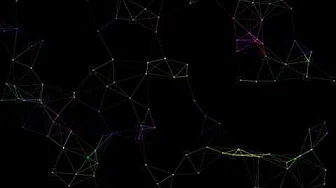
Pseudo-Triangulation using efficient Brute Force method
Pseudo-Triangulation, better known as proximal networking connection or something like this. As I wasted 3 weeks studying Delaunay Triangulation, I just stopped and started from an easier step point. The PseudoTriangulation is done by efficient bruteForce method, where a line is drawn between two points only when it less than some maxDist. If there are n points, this search is done on n*(n-1)/2 steps. The whole explanations can be found at the end of this video Coding Math: Episode 58 - Array Math. This is far from some true triangulation as the points don't act as true vertex.
The sketch looks like it's pretty inefficient, but it is actually very good. At 150 points and maxDist=100, we get around 60 frames/s. At 300 points same maxDist, 25 frames/s, 1000 points, 2 frames/s. Probably using some QuadTree structure we can improve the performance.
Visualization of this Pseudo-Triangulation is bellow:
Pseudo-Triangulation using QuadTree search
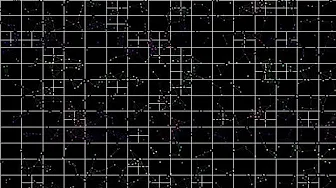
So by putting a QuadTree structure I expected at least some minor improvements, but no. Even using every trick I could come on, the QuadTree search only got the same level of performance than the efficient Brute Force method or worst. As a reminder, the efficient Brute Force makes the search for pair of points only once, and since there are no extra data structures being created, deleted, inserted, that is quite fast. For the QuadTree to do the same, even if its query gets only the nearby points, we still have to filter any repetitive pairs. To do that we need a list to catalogue those points, and adding the creation of the QuadTree object, internal search, catalogue the pair of points to decide if we add a line or not, even if we only have to do that for a small subset of points, those operations are quite expensive. And QuadTree have the tendency of only working with optimal efficiency only for a selected query range size and points distribution. So if the query size cannot be changed, like on this sketch, you get stuck on inefficient search.
As for comparison, if we start with 1000 points, maxDist = 40, it gets some 10~15 frames/s. The same as the brute force, maybe a little less fast. Also, the brute force method will nedd 499500 inexpensive checks to generate 3427 unique line segments. For the same point set, using the QuadTree system, the number of checks = 7886 to generate 3433 lines. I don't get this discrepancy for the same point set, but it is not worth investigating 6 extra lines created in a thousand points (most probably is the way I am generating ids of each line). For this animation in particular, the creation on every frame of lines are more computationally expensive than the search of pair of points proximity. So the only way I can see for the QuadTree could beat the efficient Brute force method is by merging the Node Class with the Point class, so we don't need to create new Points every frame, only update their location. But that would make the QuadTree less generic, and I'm not sure if we really could get so much of a better performance, but probably it would. I should spill some graphs comparing the QuadTree version the vanilla one, but I am getting a bit dishearted by the lack of gains for so many code inserted; so many classes for zero. Just watch the video and enjoy and never underestimate the power of efficient Brute Force.
Gilbert Johnson Keerthi collision detection algorithm
Nothing fancy here, just the function of the GJK algorithm that returns true/false for collision detection of any polygons of any size (polygons, lines, points). This is one of the most efficients algorithms for collision detection, and on its full form it can even detect the minimal distance between the shapes (not done here). A detail explanation can be found here: A Strange But Elegant Approach to a Surprisingly Hard Problem (GJK Algorithm). Other resorce used as reference for my code: https://github.com/kroitor/gjk.c, https://observablehq.com/@esperanc/2d-gjk-and-epa-algorithms.
So if you need a reliable collision detection for polygons, this is the one you need. As a test, I built an Asteroid game with minimal working physics using only this as a collision detection, and it is pretty robust. Besides the GJK algorithm, the game also has functions to calculate: polygon area, mass moment of inertia, polygon centre, polygon rotation, screen space-warping (toroidal mapping) without artifacts, elastic collision linear momentum for velocity updates, angular momentum, and more.
Simple polygon triangulation

A simple triangulation of any convex/non-convex polygon with ordered clockwise/anti-clockwise points. It creates an array of triangles using only the vertices points of the polygon. Best used if more/finer processing is required for the polygon.
Marching Squares for Metaballs/MetaDiamonds
A great algorithm to generates contour/isolines for a two-dimensional scalar field of rectangular grid array of individual numerical values. This version of Marching Squares can fill colours efficiently with gradient colours using vertex shading, hiding the small resolution given by the field values for some impressive performance. An upgraded version from the Coding Train's Marching Squares that only produces the isoline/contour. See the video tutorial and the rest of the references inside the program to know how it works. Since this is place for geometric algorithms, I used metaballls/meta-diamonds flying around a pseudo-metaball plasma field generated by the scalar grid field because why not?! Metaballs in metaballs. This algorithm is far faster than a regular metaballls/meta-diamonds implementation and the loss of resolution is hardly noticeable with the gradient colour filling.
[Metaballs/Meta-diamonds with Marching Squares Algorithm video demonstration]

Limitations: this only produces a single value isoline for some determined threshold. But this can be easily fixed by
