
Linemake
linelist generator
Install / Use
/learn @vmplacco/LinemakeREADME
linemake Atomic and Molecular Line List Generator
Before you start
The ch_masseron branch contains the most up to date CH line list from Masseron et al. (2014, A&A, 571, 47). See also https://github.com/alexji/linemake.
About
linemake is an open-source atomic and molecular line list generator. Rather than a replacement for a number of well-established atomic and molecular spectral databases, linemake aims to be a lightweight, easy-to-use tool to generate formatted and curated lists suitable for spectral synthesis work. We stress that the users of should be in charge of all of their transition data, and should cite the appropriate sources in their published work, given below.
Contributors
- Chris Sneden - Department of Astronomy and McDonald Observatory, The University of Texas, Austin, TX
- Ian Roederer - Department of Physics, North Carolina State University, Raleigh, NC
- Vinicius Placco - NSF NOIRLab, Tucson, AZ
- James E. Lawler - Department of Physics, University of Wisconsin-Madison, Madison, WI
- Elizabeth A. Den Hartog - Department of Physics, University of Wisconsin-Madison, Madison, WI
- Neda Hejazi - Department of Physics and Astronomy, Georgia State University, Atlanta, GA
- Zachary Maas - Department of Astronomy and McDonald Observatory, The University of Texas, Austin, TX
- Peter Bernath - Department of Physics and Department of Chemistry and Biochemistry, Old Dominion University, Norfolk, VA
Citing linemake in your published work
-
If you use
linemakein your work, please cite the presentation paper Placco et al. (2021, Res. Notes AAS, 5, 92), this github repository as a footnote, and the relevant articles listed below. -
linemakeis also on the Astrophysics Source Code Libray <a href="https://ascl.net/2104.027"><img src="https://img.shields.io/badge/ascl-2104.027-blue.svg?colorB=262255" alt="ascl:2104.027" /></a>
Disclaimer
The choices of which lines of which species to include in linemake have often been driven by the authors' own spectroscopic interests (e.g., note the large number of entries for transitions of neutron-capture elements that can only be detected in vacuum-UV spectroscopy). However, we would welcome hearing from users who can suggest other strongly-sourced species (with recent reliable lab/theory results) that might be added to our database.
Downloading linemake
-
For non-git users, click on the green
Codebutton on the top right then "Download ZIP". Unzip the file in your folder of choice and follow the installation instructions below. -
For
gitusers,git clone https://github.com/vmplacco/linemake.gitwill set up the repository locally, so you can then follow the instructions below.
If you have any issues, send an email to vmplacco@gmail.com or file an issue on this repository.
Compiling the code and known idiosyncrasies
First, edit the linemake.f file (line 34) at the start of the program, to point the code to its species linelists linepath='/path/to/linemake/mooglists'. Then, compile the code:
gfortran linemake.f -o linemake.go
There is one linemake oddity that we have no interest in addressing for the foreseeable future. The code will refuse to work (and will say so) when the requested beginning and ending wavelengths bridge the divide between two files of atomic line data, each of which covers 1000 Å. As a result, if you have a desired line list from, e.g., 5990 Å to 6010 Å, the code would crash without the built-in exit. The simple work-around is to run the code twice, in the example case from 5990 Å to 5999.999 Å, and from 6000 Å to 6010 Å.
Running linemake
To run the code, navigate to the installation directory and execute the binary file generated after the compilation:
cd /path/to/linemake/
./linemake.go
Then follow the prompts. After the program is executed, two new files will be generated (outlines and outsort).
Description of the database and current status
The periodic table below shows a summary of the current curated transitions available in the linemake database. Click here for an interactive version. A substantial number of additional transitions can be found in the mooglists/moogatom* files.
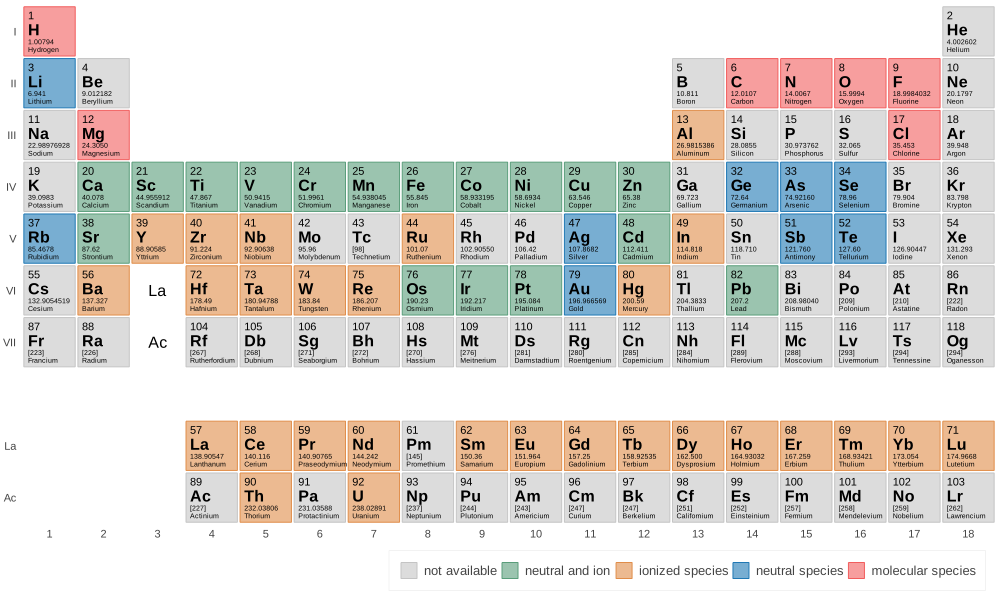
In succeeding sections we discuss first atomic and then molecular data sources. The Fe-group atomic species are considered first, followed by neutron-capture species, and finally a few other elements. The molecular species then are discussed in a bit more detail, because of the decisions needed to maximize the utility of their line lists for high-resolution spectroscopic studies.
Atomic Species: Fe-group Elements
Species|References & Notes
-------|-----
Sc I | Lawler et al. (2019, ApJS, 241, 21); includes HFS
Sc II| Lawler et al. (2019, ApJS, 241, 21); includes HFS
Ti I | Lawler et al. (2013, ApJS, 205, 11)
Ti II| Wood et al. (2013, ApJS, 208, 27)
V I | Lawler et al. (2014, ApJS, 215, 20) and Wood et al. (2018, ApJS, 234, 25). Holmes et al. (2016, ApJS, 224, 35) suggested some problems with the Lawler et al. transition probabilities in the wavelength range > 9000 Å, but Wood et al. showed that the Lawler et al. gf's are correct; Wood et al. also has extensive new HFS data
V II | Wood et al. (2014, ApJS, 214, 18); there is additional HFS information in the Kurucz database, collected in vI.kurhfs
Cr I | Sobeck et al. (2007, ApJ, 667, 1267); the line wavelengths have been adjusted to conform to those given at the NIST website
Cr II| The most current and tested transition probabilities are from Lawler et al. (2017, ApJS, 228, 10). We added in earlier good results from Nilsson et al. (2006, A&A, 445, 1165) and Gurell et al. (2010, A&A, 511, A68), but adjusted their wavelengths to agree with NIST values (which are in better agreement with those seen in solar/stellar spectra). We also added values from Ward et al. (2023, ApJ, 959, 8), whose results largely supersede the Gurell et al. values.
Mn I | Den Hartog et al. (2011, ApJS, 194, 35); there is additional HFS information in the Kurucz database, collected in mnI.kurhfs
Mn II| Den Hartog et al. (2011, ApJS, 194, 35); there is no additional HFS information in the Kurucz database
Fe I | Recent laboratory studies are by Ruffoni et al. (2014, MNRAS, 441, 3127), Den Hartog (2014, ApJS, 215, 23), and Belmonte et al. (2017, ApJ, 848, 126). The first two of these papers deal with lines arising (in absorption) from levels with E.P. > 2.3 eV. One of the good things about the last paper is that it overlaps the older-but-still-mostly-reliable study of O'Brian et al. (1991, JOSAB, 8, 1185) for lower-excitation transitions. Here we have chosen to adopt the new lab values, and have added in the O'Brian values not included in the Belmonte paper AND with E.P < 2.2 eV. We consider this list to be as close to an "internally consistent single source" as we are likely to get for a while.
Fe II| Den Hartog et al. (2019, ApJS, 243, 33); most of the new laboratory data are for UV lines, but enough blue lines (10 of them) are included that it is clear that the Meléndez & Barbuy (2009, A&A, 497, 611) empirical values were more reliable than those at the NIST website. Our choice here is to use the Den Hartog values when available, otherwise to use the Meléndez & Barbuy values
Co I | Lawler et al. (2015, ApJS, 220, 13); Co I with and without HFS are in different files here
Co II| Lawler et al. (2018, ApJS, 238, 7); there are 12 lines in this paper with good laboratory HFS patterns. To these we have added another 4 lines with new gf values but approximate HFS patters from the Co I paper; these appear with the notations LAW??? in a linelist generated by linemake. Added Co II HFS for 9 UV lines, computed using HFS A constants from Lawler et al. (2018, ApJS, 238, 7) and [Ding & Pickering (2020, ApJS, 251, 24)](https://ui.adsabs.harvar
