
Patchpack
Json patch serializer
Install / Use
/learn @udamir/PatchpackREADME
PatchPack
<img alt="npm" src="https://img.shields.io/npm/v/patchpack"> <img alt="npm" src="https://img.shields.io/npm/dm/patchpack?label=npm"> <img alt="CircleCI" src="https://img.shields.io/circleci/build/github/udamir/patchpack"> <img alt="npm type definitions" src="https://img.shields.io/npm/types/patchpack"> <img alt="GitHub" src="https://img.shields.io/npm/l/patchpack">
A binary JsonPatch serializer based on schema. Efficiently encode state object and JsonPatch in to compact byte buffers and then decode them back in to objects on the receiver. Integrates very well with observable state and WebSockets.
Originally it was part of mosx State Management engine, but then it moved to separate package.
Motivation
I was working on an magx game server framework that used WebSockets to syncronize state between server and clients. Syncronization principle is simple: first server sends full state to clients then on every change sends patches in JsonPatch format. I have found the problem that sending a lot of patches without serialization is a waste of bandwidth.
As state's schema is known on server side it can be sent to the clients, then state and each patch can be encoded based on that schema on server side and decoded back on client side. State schema is not static that means it must be also syncronized with clients. This sophisticated approach can significantly reduce patch size and bandwidth usage.
Concept
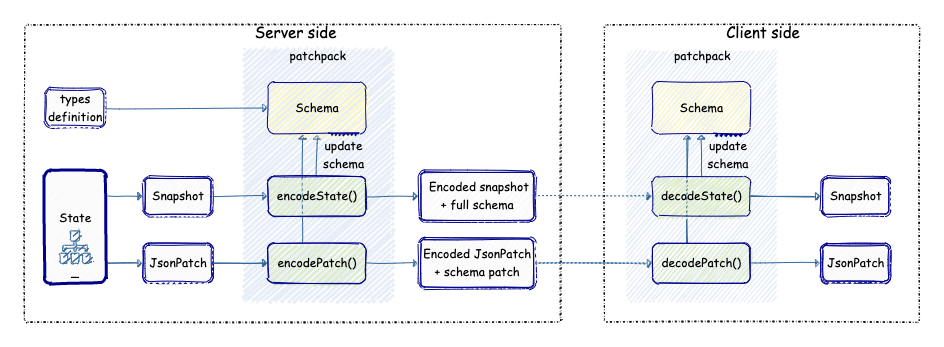
Installation
npm install --save patchpack
Browser
A browser version of patchpack is also available:
<script src="https://cdn.jsdelivr.net/npm/patchpack@0.4.2/browser/patchpack.min.js"></script>
<script src="https://cdn.jsdelivr.net/npm/patchpack@0.4.2/browser/patchpack.js"></script>
Example
Server side
import { PatchPack } from "patchpack"

class Client {
  constructor(public name: string, public info = "") {}
}

// initial state
const state: any = {
  clients: {
    "1": new Client("Foo"),
    "2": new Client("Baz", "FooBaz"),
  },
  objects: [
    { id: 1, name: "Foo" },
    { id: 2, name: "Foo", foo: "Baz" },
  ],
  foo: { baz: false }
}

// create patchpack instance and define schema types
const ppServer = new PatchPack({
  State: ["clients", "objects", "foo"],
  Client, // it is recommended to use class in schema (better performance)
  Object: ["id", "name", "foo"],
  Foo: ["baz"]
})

// encoded state can include types definition
const encodedStateWithTypes = ppServer.encodeState(state)

const encodedState = ppServer.encodeState(state, false)

// add item

const client = new Client("FooBaz", "test" )
state.clients["3"] = client

const patch1 = { op: "add", path: "/clients/3", value: client }
const encodedPatch1 = ppServer.encodePatch(patch1)

// update value

state.foo.baz = true

const patch2 = { op: "replace", path: "/foo/baz", value: true }
const encodedPatch2 = ppServer.encodePatch(patch2)
Benchmark
Benchmark for encoded object size (byte): | | PatchPack | MessagePack | JSON.stringify | | ------ | --------- | ----------------------------------- | -------------- | | state | 60 | 107 (+78%) | 165 (+175%) | | patch1 | 22 | 53 (+140%) | 72 (+227%) | | patch2 | 5 | 33 (+560%) | 47 (+840%) |
Send encodedStateWithTypes, encodedPatch1 and encodedPatch2 to Client and decode them:
Client side
const ppClient = new PatchPack()

const decodedState = ppClient.decodeState(encodedStateWithTypes)
console.log(decodedState)

// {
//   clients: {
//     '1': { name: 'Foo', info: '' },
//     '2': { name: 'Baz', info: 'FooBaz' }
//   },
//   objects: [
//      { id: 1, name: 'Foo' },
//      { id: 2, name: 'Foo', foo: 'Baz' } ],
//   foo: { baz: false }
// }

const decodedPatch1 = ppClient.decodePatch(encodedPatch1)
console.log(decodedPatch1)

// {
//   op: 'add',
//   path: '/clients/3',
//   value: { name: 'FooBaz', info: 'test' }
// }

const decodedPatch2 = ppClient.decodePatch(encodedPatch2)
console.log(decodedPatch2)

// { op: 'replace', path: '/foo/baz', value: true }
Documentation
Patchpack
constructor
Return instance of PatchPack with defined schema types
constructor (types?: { [type: string]: string[] | Type<any> })
Types can be defined in 2 ways:
- array of properties
- Class name
Example:
class User {
  constructor (public name: string) {}
}

class Item {
  constructor (public id: number) {}
}

const state = {
  users: [ new User("John"), new User("Santa") ]
  item: new Item(123)
}

const pp = new PatchPack({
  State: ["users", "item"],
  User,
  Item,
})
encodeState
Encode state and return in binary format
encodeState(state: any, includeTypes = true, updateSchema = true): Buffer
If parameter includeTypes = false used, decoder instance of PatchPack must be created with the same types.
First time state encoding must be with updateSchema = true. If you need to encode state with the same schema second time updateSchema can be set as false.
decodeState
Decode state from binary format to object
decodeState(buffer: Buffer): any
!Important. State can be decoded only once.
Example:
const pp = new PatchPack()
const state = pp.decodeState(encodedStatewWithTypes)
encodePatch
Encode JsonPatch and return in binary format
encodePatch(patch: IReversibleJsonPatch, updateSchema = true): Buffer
First time patch encoding must be with updateSchema = true. If you need to encode the same patch second time updateSchema must be set as false.
The following JsonPatch operation are supported:
- add
- replace
- remove
ReversibleJsonPatch with oldValue is supported
Example:
// JsonPatch
const p1 = pp.encodePatch({
  op: "replace",
  path: "/a/b/c",
  value: "100",
})

// ReversibleJsonPatch
const p1 = pp.encodePatch({
  op: "replace",
  path: "/a/b/c",
  value: "100",
  oldValue: "99",
})
decodePatch
Decode patch from binary format to JsonPatch (or ReversibleJsonPatch).
decodePatch (buffer: Buffer): IReversibleJsonPatch
!Important. Patch can be decoded only once.
PatchPack.encode
Encode object to binary with last MessagePack specification.
static encode(value: any): Buffer
PatchPack.decode
Decode binary to object with last MessagePack specification.
static decode(buffer: Buffer): any
Specification
will be soon...
License
MIT
Related Skills
node-connect
338.7kDiagnose OpenClaw node connection and pairing failures for Android, iOS, and macOS companion apps
frontend-design
83.6kCreate distinctive, production-grade frontend interfaces with high design quality. Use this skill when the user asks to build web components, pages, or applications. Generates creative, polished code that avoids generic AI aesthetics.
Writing Hookify Rules
83.6kThis skill should be used when the user asks to "create a hookify rule", "write a hook rule", "configure hookify", "add a hookify rule", or needs guidance on hookify rule syntax and patterns.
review-duplication
99.3kUse this skill during code reviews to proactively investigate the codebase for duplicated functionality, reinvented wheels, or failure to reuse existing project best practices and shared utilities.
