
Spline
c++ cubic spline library
Install / Use
/learn @ttk592/SplineREADME
C++ cubic spline interpolation
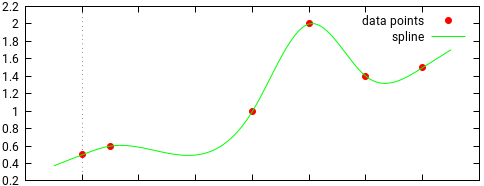
This is a lightweight implementation of cubic splines to interpolate points f(x<sub>i</sub>) = y<sub>i</sub> with the following features.
- available spline types:
- cubic C<sup>2</sup> splines: global, twice continuously differentiable
- cubic Hermite splines: local, continuously differentiable (C<sup>1</sup>)
- boundary conditions: first and second order derivatives can be specified, not-a-knot condition, periodic condition is not implemented
- extrapolation
- linear: if first order derivatives are specified or 2nd order = 0
- quadratic: if 2nd order derivatives not equal to zero specified
- monotonicity can be enforced (when input is monotonic as well)
Usage
The library is a header-only file with no external dependencies and can be used like this:
#include <vector>
#include "spline.h"
...
    std::vector<double> X, Y;
    ...
    // default cubic spline (C^2) with natural boundary conditions (f''=0)
    tk::spline s(X,Y);			// X needs to be strictly increasing
    double value=s(1.3);		// interpolated value at 1.3
    double deriv=s.deriv(1,1.3);	// 1st order derivative at 1.3
    std::vector<double> solutions = s.solve(0.0);	// solves s(x)=0.0
    ...
The constructor can take more arguments to define the spline, e.g.:
    // cubic Hermite splines (C^1) with enforced monotonicity and
    // left curvature equal to 0.0 and right slope equal 1.0
    tk::spline s(X,Y,tk::spline::cspline_hermite, true,
                 tk::spline::second_deriv, 0.0,
                 tk::spline::first_deriv, 1.0);
This is identical to (must be called in that order):
    tk::spline s;
    s.set_boundary(tk::spline::second_deriv, 0.0,
                   tk::spline::first_deriv, 1.0);
    s.set_points(X,Y);
    s.make_monotonic();
Spline types
Splines are piecewise polynomial functions to interpolate points (x<sub>i</sub>, y<sub>i</sub>). In particular, cubic splines can be represented as
- f(x) = a<sub>i</sub> + b<sub>i</sub> (x-x<sub>i</sub>) + c<sub>i</sub> (x-x<sub>i</sub>)<sup>2</sup> + d<sub>i</sub> (x-x<sub>i</sub>)<sup>3</sup>, for all x in [x<sub>i</sub>, x<sub>i+1</sub>)
- f(x<sub>i</sub>)=y<sub>i</sub>
The following splines are available.
tk::spline::cspline: cubic C<sup>2</sup> spline- twice continuously differentiable, e.g. f'(x<sub>i</sub>) and f''(x<sub>i</sub>) exist
- this, together with boundary conditions uniquely determines the spline
- requires solving a sparse equation system
- is a global spline in the sense that changing an input point will impact the spline everywhere
- setting first order derivatives at the boundary will break C<sup>2</sup> at the boundary
tk::spline::cspline_hermite: cubic Hermite spline- once continuously differentiable (C<sup>1</sup>)
- first order derivatives are specified by finite differences, e.g. on a uniform x-grid:
- f'(x<sub>i</sub>) = (y<sub>i+1</sub>-y<sub>i-1</sub>)/(x<sub>i+1</sub>-x<sub>i-1</sub>)
- is a local spline in the sense that changing grid points will only affect the spline around that grid point in a few adjacent segments
A function to enforce monotonicity is available as well:
tk::spline::make_monotonic(): will make the spline monotonic if input grid points are monotonic- this function can only be called after
set_points(...)has been called - it will break C<sup>2</sup> if the original spline was C<sup>2</sup> and not already monotonic
- it will break boundary conditions if it was not monotonic in the first or last segment
- this function can only be called after
References
https://kluge.in-chemnitz.de/opensource/spline/
