
Gcn
Implementation of Graph Convolutional Networks in TensorFlow
Install / Use
/learn @tkipf/GcnREADME
Graph Convolutional Networks
This is a TensorFlow implementation of Graph Convolutional Networks for the task of (semi-supervised) classification of nodes in a graph, as described in our paper:
Thomas N. Kipf, Max Welling, Semi-Supervised Classification with Graph Convolutional Networks (ICLR 2017)
For a high-level explanation, have a look at our blog post:
Thomas Kipf, Graph Convolutional Networks (2016)
Installation
python setup.py install
Requirements
- tensorflow (>0.12)
- networkx
Run the demo
cd gcn
python train.py
Data
In order to use your own data, you have to provide
- an N by N adjacency matrix (N is the number of nodes),
- an N by D feature matrix (D is the number of features per node), and
- an N by E binary label matrix (E is the number of classes).
Have a look at the load_data() function in utils.py for an example.
In this example, we load citation network data (Cora, Citeseer or Pubmed). The original datasets can be found here: http://www.cs.umd.edu/~sen/lbc-proj/LBC.html. In our version (see data folder) we use dataset splits provided by https://github.com/kimiyoung/planetoid (Zhilin Yang, William W. Cohen, Ruslan Salakhutdinov, Revisiting Semi-Supervised Learning with Graph Embeddings, ICML 2016).
You can specify a dataset as follows:
python train.py --dataset citeseer
(or by editing train.py)
Models
You can choose between the following models:
gcn: Graph convolutional network (Thomas N. Kipf, Max Welling, Semi-Supervised Classification with Graph Convolutional Networks, 2016)gcn_cheby: Chebyshev polynomial version of graph convolutional network as described in (Michaël Defferrard, Xavier Bresson, Pierre Vandergheynst, Convolutional Neural Networks on Graphs with Fast Localized Spectral Filtering, NIPS 2016)dense: Basic multi-layer perceptron that supports sparse inputs
Graph classification
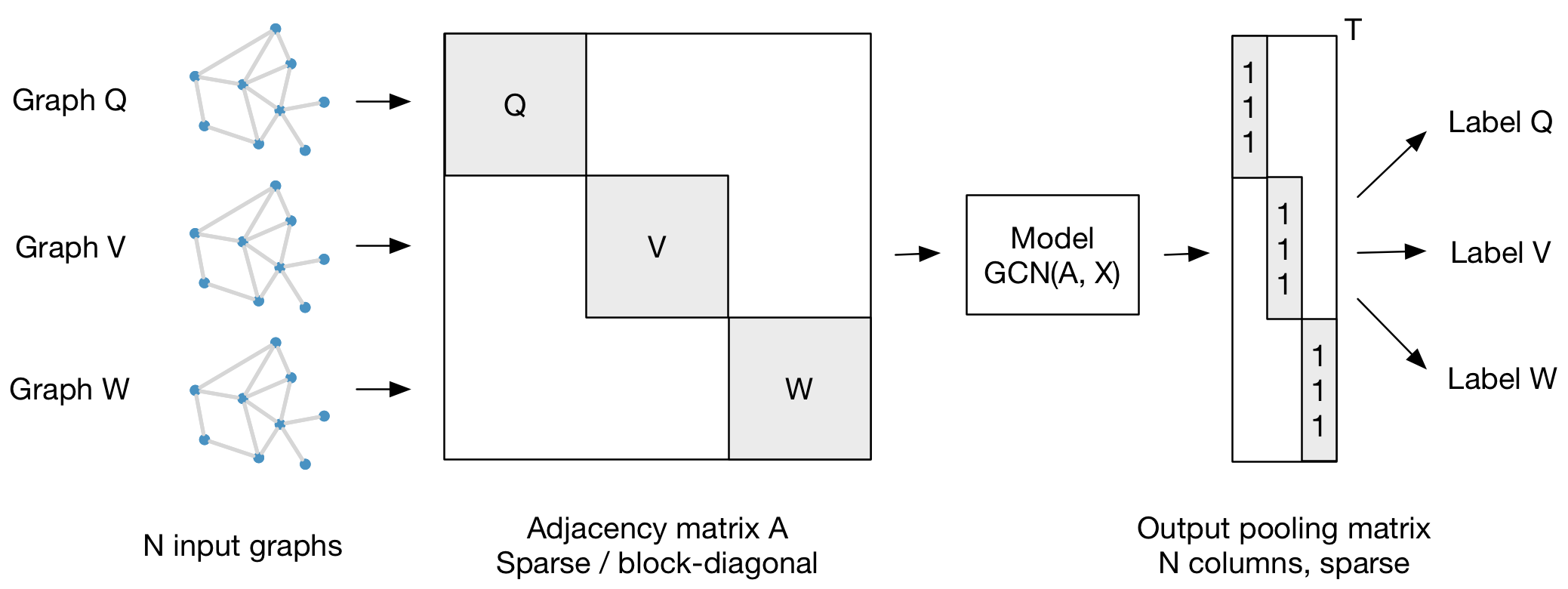
Our framework also supports batch-wise classification of multiple graph instances (of potentially different size) with an adjacency matrix each. It is best to concatenate respective feature matrices and build a (sparse) block-diagonal matrix where each block corresponds to the adjacency matrix of one graph instance. For pooling (in case of graph-level outputs as opposed to node-level outputs) it is best to specify a simple pooling matrix that collects features from their respective graph instances, as illustrated below:
Cite
Please cite our paper if you use this code in your own work:
@inproceedings{kipf2017semi,
  title={Semi-Supervised Classification with Graph Convolutional Networks},
  author={Kipf, Thomas N. and Welling, Max},
  booktitle={International Conference on Learning Representations (ICLR)},
  year={2017}
}
Related Skills
node-connect
334.5kDiagnose OpenClaw node connection and pairing failures for Android, iOS, and macOS companion apps
frontend-design
82.2kCreate distinctive, production-grade frontend interfaces with high design quality. Use this skill when the user asks to build web components, pages, or applications. Generates creative, polished code that avoids generic AI aesthetics.
openai-whisper-api
334.5kTranscribe audio via OpenAI Audio Transcriptions API (Whisper).
commit-push-pr
82.2kCommit, push, and open a PR
