
TextX
Domain-Specific Languages and parsers in Python made easy http://textx.github.io/textX/
Install / Use
/learn @textX/TextXREADME





textX is a meta-language for building Domain-Specific Languages (DSLs) in Python. It is inspired by Xtext.
In a nutshell, textX will help you build your textual language in an easy way. You can invent your own language or build a support for already existing textual language or file format.
From a single language description (grammar), textX will build a parser and a meta-model (a.k.a. abstract syntax) for the language. See the docs for the details.
textX follows the syntax and semantics of Xtext but differs in some places and is implemented 100% in Python using Arpeggio PEG parser - no grammar ambiguities, unlimited lookahead, interpreter style of work.
Quick intro
Here is a complete example that shows the definition of a simple DSL for drawing. We also show how to define a custom class, interpret models and search for instances of a particular type.
from textx import metamodel_from_str, get_children_of_type

grammar = """
Model: commands*=DrawCommand;
DrawCommand: MoveCommand | ShapeCommand;
ShapeCommand: LineTo | Circle;
MoveCommand: MoveTo | MoveBy;
MoveTo: 'move' 'to' position=Point;
MoveBy: 'move' 'by' vector=Point;
Circle: 'circle' radius=INT;
LineTo: 'line' 'to' point=Point;
Point: x=INT ',' y=INT;
"""

# We will provide our class for Point.
# Classes for other rules will be dynamically generated.
class Point:
    def __init__(self, parent, x, y):
        self.parent = parent
        self.x = x
        self.y = y

    def __str__(self):
        return "{},{}".format(self.x, self.y)

    def __add__(self, other):
        return Point(self.parent, self.x + other.x, self.y + other.y)

# Create meta-model from the grammar. Provide `Point` class to be used for
# the rule `Point` from the grammar.
mm = metamodel_from_str(grammar, classes=[Point])

model_str = """
    move to 5, 10
    line to 10, 10
    line to 20, 20
    move by 5, -7
    circle 10
    line to 10, 10
"""

# Meta-model knows how to parse and instantiate models.
model = mm.model_from_str(model_str)

# At this point model is a plain Python object graph with instances of
# dynamically created classes and attributes following the grammar.

def cname(o):
    return o.__class__.__name__

# Let's interpret the model
position = Point(None, 0, 0)
for command in model.commands:
    if cname(command) == 'MoveTo':
        print('Moving to position', command.position)
        position = command.position
    elif cname(command) == 'MoveBy':
        position = position + command.vector
        print('Moving by', command.vector, 'to a new position', position)
    elif cname(command) == 'Circle':
        print('Drawing circle at', position, 'with radius', command.radius)
    else:
        print('Drawing line from', position, 'to', command.point)
        position = command.point
print('End position is', position)

# Output:
# Moving to position 5,10
# Drawing line from 5,10 to 10,10
# Drawing line from 10,10 to 20,20
# Moving by 5,-7 to a new position 25,13
# Drawing circle at 25,13 with radius 10
# Drawing line from 25,13 to 10,10

# Collect all points starting from the root of the model
points = get_children_of_type("Point", model)
for point in points:
    print('Point: {}'.format(point))

# Output:
# Point: 5,10
# Point: 10,10
# Point: 20,20
# Point: 5,-7
# Point: 10,10
Video tutorials
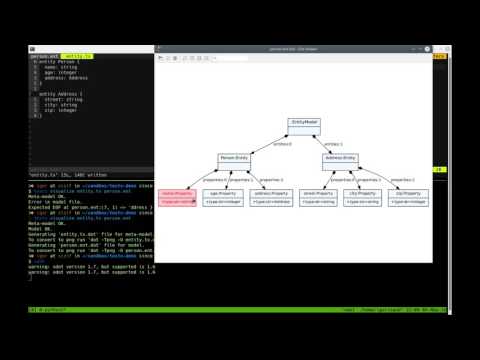
Introduction to textX
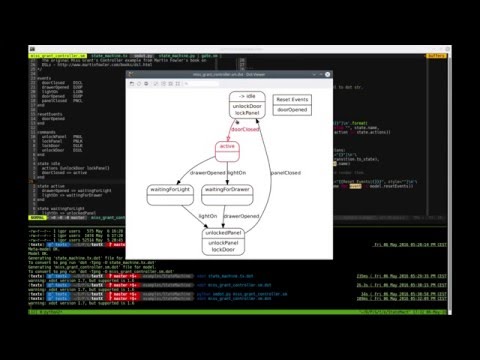
Implementing Martin Fowler's State Machine DSL in textX
Docs and tutorials
The full documentation with tutorials is available at http://textx.github.io/textX/stable/
You can also try textX in our playground. There is a dropdown with several examples to get you started.
Support in IDE/editors
Projects that are currently in progress are:
- textX-LS - support for Language Server
Protocol and VS Code for any textX based language. This project is about to
supersede the following projects:
- textX-languageserver - Language Server Protocol support for textX languages
- textX-extensions - syntax highlighting, code outline
- viewX - creating visualizers for textX languages
If you are a vim editor user check out support for vim.
For emacs there is textx-mode which is also available in MELPA.
You can also check out textX-ninja project. It is currently unmaintained.
Discussion and help
For general questions, suggestions, and feature requests please use GitHub Discussions.
For issues please use GitHub issue tracker.
Citing textX
If you are using textX in your research project we would be very grateful if you cite our paper:
Dejanović I., Vaderna R., Milosavljević G., Vuković Ž. (2017). TextX: A Python tool for Domain-Specific Languages implementation. Knowledge-Based Systems, 115, 1-4.
License
MIT
Python versions
Tested for 3.8+
Related Skills
claude-opus-4-5-migration
96.8kMigrate prompts and code from Claude Sonnet 4.0, Sonnet 4.5, or Opus 4.1 to Opus 4.5
model-usage
344.1kUse CodexBar CLI local cost usage to summarize per-model usage for Codex or Claude, including the current (most recent) model or a full model breakdown. Trigger when asked for model-level usage/cost data from codexbar, or when you need a scriptable per-model summary from codexbar cost JSON.
TrendRadar
50.4k⭐AI-driven public opinion & trend monitor with multi-platform aggregation, RSS, and smart alerts.🎯 告别信息过载,你的 AI 舆情监控助手与热点筛选工具!聚合多平台热点 + RSS 订阅,支持关键词精准筛选。AI 智能筛选新闻 + AI 翻译 + AI 分析简报直推手机,也支持接入 MCP 架构,赋能 AI 自然语言对话分析、情感洞察与趋势预测等。支持 Docker ,数据本地/云端自持。集成微信/飞书/钉钉/Telegram/邮件/ntfy/bark/slack 等渠道智能推送。
mcp-for-beginners
15.7kThis open-source curriculum introduces the fundamentals of Model Context Protocol (MCP) through real-world, cross-language examples in .NET, Java, TypeScript, JavaScript, Rust and Python. Designed for developers, it focuses on practical techniques for building modular, scalable, and secure AI workflows from session setup to service orchestration.
