
sno-station-skills
Sno Station Skills: 31 tested skills that turn Claude Code and Codex into one working team. Cross-vendor peer review, automatic handoff when an agent hits its quota, a one-page morning brief, work orders with proof, and a nightly loop that learns from your own sessions.
Install / Use
npx skills add sno-ai/sno-station-skillsInstalls into whichever agent you are using.
Other
Other agent config
Quality Score
Category
AutomationSupported Platforms
Tags
Our assessment of sno-station-skills
sno-station-skills scores 92/100 on our quality scale, 764th of 2,890 Automation skills we index (top 27%).
Its Other is 35 KB long, well organised into 48 sections with 8 code examples: a thorough specification that gives an agent plenty to work with.
It has 749 GitHub stars, a meaningful sign that others use it.
Maintenance, license and trust
- The repository was last updated today, so sno-station-skills is actively maintained.
- It is released under the Apache-2.0 license, a permissive license that allows use, modification and commercial use with attribution.
- Its trust signals score 100/100, with no cautions. These come from repository metadata, not a code audit — read the skill file before letting an agent act on it.
sno-station-skills compared with similar skills
All 4 of these similar skills score higher than sno-station-skills; compare them before choosing.
| Skill | Score | Stars | Updated | Format |
|---|---|---|---|---|
| sno-station-skills (this skill)by sno-ai | 92 | 749 | today | Other |
| Agent-Reachby Panniantong | 100 | 101.5k | 1d ago | CLAUDE.md |
| Scraplingby D4Vinci | 100 | 89.4k | 1d ago | MCP Server |
| rufloby ruvnet | 100 | 79.0k | today | MCP Server |
| ui-ux-pro-maxby nextlevelbuilder | 100 | 137.2k | 9d ago | SKILL.md |
Frequently asked questions
- How do I install sno-station-skills?
- Run
npx skills add sno-ai/sno-station-skills. The install tabs above show the steps for each supported agent. - Which AI agents does sno-station-skills work with?
- It is written for Claude Code and OpenAI Codex, as a Other file. Other agents that read the same format can often use it too.
- Is sno-station-skills safe to use?
- It is Apache-2.0-licensed and scores 100/100 on trust signals. Skills are instructions an agent will follow, so read the file before installing it and do not approve commands you do not understand.
- Is sno-station-skills still maintained?
- The repository was last updated today, so sno-station-skills is actively maintained.
Skill content
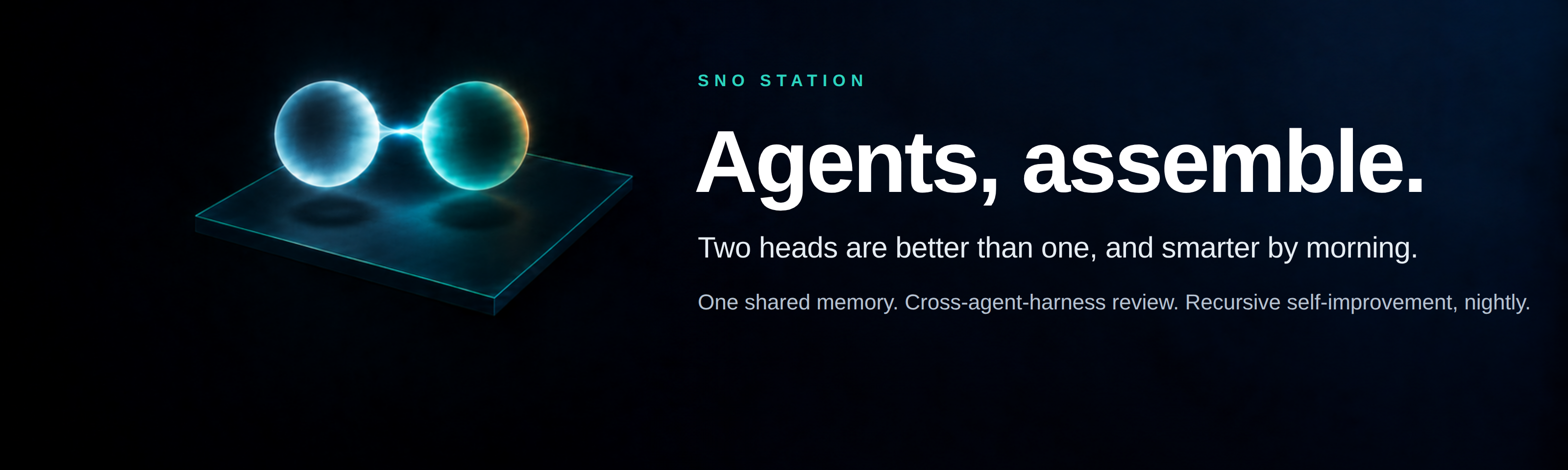
View source on GitHubSno Station Skills — The working habits of a real team, installed into your AI agents.




Install
All skills with Sno Station
Copy this prompt into your agent's chat:
Install sno.ai from GitHub.
This installs Sno Station and sets up all 37 skills, plus the programs they call, for the supported agents it finds on your machine.
Or paste this command into your terminal:
sh -c 'sno_installer_body=$(curl -fsSL https://sno.ai/install) && printf "%s\n" "$sno_installer_body" | sh'
Already have Sno Station? Run sno setup to install the skills into your agents.
Run it again if you add another agent later.
Install one skill
Use the copy button on either prompt below, then paste it into your agent's chat. Your agent finds and installs the skill; you do not need to download or copy files yourself.
peer-review checks code, plans and documents with a reviewer from another model vendor.
It needs Sno Station programs and a logged-in reviewer. The prompt checks those dependencies first.
Install only the peer-review skill from https://github.com/sno-ai/sno-station-skills
for this project, including its scripts and references.
Check its dependencies and tell me what is missing before installing anything else.
less-is-more helps your agent write less code and remove unnecessary complexity.
It can run without Sno Station.
Install only the less-is-more skill from https://github.com/sno-ai/sno-station-skills
for this project, including its scripts and references.
Supported agents for Sno Station: Claude Code, Codex, OpenClaw and Hermes Agent. Each skill declares what it needs from the agent. Setup uses that declaration to install it fully, install it in a reduced form, or skip it when the agent cannot run it.
Updates come by themselves: sno updates itself when it finds a newer release. The full
command list is in Sno Station's command reference.
Install as a plugin
Claude Code:
claude plugin marketplace add sno-ai/sno-station-skills
claude plugin install sno-station@sno-ai
Codex:
codex plugin marketplace add sno-ai/sno-station-skills
codex plugin add sno-station@sno-ai
sno-station holds all 37 skills; most of them call Sno Station programs, so install Sno Station too.
For only the 7 skills that run without Sno Station, install sno-station-standalone@sno-ai instead.
Install · What changes for you · Why these skills · The pain, and what fixes it · Stories from our own machine · The skills · Built to be trusted · For skill authors · License
What changes for you
You keep working exactly as before, in whichever agent you like. Then:
- You finish a change and want it checked. Say "peer-review this". A reviewer from the other vendor reads it cold, reports what would break in real use, and the author fixes the root cause, round after round, until the review comes back clean.
- You start a long run before bed. Say "arm rotate-agent". If the working agent's quota drops to the threshold overnight, it hands the task to a fresh agent from the other vendor, with the brief verified before a single file is touched.
- You come back. Say "away brief". One page, at most 60 lines: what got done, what is stuck and why, what waits for your answer, and what it cost in quota.
- You have a job for someone else. Say "write a charter". You get one file that says what
to deliver, what is out of bounds, what you already decided, and how each success check will
be proven. Any agent can then
deliverit, and every check is proven by a recorded real run. - Every night, the team looks back. The nightly loop reads the day's Claude Code and Codex
sessions, finds the mistakes that repeat, and proposes lessons and skill changes. In the
morning you accept the ones you like with
sno rem-reflect accept <id>. Nothing changes without that accept.
Why these skills
One AI agent is a brilliant new hire with no colleagues. It reviews its own work, so it misses what it cannot see. It stops dead when its quota runs out, at 3 a.m., halfway through your build. It says "done" when the tests are green and nothing actually happened. It builds three layers of machinery you never asked for. And tomorrow it makes the same mistake it made today, because nobody told it otherwise.
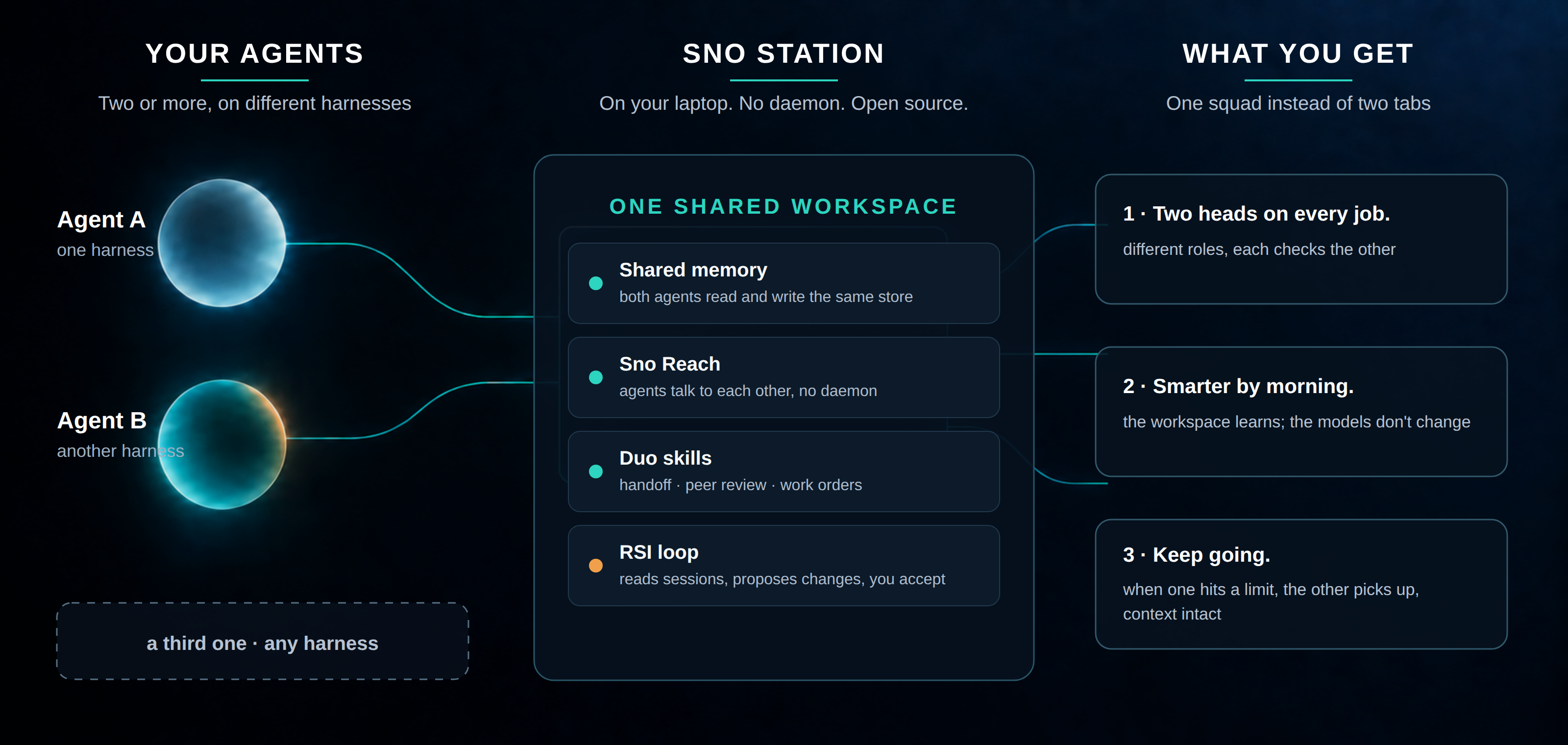
Sno Station Skills fixes the team, not the model. These are the skills Sno Station installs into the agents you already run. They give Claude Code and Codex the habits every good engineering team has: a second pair of eyes from a different vendor, a clean handover when someone has to leave, a lead who hands out work with a written definition of done, a one-page brief when you come back, and a retrospective every night that turns this week's mistakes into next week's rules.
Dual Brain: different roles, one team. One agent carries out your task. The other reviews the result against your requirements. Claude Code and Codex can take either role. When both CLIs are installed, the review runs in the other vendor's CLI, in a fresh session with none of the author's conversation. The agents exchange findings and corrections. Add more roles, and you have an Agent Squad.
Work that finishes while you sleep. Arm it before bed, and when the working agent's subscription runs low it writes a handover brief while it still can, wakes an agent from the other vendor, and hands the task over with the exact commit to continue from. Your build does not care which vendor finished it.
"Done" means proven. Every task can carry a written list of success checks, each one answered pass or fail by a real run. Nothing counts as done because an agent said so.
Tested before it ships. Every skill in a release passed its own self-tests on a clean copy, was scanned for personal paths and leftovers, and carries a stamp that says so. A skill that fails is not published.
The pain, and what fixes it
Last updated 2026-10-23. Every line in the left column is a real complaint from r/ClaudeCode, r/codex or r/ClaudeAI in the week of October 20, 2026. The right column is what runs on our own machines, free and open source, to make it stop.
| What people said this week | What fixes it | Where |
|---|---|---|
| “Ran out of my 5-hour limit within 30 minutes.” | Stop sending the biggest model to do everything. Opus plans and reviews; Codex writes the code, called as an agent from the same session. When one subscription runs dry, the other picks the task up from the same memory. | codex-coder, sno reach call |
| “Lost 10 hours of overnight work to ‘this model is at capacity’.” | At 2% of its quota the working agent writes a handover brief and wakes the other vendor's agent, which continues from the exact commit. You were asleep. | rotate-agent |
| “1,100 files, 30,000 lines. I don't have the token budget to review their PRs.” | Whoever pushes, reviews first: the author runs a review by the other vendor, in a fresh session that never saw the conversation, and fixes what comes back before anyone else looks. | peer-review |
| “A reviewer subagent checked every commit for two weeks. 86 runs, it stopped exactly one.” | A harness reviewing itself finds nothing real. The reviewer is always a different model in a different harness, with none of the author's chat. | peer-review |
| “Codex never finishes a review.” | Hard caps written into the skill: 3 rounds on code, 5 on a plan, 1 on tests, then it stops and waits for a person. A run that has written nothing for 15 minutes is killed as stalled. | peer-review, codex-coder, heartbeat |
| “Codex treats every byte like a criminal.” | Speculative safeguards, blockers and hashes are the first thing the review deletes. Nothing goes in without an observed failure asking for it. | less-is-more |
| “When Claude says it won't change something, is that reason stored anywhere Codex reads next time?” | Every finding is filed once, with a status only a human sets. A finding raised again updates its row instead of coming back as new, and earlier rulings are handed to the next review. | peer-review findings ledger |
| “It said done. Nothing happened.” | A task carries a written list of success checks, each answered pass or fail by a real run. An agent saying “done” counts for nothing. | pl work orders |
| “Tomorrow it makes the same mistake it made today.” | Every night a separate model reads the day's sessions, turns your corrections into one-line lessons, and you approve what stays. On our own machine: 162 written so far, 7 approved. The bottleneck is us. | Self Learning (R skills) |
| “Half my subagents were glorified one-liners with a fresh context window.” | Procedures live in skills, not subagents. Two agents remain, for plan and execution, and for review, because those two splits are the ones that pay. | the whole set |
Each skill in the right column is in this repository, free to copy into your own agents. The memory they share, the quota watch that fires the handover, and the nightly run that writes the lessons live in Sno Station; install that and every skill here comes with it, so you get the whole experience at once.
"I went to bed. It changed shifts."
From Sno Station's own repository, 2026-09-18.
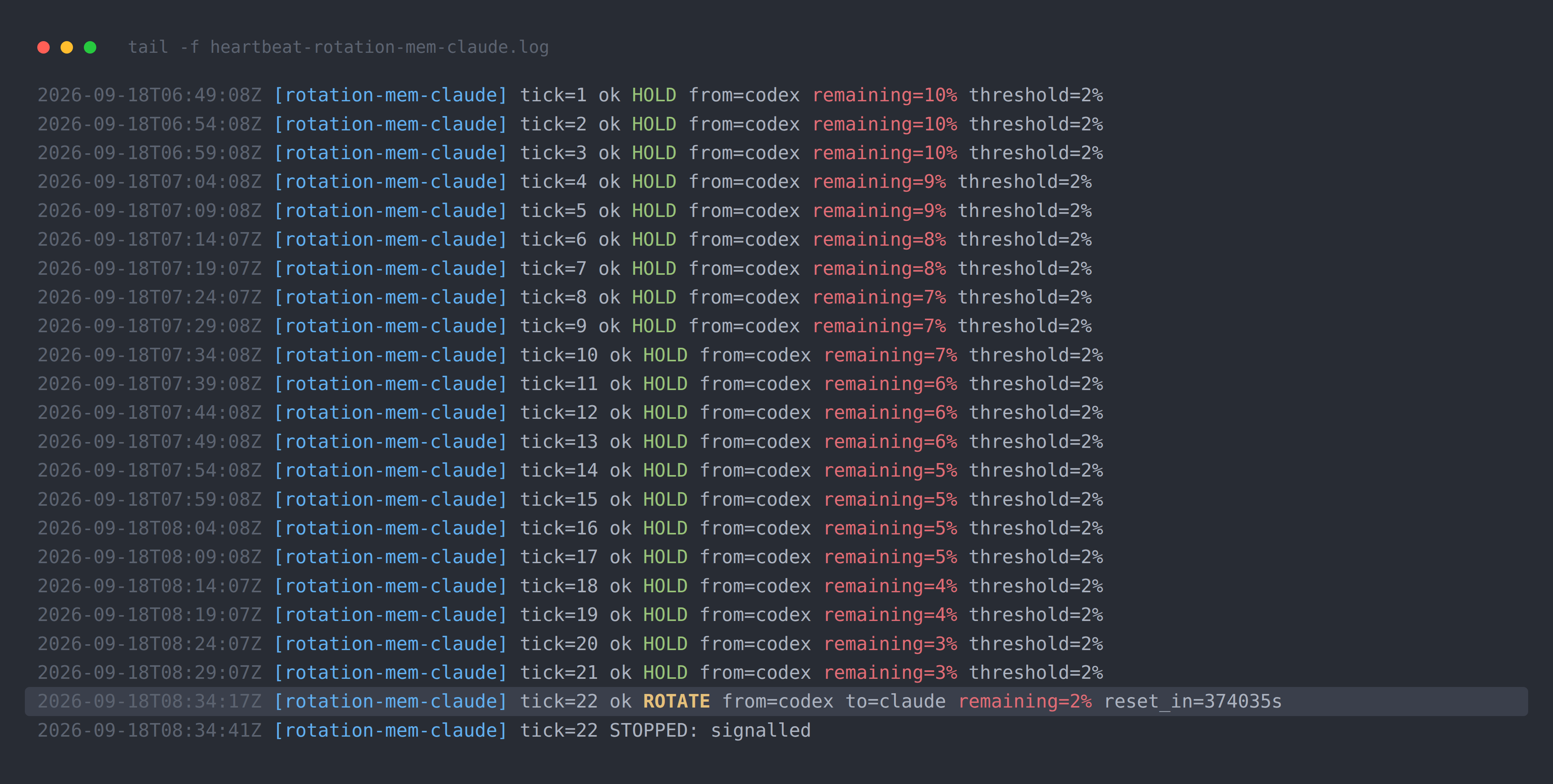
One of our agents was twenty-one tasks into a twenty-seven-task build when its weekly quota reached 2%. It did not wait to die. It wrote a handover brief: what was done, what was half-done, the exact commit to continue from. Then it woke an agent from the other vendor and would not let it touch anything until the brief was verified. Fourteen minutes and forty-one seconds after the handover began, the second agent was working and the first signed off with 1% left. The second agent continued from the first unchecked task, not from the beginning.
That night ran on the same four skills that ship here: subscription-quota-check read the quota
without spending it, heartbeat took a reading every five minutes, rotate-agent decided when
and to whom, and handoff moved the work. Every quota reading, both versions of the brief and
the commit summary are published in
Sno Station's evidence folder.
"In months, the other one has never once said 'looks good.'"
Claude Code has reviewed Codex's work, and Codex has reviewed Claude Code's, on Sno Station's own repository for months. Not one review has come back empty. We used to think that meant the work was bad. It means one reviewer from one vendor
Truncated for display — read the full file on GitHub.
Related Skills
Agent-Reach
101.5kGive your AI agent eyes to see the entire internet. Read & search Twitter, Reddit, YouTube, GitHub, Bilibili, XiaoHongShu — one CLI, zero API fees.
Scrapling
89.4k🕷️ A Web Scraping framework that handles everything from a single request to a full-scale crawl! Don't be shy, join here: https://discord.gg/EMgGbDceNQ and follow here for daily tips and tricks: https://x.com/Scrapling_dev
ruflo
79.0k🌊 The original agent harness. Deploy intelligent multi-player swarms, coordinate autonomous workflows, and build conversational AI systems. Features adaptive memory, self-learning intelligence, federation, vector RAG integration, and native Claude Code / Codex / Hermes and many more Integrated
ui-ux-pro-max
137.2kUI/UX design intelligence for web, mobile, and desktop. This skill should be used when designing, building, reviewing, or fixing interfaces, including pages, components, design systems, accessibility, interaction, responsive layout, typography, color, charts, and stack-specific UI implementation.

Languages
Trust signals
From repository metadata: license, adoption, age and documentation. Not a code audit — see the Safety scan above for what the skill file itself contains.