
siyuan
An open-source, privacy-first, self-hosted knowledge workspace where humans and AI agents work together 开源、隐私优先、自托管的知识工作空间,让人与智能体在此协作
Install / Use
claude mcp add siyuan-note -- npx -y github:siyuan-note/siyuanIf the server publishes to npm under a different name, use that package instead — check the repo README.
MCP Server
Model Context Protocol server
Quality Score
Category
Content & MediaSupported Platforms
Tags
Skill content
View source on GitHubTable of Contents
- 💡 Introduction
- 🔮 Features
- 🏗️ Architecture and Ecosystem
- 🗺️ Roadmap
- 🚀 Download Setup
- ⌨️ Command-line Interface
- 🏘️ Community
- 🛠️ Development Guide
- ❓ FAQ
- How does SiYuan store data?
- Does it support data synchronization through a third-party sync disk?
- Is SiYuan open source?
- How to upgrade to a new version?
- What if some blocks (such as paragraph blocks in list items) cannot find the block icon?
- What should I do if the data repo key is lost?
- Do I need to pay for it?
- 🙏 Acknowledgement
💡 Introduction
SiYuan is a privacy-first personal knowledge management system, supporting fine-grained block-level reference and Markdown WYSIWYG.
Welcome to SiYuan English Discussion Forum to learn more.
Online user guide: English
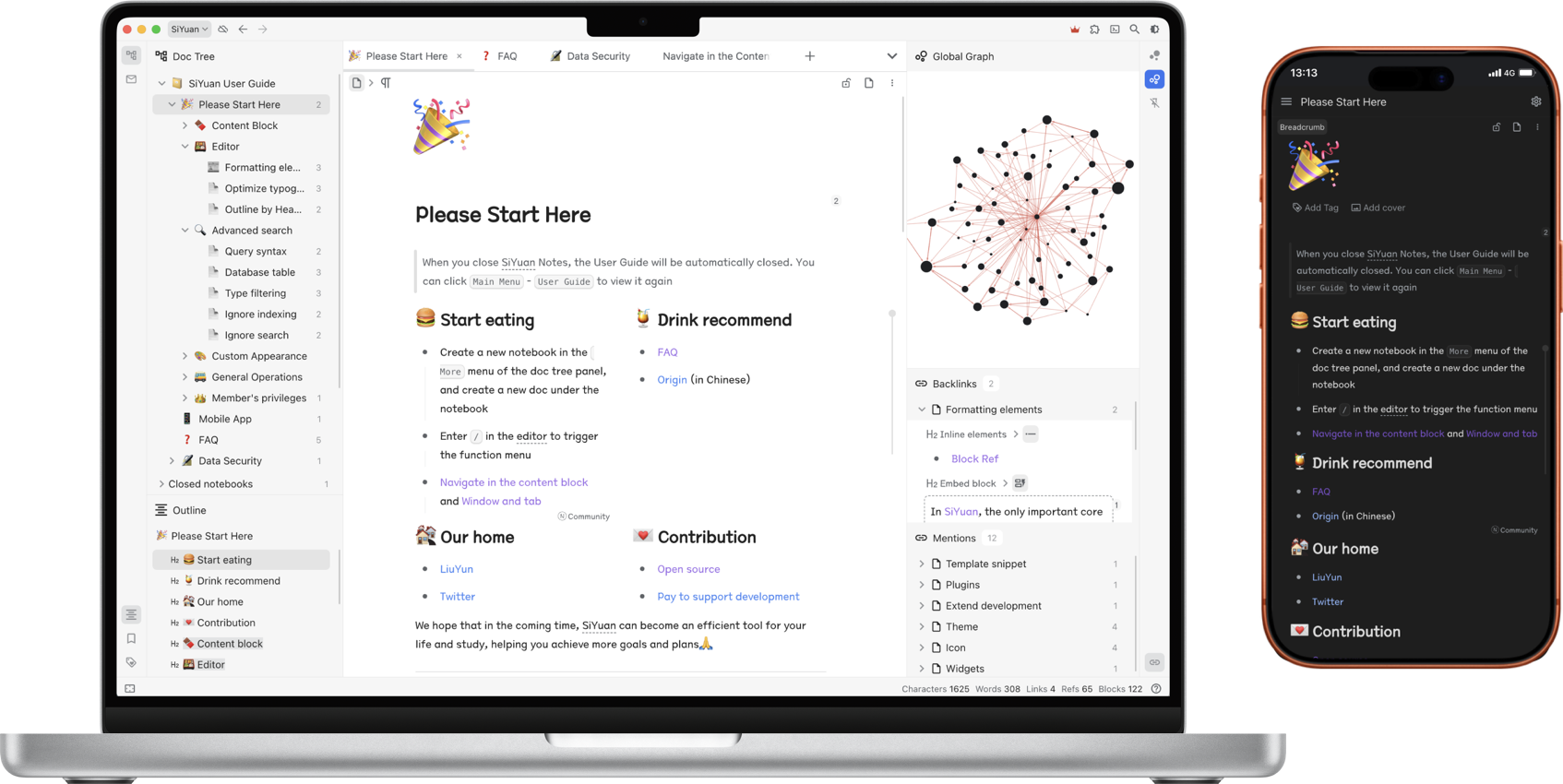

🔮 Features
Most features are free, even for commercial use.
- Content block
- Block-level reference and two-way links
- Custom attributes
- SQL query embed
- Protocol
siyuan://
- Editor
- Block-style
- Markdown WYSIWYG
- List outline
- Block zoom-in
- Million-word large document editing
- Mathematical formulas, charts, flowcharts, Gantt charts, timing charts, staves, etc.
- Web clipping
- PDF Annotation link
- Export
- Block ref and embed
- Standard Markdown with assets
- PDF, Word and HTML
- Copy to WeChat MP, Zhihu and Yuque
- Database
- Table view
- Flashcard spaced repetition
- AI writing and Q/A chat via OpenAI API
- Tesseract OCR
- Multi-tab, drag and drop to split screen
- Template snippet
- JavaScript/CSS snippet
- Android/iOS/HarmonyOS App
- Docker deployment
- API
- Community marketplace
Some features are only available to paid members, for more details please refer to Pricing.
🏗️ Architecture and Ecosystem
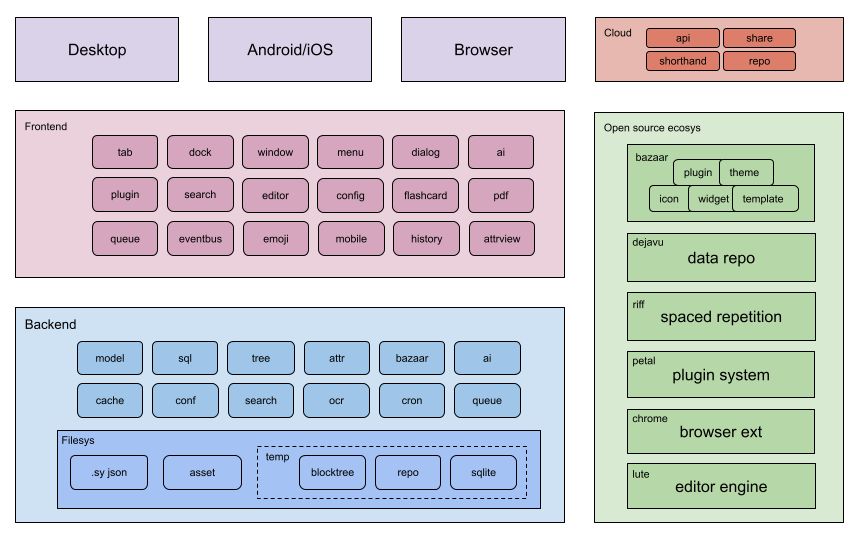
| Project | Description | Forks | Stars |
|----------------------------------------------------------|-----------------------|---------------------------------------------------------------------------------|--------------------------------------------------------------------------------------|
| lute | Editor engine | 


🗺️ Roadmap
🚀 Download Setup
It is recommended to give priority to installing through the application market on desktop and mobile, so that you can upgrade the version with one click in the future.
App Market
Mobile:
Desktop:
Installation Package
Package Manager
siyuan

siyuan-note

Docker Hosting
<details> <summary>Docker Deployment</summary>Overview
The easiest way to serve SiYuan on a server is to deploy it through Docker.
- Image name
b3log/siyuan - Image URL
File structure
The overall program is located under /opt/siyuan/, which is basically the structure under the resources folder of the Electron installation package:
- appearance: icon, theme, languages
- guide: user guide document
- stage: interface and static resources
- kernel: kernel program
Entrypoint
The entry point is set when building the Docker image: ENTRYPOINT ["/opt/siyuan/entrypoint.sh"]. This script allows changing the PUID and PGID of the user that will run inside the container. This is especially relevant to solve permission issues when mounting directories from the host. The PUID (User ID) and PGID (Group ID) can be passed as environment variables, making it easier to ensure correct permissions when accessing host-mounted directories.
Use the following parameters when running the container with docker run b3log/siyuan:
Note: Since v3.7.0, the
servesubcommand must be passed explicitly (e.g.docker run b3log/siyuan serve --workspace=...). Rundocker run --rm b3log/siyuan serve --helpto see all serving options.
--workspace: Specifies the workspace folder path, mounted to the container via-von the host--accessAuthCode: Specifies the lock screen password
More parameters can be found using --help. Here’s an example of a startup command with the new environment variables:
docker run -d \
  -v workspace_dir_host:workspace_dir_container \
  -p 6806:6806 \
  -e PUID=1001 -e PGID=1002 \
  b3log/siyuan \
  serve \
  --workspace=workspace_dir_container \
  --accessAuthCode=xxx
PUID: Custom user ID (optional, defaults to1000if not provided)PGID: Custom group ID (optional, defaults to1000if not provided)- `workspace_dir_
Truncated for display — read the full file on GitHub.
Related Skills
Agent-Reach
84.5kGive your AI agent eyes to see the entire internet. Read & search Twitter, Reddit, YouTube, GitHub, Bilibili, XiaoHongShu — one CLI, zero API fees.
headroom
73.4kCompress tool outputs, logs, files, and RAG chunks before they reach the LLM. 20% fewer tokens for coding agents, 60-95% fewer tokens for JSON, same answers. Library, proxy, MCP server.
ruflo
73.0k🌊 The original agent harness. Deploy intelligent multi-player swarms, coordinate autonomous workflows, and build conversational AI systems. Features adaptive memory, self-learning intelligence, federation, vector RAG integration, and native Claude Code / Codex / Hermes and many more Integrated
CowAgent
47.1kOpen-source super AI assistant & Agent Harness. Plans tasks, runs tools and skills, self-evolves with memory and knowledge. Multi-agent, multi-model, multi-channel. Lightweight, extensible, one-line install.
