
NanoCluster
NanoCluster: Compact & Affordable Cluster for Everyone
Install / Use
/learn @sipeed/NanoClusterREADME
NanoCluster
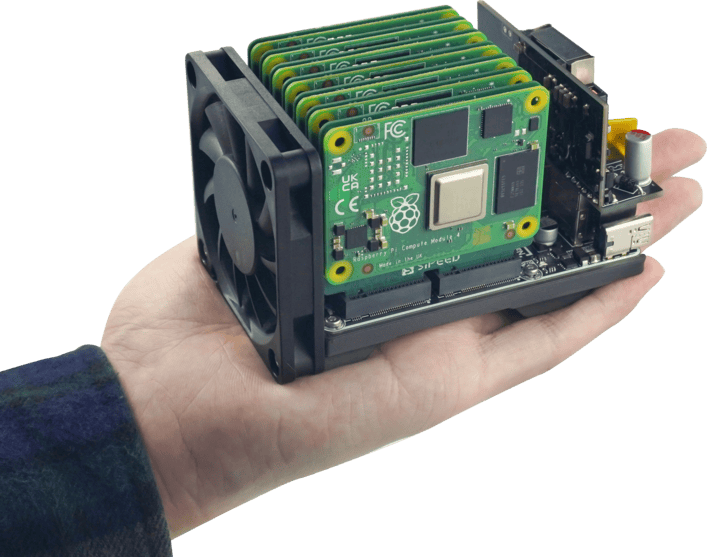
Compact & Affordable Cluster for Everyone
This repository is mainly for user feedback. You can submit related usage issues to discuss.
Introduction
NanoCluster is an ultra-miniature cluster board developed by Sipeed, featuring 7 SOM slots interconnected via a RISC-V-based Gigabit switch. It supports USB-C PD power supply and optional PoE expansion. Additionally, NanoCluster provides independent UART and power control, making it an ideal entry-level platform for HomeLab users exploring distributed computing, Kubernetes, Docker, and edge computing.
NanoCluster is compatible with Sipeed's Longan Module 3H (4 × Cortex-A53), M4N (4 × Cortex-A55 + NPU), as well as the Raspberry Pi Compute Module 4 (4 × Cortex-A72) and Compute Module 5 (4× Cortex-A76). Users can freely choose compute modules based on performance needs and budget, or mix and match different architectures to build a highly customized and heterogeneous computing cluster.
The NanoCluster adopts an open SOM interface standard, supporting both official core modules and custom adapter boards for third-party SOM solutions. This design greatly enhances the platform's flexibility.
Baseboard
<table> <thead> <tr> <th colspan="2">Hardware Specifications</th> </tr> </thead> <tbody> <tr> <td><strong>SOM Slots</strong></td> <td>7× Dual M.2 M-Key vertical slots</td> </tr> <tr> <td><strong>Power Supply</strong></td> <td>USB-C 20V PD (Max 60W), Optional 60W PoE module</td> </tr> <tr> <td><strong>Ethernet</strong></td> <td>Integrated RISC-V Gigabit switch chip JL6108 for high-speed interconnection, supporting web-based management and SDK-based custom feature development</td> </tr> <tr> <td><strong>USB Ports</strong></td> <td>USB-A Host (Top), USB-A OTG (Bottom), connected to Slot 1</td> </tr> <tr> <td><strong>Display Interface</strong></td> <td>HDMI, connected to Slot 1</td> </tr> <tr> <td><strong>Cooling System</strong></td> <td>Equipped with a 60mm 2-pin fan for efficient cooling</td> </tr> <tr> <td><strong>Status Indicators</strong></td> <td>7× SYS LED indicators for node status monitoring</td> </tr> <tr> <td><strong>Serial Communication</strong></td> <td>7× independent UARTs for easy debugging and control, optional quad-serial USB module available</td> </tr> <tr> <td><strong>Power Management</strong></td> <td>Slot1 centrally manages other Slots and switch power through IO expansion chip</td> </tr> <tr> <td><strong>Power Consumption</strong></td> <td>3.6 W</td> </tr> <tr> <td><strong>Dimensions</strong></td> <td>PCBA: 88x57mm, approximately 100x60x60mm with SOMs installed and fan mounted</td> </tr> </tbody> </table> <br> <img src="https://wiki.sipeed.com/hardware/zh/cluster/NanoCluster/assets/bare_board.jpeg" alt="底板裸板特写图" width="600" height="450"/>SOM
<table> <tr> <th>SOM</th> <th>LM3H</th> <th>M4N</th> <th>CM4</th> <th>CM5</th> </tr> <tr> <td>SoC</td> <td>H618</td> <td>AX650N</td> <td>BCM2711</td> <td>BCM2712</td> </tr> <tr> <td>Memory</td> <td>2GB ~ 4GB</td> <td>8GB</td> <td>1GB ~ 8GB</td> <td>1GB ~ 16GB</td> </tr> <tr> <td>eMMC</td> <td>32GB</td> <td>32GB</td> <td>0GB ~ 64GB</td> <td>0GB ~ 64GB</td> </tr> <tr> <td>CPU</td> <td>4 × A53<br>1.5 GHz</td> <td>8 × A55<br>1.6 GHz</td> <td>4 × A72<br>1.5 GHz</td> <td>4 × A76<br>2.4 GHz</td> </tr> <tr> <td>GPU</td> <td>Mali-G31</td> <td>-</td> <td>VideoCore VI</td> <td>VideoCore VII</td> </tr> <tr> <td>NPU</td> <td>-</td> <td>18TOPS INT8</td> <td>-</td> <td>-</td> </tr> <tr> <td>Network</td> <td>100M</td> <td>1G</td> <td>1G</td> <td>1G</td> </tr> <tr> <td>Additional Interfaces</td> <td>None</td> <td>Download interface + M.2 SSD + USB 3.0</td> <td>Download interface + M.2 SSD</td> <td>Download interface + M.2 SSD + USB 3.0</td> </tr> <tr> <td>Power<br>Idle /<br>Full Load /<br>Peak</td> <td><nobr>1.2W/2.6W/3.7W</nobr></td> <td><nobr>3W/8.3W/9W</nobr></td> <td><nobr>3W/4.5W/4.6W</nobr></td> <td><nobr>4W/7.6W/8W</nobr></td> </tr> </table>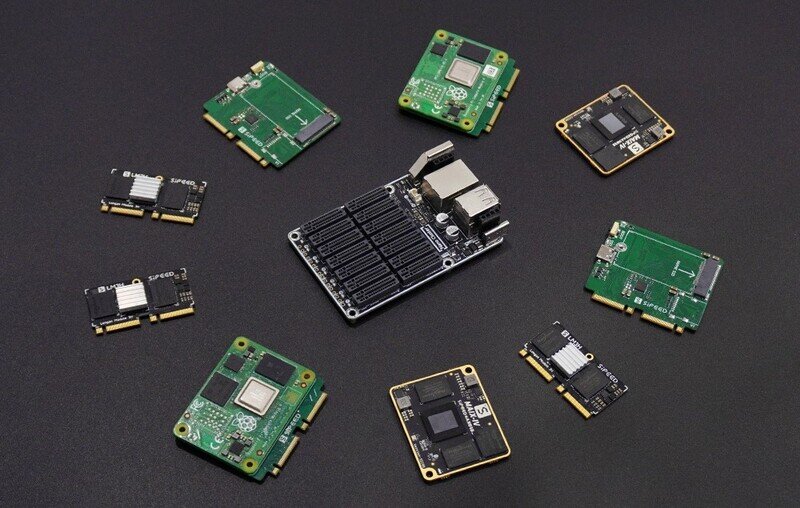
Interface Diagram
Baseboard Interfaces

SOM
-
The LM3H SOM connects directly to the baseboard via 7 × dual M.2 M-Key vertical slots.
-
The M4N SOM connects to a dedicated adapter board through a BTB connector, which then interfaces with the baseboard.
Adapter Boards
-
The CM4 / CM5 adapter board features a BTB connector on the front side, supporting CM4 and CM5 SOMs. It also includes a Boot button and a Type-C port for flashing. The back side includes an SD card slot, an M.2 NVMe SSD connector (compatible with 2242 or 2230 size), and a reserved USB pad for optional CM5 USB 3.0 support.
-
The M4N adapter board features a BTB connector for Sipeed M4N SOMs, a Boot button, and a Type-C flashing port on the front side. The back side includes an M.2 NVMe SSD connector (2242 or 2230), and a reserved USB pad for optional USB 3.0 support.
Community Projects
-
NanoCtl: A native Go CLI tool and daemon for managing Nano Cluster nodes (CM5). Features include power management via GPIO, intelligent PID fan control, and metrics export to Prometheus/OpenTelemetry.
-
Nomad & Consul Playbook: An Ansible playbook to bootstrap a single-server Nomad & Consul cluster (with client nodes) using Podman or Docker. Enables one-command deployment ideal for HomeLab setups.
Where to Buy
Resources & Community

Security Score
Audited on Apr 3, 2026