
Datalinguist
Stanford CoreNLP in idiomatic Clojure.
Install / Use
/learn @simongray/DatalinguistREADME
DataLinguist

DataLinguist<sup>†</sup> is a Clojure wrapper for the Natural Language Processing behemoth, Stanford CoreNLP. The goal of the project is to support an NLP workflow in a data-oriented style, integrating relevant Clojure protocols and libraries.
Most Lisp dialects facilitate interactive development centred around a REPL. Clojure - being both a JVM language and a data-oriented one - is perfectly suited for wrapping Stanford CoreNLP's fairly opaque language processing tools. The dizzying heights of Java class hierarchies are brought down to eye level and repackaged into more accessible functions inside a few Clojure namespaces. At the same time, the API is streamlined with most of the obvious cruft left out.
<a name="name"><sup>†</sup></a> The name is a play on "datalingvist" - the Danish word for "computational linguist" - and Clojure's love of all things data. As a sidenote, the Danish translation of "computer scientist" is actually "datalog"!
Setup
Major releases are available on Clojars—look there for instructions!
The library can also be included as a deps.edn dependency by referencing a specific commit SHA in this repository:
simongray/datalinguist {:git/url "https://github.com/simongray/datalinguist"
                        :sha     "..."}
Language models
DataLinguist requires a language model to access the full feature set. Several precompiled models are available through Maven Central<sup>††</sup>. These models follow the same versioning scheme as CoreNLP itself. See the official CoreNLP documentation for more on language models.
In addition to adding DataLinguist itself as a project dependency, you should therefore also make sure to add any language models you might need:
;; Currently available precompiled language models in deps.edn format
edu.stanford.nlp/stanford-corenlp$models             {:mvn/version "4.4.0"}
edu.stanford.nlp/stanford-corenlp$models-arabic      {:mvn/version "4.4.0"}
edu.stanford.nlp/stanford-corenlp$models-chinese     {:mvn/version "4.4.0"}
edu.stanford.nlp/stanford-corenlp$models-english     {:mvn/version "4.4.0"}
edu.stanford.nlp/stanford-corenlp$models-english-kbp {:mvn/version "4.4.0"}
edu.stanford.nlp/stanford-corenlp$models-french      {:mvn/version "4.4.0"}
edu.stanford.nlp/stanford-corenlp$models-german      {:mvn/version "4.4.0"}
edu.stanford.nlp/stanford-corenlp$models-hungarian   {:mvn/version "4.4.0"}
edu.stanford.nlp/stanford-corenlp$models-italian     {:mvn/version "4.4.0"}
edu.stanford.nlp/stanford-corenlp$models-spanish     {:mvn/version "4.4.0"}
Note that several unofficial language models also exist!
You will likely also need to increase the amount of memory allotted to your JVM process, e.g. for Chinese I make sure to add :jvm-opts ["-Xmx4G"] to my deps.edn file.
<a name="maven"><sup>††</sup></a> Stanford can sometimes be bit slow when it comes to uploading more recent versions of CoreNLP to Maven Central.
How to use
If you just want to get going quick, refer to the deps.edn example project.
DataLinguist has a very simple API for executing various NLP operations. To perform any language processing task you will generally need to 1. build an annotation pipeline, 2. annotate some text, 3. extract some of these annotations for analysis, and (optionally) 4. datafy the annotations for more idiomatic use in Clojure.
1. Building an annotation pipeline
Before anything can happen, we need to construct an NLP pipeline. Pipelines are built using plain Clojure data structures which are converted into properties:
(require '[dk.simongray.datalinguist :refer :all])

;; Create a closure around a CoreNLP pipeline.
;; By default, a CoreNLP pipeline will annotate text in the English language.
(def nlp
  (->pipeline {:annotators ["depparse" "lemma"]}))
This will create a pipeline with all of the annotators required for dependency parsing and lemmatisation.
2. Using the pipeline to annotate text
If the resulting pipeline function is called on a piece of text it will output annotated data.
(def annotated-text
  (nlp "This is a piece of text. This is another one."))
This data consists of various Java objects and takes the shape of a tree. The data can then be queried using the annotation functions.
3. Extracting annotations using the annotation functions
In our example we built a pipeline that could do both dependency parsing and lemmatisation, so let's extract a dependency graph of the second sentence:
(->> annotated-text sentences second dependency-graph)
;=>
;#object[edu.stanford.nlp.semgraph.SemanticGraph
;        0x79d17876
;        "-> one/CD (root)
;           -> This/DT (nsubj)
;           -> is/VBZ (cop)
;           -> another/DT (det)
;           -> ./. (punct)
;         "]
We can also annotate another piece of text and return the lemmas:
(->> (nlp "She has beaten him before.")
     tokens
     lemma)
;=> ("she" "have" "beat" "he" "before" ".")
While lemmas are technically only attached to tokens in CoreNLP (and dependency graphs to sentences), the DataLinguist functions do allow you to skip ahead in most cases, i.e. we could have written:
(lemma (nlp "She has beaten him before."))
;=> ("she" "have" "beat" "he" "before" ".")
NOTE: while this is really convenient behaviour to have in the REPL - particularly if you have not yet memorised the somewhat arbitrary annotation hierarchy used in CoreNLP - it does come with one caveat: the return type can vary unexpectedly!
For example,
(text :plain (nlp "..."))"will return a string, while(text :true-case (nlp "..."))"will return a sequence of strings. The reason for this is simple: text annotations exist at both the document, sentence, and token level, while true-case text annotations only exist at the token level. If you don't want any surprises, make sure to explicitly navigate down the annotation hierarchy usingsentences,tokens, and other relevant functions.
4. Datafying results
If at any point we grow tired of accessing Java objects using the annotation functions, we can call recur-datafy and get plain Clojure data structures:
(-> annotated-text tokens second recur-datafy)
;=>
;{:token-end 2,
; :original-text "is",
; :index 2,
; :part-of-speech "VBZ",
; :token-begin 1,
; :value "is",
; :sentence-index 0,
; :lemma "be",
; :newline? false,
; :character-offset-begin 5,
; :after " ",
; :character-offset-end 7,
; :before " ",
; :text "is"}
These data structures expose the underlying annotation maps of the CoreNLP objects. The keys are based on what set of annotators you have enabled in your pipeline.
NOTE: the regular
datafyfunction can of course be used as well, butrecur-datafywill always datafy the entire tree.
Clojure integration
Apart from wrapping the features of Stanford CoreNLP, DataLinguist also integrates with common Clojure libraries and workflows.
View in the REBL
The pipeline's annotated output data extends the Datafiable protocol introduced in Clojure 1.10 and can therefore be navigated using the REBL.
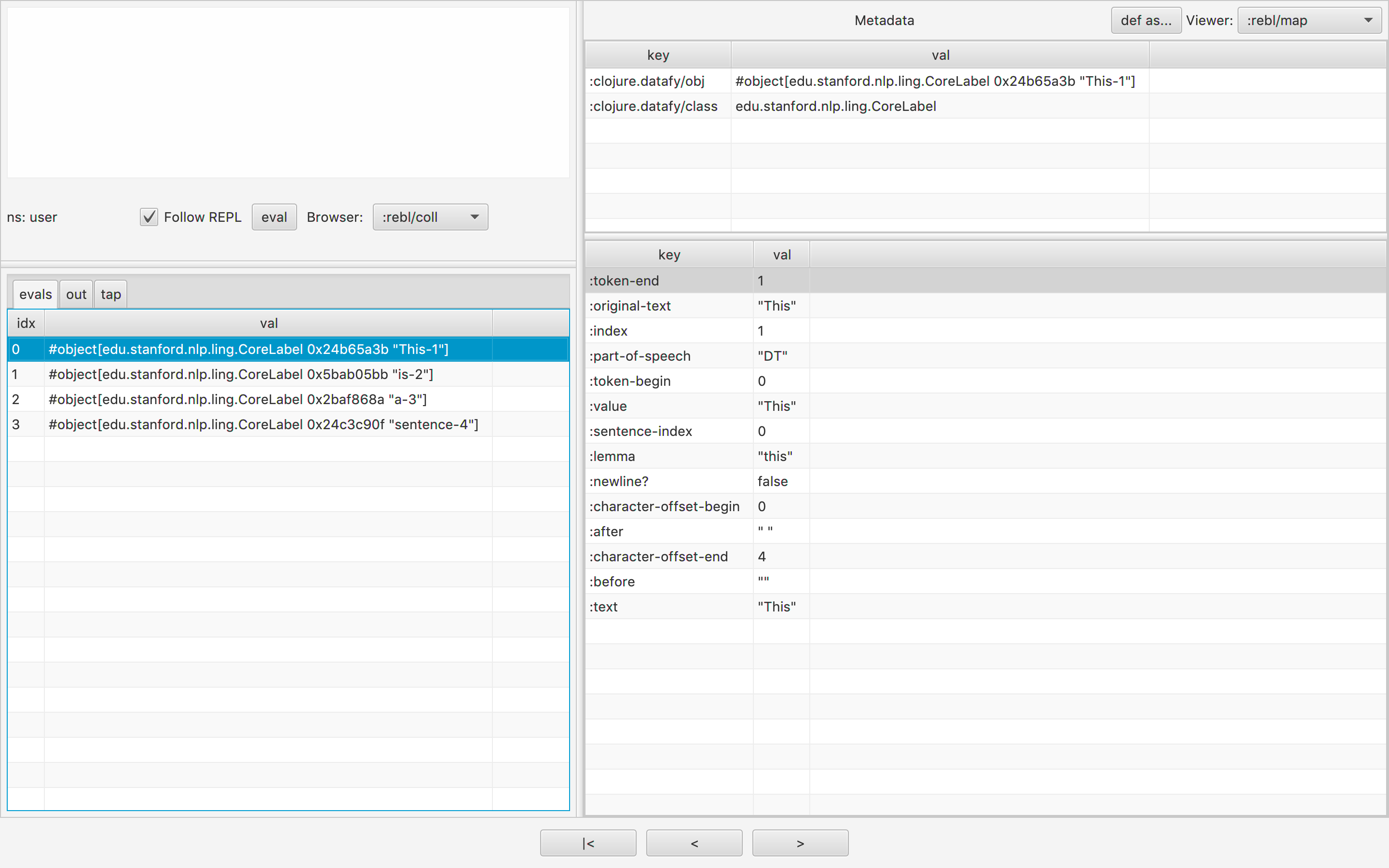
Within the REBL, text annotations can be visualised and analysed interactively.
Loom integration
The dependency graphs support the Graph and DiGraph protocols from Loom and associated algorithms.
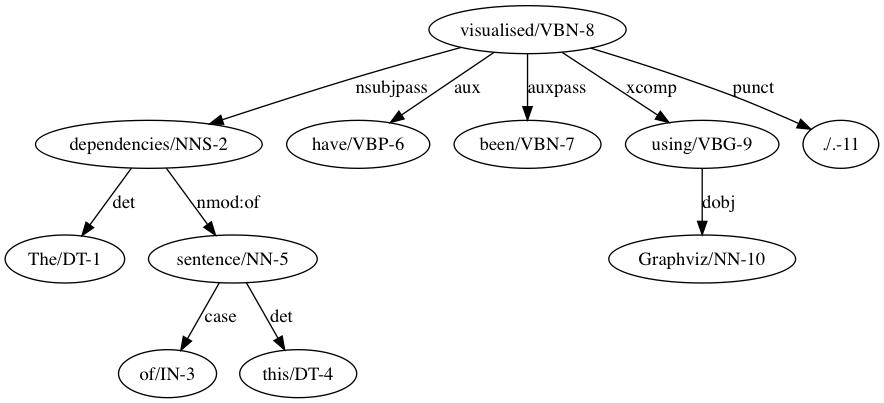
Dependency graphs can also be visualised using a modified version of the view function from Loom (requires Graphiz installed).
(require '[dk.simongray.datalinguist.loom.io :refer [view]])

(view (->> (nlp "The dependencies of this sentence have been visualised using Graphviz.")
           sentences
           dependency-graph
           first))
Generate Datalog tuples
Some CoreNLP annotators allow you to extract triples from text. You can use the dk.simongray.datalinguist.triple/triple->datalog function to convert these triples directly into Datomic-style EaV tuples. In fact, this is the way DataLinguist datafies any CoreNLP triple objects.
Assuming a pipeline containing the openie annotator:
(->> (nlp (str "Donald Trump was elected president in 2016. "
               "In 2021, Joe Biden will succeed Donald Trump as president.")
     triples
     recur-datafy))
The above code might then return the following Datalog-like tuples
Related Skills
node-connect
339.1kDiagnose OpenClaw node connection and pairing failures for Android, iOS, and macOS companion apps
frontend-design
83.8kCreate distinctive, production-grade frontend interfaces with high design quality. Use this skill when the user asks to build web components, pages, or applications. Generates creative, polished code that avoids generic AI aesthetics.
openai-whisper-api
339.1kTranscribe audio via OpenAI Audio Transcriptions API (Whisper).
commit-push-pr
83.8kCommit, push, and open a PR
