
LargeScaleClinicalEmbedding
A C++ application to compute the SVD of a word-word cooccurrence matrix
Install / Use
/learn @rusheniii/LargeScaleClinicalEmbeddingREADME
Large Scale Clinical Embeddings
This pipeline for creating clinical embeddings contains two steps.
- Count the frequency of cooccurring medical concepts using a sliding 30 day window.
- Perform singular value decomposition on the concept-concept matrix.
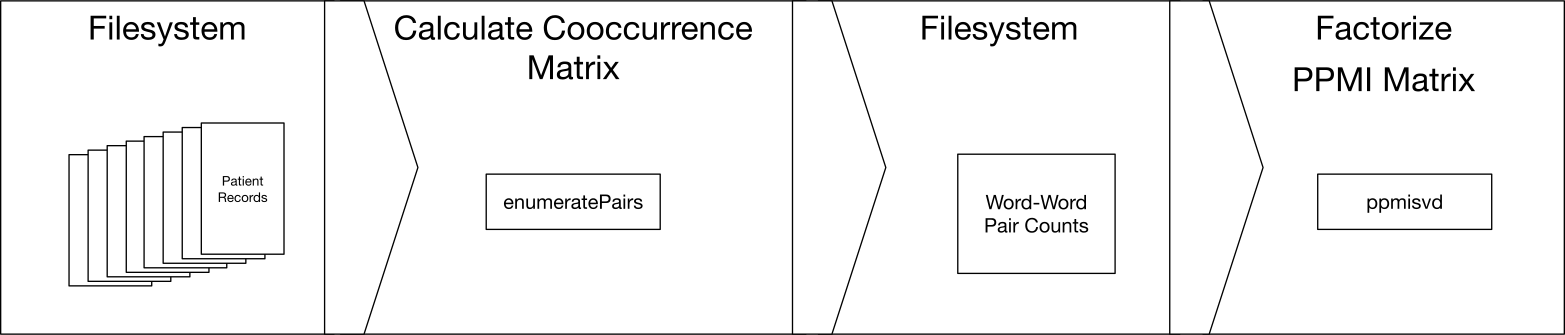 This figure shows how to create a factorized PPMI matrix from patient records. The application
 enumeratePairs takes a number of patient records as input and counts the frequency of all the cooccurring pairs of concepts. The output file is a sparse matrix in parquet format with three columns: i,j, and count. Next the application called ppmisvd takes the sparse matrix file as input and writes the left singular vectors of the corresponding PPMI matrix.
For cases where the input data is very large and needs to be scaled beyond a single machine, we recommend using an architecture similar to the pipeline below. The input data for enumeratePairs should be bucketed by the patient identifier. Then use a workflow manager to run the application in parallel across multiple machines. You will need to add an additional combine step to add all the sparse matrices. We recommend using the map-reduce framework to combine all the (i,j) pairs. Finally you can use ppmisvd to factorize the reduced sparse matrix.

Requirements:
- Anaconda
- Linux
Installation Instructions
conda install -c conda-forge gxx_linux-64 arrow-cpp=3.0.0 cmake gfortran_linux-64 slepc=3.15 tbb-devel=2020.3 <br/><br/>
mkdir build <br/><br/>
cd build <br/><br/>
cmake .. <br/><br/>
make -j 5 <br/><br/>
These steps should compile both applications. The binaries are in a directory named bin.
Installation without MPI
conda install -c conda-forge gxx_linux-64 arrow-cpp=3.0.0 cmake gfortran_linux-64 openblas tbb-devel=2020.3 <br/><br/>
bash no_mpi_build.sh <br/><br/>
cd build <br/><br/>
cmake .. <br/><br/>
make -j 5 <br/><br/>
Usage
enumeratePairs [outputFile] [numberOfThreads] [input files] ...
This program using Intel's TBB to count the frequency of cooccurring medical concepts using a sliding 30 day window. The program expects the input to be in parquet format and already sorted by Patient and number of days. <br/><br/>
The input schema must conform to the following
PatientOrder (int64), NumDays(int32), WordIndex(int32), window(int32) <br/><br/>
ppmisvd -inputFilePath <path> -outputFilePath <path>
This a C++ implementation that performs singular value decomposition of a large sparse matrix using SLEPc and PETSc. The input is a word-word cooccurrence matrix in parquet format. The application will calculate the positive pointwise mutual information (PPMI) matrix. Then it performs SVD and writes the left singular vectors to a file. The PETSc ecosystem is designed for large sparse matrices. The SLEPc eigenvalue problem solver is implemented on top of PETSc.
-help or -h : This will display the help menu and provides a full list of options. <br/><br/>
-inputFilePath <input path>: This is the filepath to a parquet file with schema: i (int32),j (int32), count (int64) <br/><br/>
-outputFilePath <output path>: This is the location to write the left singular vectors as a PETSc Matrix <br/><br/>
-sym : For each i,j pair in input file, this flag also adds pair j,i into the matrix. (ie the input is stored as a triangular matrix but should be symmetric).<br/><br/>
-eigenWeight : should the left signular vectors be scaled by square root of sigma? <br/><br/>
-alpha <smoothing parameter>: This is context distributional smoothing. <br/><br/>
-svd_nsv <number of singular vectors>: This specifies the number of singular vectors to find. <br/><br/>
-svd_type : SVD solver method (one of) cross cyclic lapack lanczos trlanczos. <br/><br/>
-svd_largest or -svd_smallest: Compute largest or smallest singular values. <br/><br/>
References
[1] Levy, Omer, et al. “Improving Distributional Similarity with Lessons Learned from Word Embeddings.” Transactions of the Association for Computational Linguistics, vol. 3, Dec. 2015, pp. 211–25.<br/><br/> [2] S. Balay, S. Abhyankar, M. F. Adams, J. Brown, P. Brune, K. Buschelman,L. Dalcin, A. Dener, V. Eijkhout, W. D. Gropp, D. Karpeyev, D. Kaushik,M. G. Knepley, D. A. May, L. C. McInnes, R. T. Mills, T. Munson, K. Rupp,P. Sanan, B. F. Smith, S. Zampini, H. Zhang, and H. Zhang, “PETScWeb page,” https://www.mcs.anl.gov/petsc, 2019. [Online]. Available:https://www.mcs.anl.gov/petsc <br/><br/> [3] S. Balay, W. D. Gropp, L. C. McInnes, and B. F. Smith, “Efficient man-agement of parallelism in object oriented numerical software libraries,” in Modern Software Tools in Scientific Computing, E. Arge, A. M. Bruaset,and H. P. Langtangen, Eds. Birkh ̈auser Press, 1997, pp. 163–202. <br/><br/> [4] “PETSc Users Manual", Argonne National Laboratory,Tech. Rep. ANL-95/11 - Revision 3.13, 2020. [Online]. Available:https://www.mcs.anl.gov/petsc <br/><br/> [5] V. Hernandez, J. E. Roman, and V. Vidal. SLEPc: A scalable and flexible toolkit for the solution of eigenvalue problems. ACM Trans. Math. Software, 31(3):351-362, 2005. <br/><br/> [6] V. Hernandez, J. E. Roman, and V. Vidal. SLEPc: Scalable Library for Eigenvalue Problem Computations. Lect. Notes Comp. Sci., vol. 2565, pages 377-391. Springer, 2003. <br/><br/> [7] J. E. Roman, C. Campos, E. Romero and A. Tomas. SLEPc Users Manual. Tech. Rep. DSIC-II/24/02 - Revision 3.13, Universitat Politècnica de València, 2020. <br/><br/> [8] V. Hernández, J. E. Román and A. Tomás. Parallel Arnoldi eigensolvers with enhanced scalability via global communications rearrangement. Parallel Comput., 33(7-8):521-540, 2007. <br/><br/> [9] V. Hernández, J. E. Román and A. Tomás. A robust and efficient parallel SVD solver based on restarted Lanczos bidiagonalization. Electron. Trans. Numer. Anal., 31:68-85, 2008 <br/><br/>
