
V8go
Execute JavaScript from Go
Install / Use
/learn @rogchap/V8goREADME
Execute JavaScript from Go
<a href="https://github.com/rogchap/v8go/releases"><img src="https://img.shields.io/github/v/release/rogchap/v8go" alt="Github release"></a>






Usage
import v8 "rogchap.com/v8go"
Running a script
ctx := v8.NewContext() // creates a new V8 context with a new Isolate aka VM
ctx.RunScript("const add = (a, b) => a + b", "math.js") // executes a script on the global context
ctx.RunScript("const result = add(3, 4)", "main.js") // any functions previously added to the context can be called
val, _ := ctx.RunScript("result", "value.js") // return a value in JavaScript back to Go
fmt.Printf("addition result: %s", val)
One VM, many contexts
iso := v8.NewIsolate() // creates a new JavaScript VM
ctx1 := v8.NewContext(iso) // new context within the VM
ctx1.RunScript("const multiply = (a, b) => a * b", "math.js")

ctx2 := v8.NewContext(iso) // another context on the same VM
if _, err := ctx2.RunScript("multiply(3, 4)", "main.js"); err != nil {
  // this will error as multiply is not defined in this context
}
JavaScript function with Go callback
iso := v8.NewIsolate() // create a new VM
// a template that represents a JS function
printfn := v8.NewFunctionTemplate(iso, func(info *v8.FunctionCallbackInfo) *v8.Value {
    fmt.Printf("%v", info.Args()) // when the JS function is called this Go callback will execute
    return nil // you can return a value back to the JS caller if required
})
global := v8.NewObjectTemplate(iso) // a template that represents a JS Object
global.Set("print", printfn) // sets the "print" property of the Object to our function
ctx := v8.NewContext(iso, global) // new Context with the global Object set to our object template
ctx.RunScript("print('foo')", "print.js") // will execute the Go callback with a single argunent 'foo'
Update a JavaScript object from Go
ctx := v8.NewContext() // new context with a default VM
obj := ctx.Global() // get the global object from the context
obj.Set("version", "v1.0.0") // set the property "version" on the object
val, _ := ctx.RunScript("version", "version.js") // global object will have the property set within the JS VM
fmt.Printf("version: %s", val)

if obj.Has("version") { // check if a property exists on the object
    obj.Delete("version") // remove the property from the object
}
JavaScript errors
val, err := ctx.RunScript(src, filename)
if err != nil {
  e := err.(*v8.JSError) // JavaScript errors will be returned as the JSError struct
  fmt.Println(e.Message) // the message of the exception thrown
  fmt.Println(e.Location) // the filename, line number and the column where the error occured
  fmt.Println(e.StackTrace) // the full stack trace of the error, if available

  fmt.Printf("javascript error: %v", e) // will format the standard error message
  fmt.Printf("javascript stack trace: %+v", e) // will format the full error stack trace
}
Pre-compile context-independent scripts to speed-up execution times
For scripts that are large or are repeatedly run in different contexts, it is beneficial to compile the script once and used the cached data from that compilation to avoid recompiling every time you want to run it.
source := "const multiply = (a, b) => a * b"
iso1 := v8.NewIsolate() // creates a new JavaScript VM
ctx1 := v8.NewContext(iso1) // new context within the VM
script1, _ := iso1.CompileUnboundScript(source, "math.js", v8.CompileOptions{}) // compile script to get cached data
val, _ := script1.Run(ctx1)

cachedData := script1.CreateCodeCache()

iso2 := v8.NewIsolate() // create a new JavaScript VM
ctx2 := v8.NewContext(iso2) // new context within the VM

script2, _ := iso2.CompileUnboundScript(source, "math.js", v8.CompileOptions{CachedData: cachedData}) // compile script in new isolate with cached data
val, _ = script2.Run(ctx2)
Terminate long running scripts
vals := make(chan *v8.Value, 1)
errs := make(chan error, 1)

go func() {
    val, err := ctx.RunScript(script, "forever.js") // exec a long running script
    if err != nil {
        errs <- err
        return
    }
    vals <- val
}()

select {
case val := <- vals:
    // success
case err := <- errs:
    // javascript error
case <- time.After(200 * time.Milliseconds):
    vm := ctx.Isolate() // get the Isolate from the context
    vm.TerminateExecution() // terminate the execution
    err := <- errs // will get a termination error back from the running script
}
CPU Profiler
func createProfile() {
	iso := v8.NewIsolate()
	ctx := v8.NewContext(iso)
	cpuProfiler := v8.NewCPUProfiler(iso)

	cpuProfiler.StartProfiling("my-profile")

	ctx.RunScript(profileScript, "script.js") # this script is defined in cpuprofiler_test.go
	val, _ := ctx.Global().Get("start")
	fn, _ := val.AsFunction()
	fn.Call(ctx.Global())

	cpuProfile := cpuProfiler.StopProfiling("my-profile")

	printTree("", cpuProfile.GetTopDownRoot()) # helper function to print the profile
}

func printTree(nest string, node *v8.CPUProfileNode) {
	fmt.Printf("%s%s %s:%d:%d\n", nest, node.GetFunctionName(), node.GetScriptResourceName(), node.GetLineNumber(), node.GetColumnNumber())
	count := node.GetChildrenCount()
	if count == 0 {
		return
	}
	nest = fmt.Sprintf("%s  ", nest)
	for i := 0; i < count; i++ {
		printTree(nest, node.GetChild(i))
	}
}

// Output
// (root) :0:0
//   (program) :0:0
//   start script.js:23:15
//     foo script.js:15:13
//       delay script.js:12:15
//         loop script.js:1:14
//       bar script.js:13:13
//         delay script.js:12:15
//           loop script.js:1:14
//       baz script.js:14:13
//         delay script.js:12:15
//           loop script.js:1:14
//   (garbage collector) :0:0
Documentation
Go Reference & more examples: https://pkg.go.dev/rogchap.com/v8go
Support
If you would like to ask questions about this library or want to keep up-to-date with the latest changes and releases, please join the #v8go channel on Gophers Slack. Click here to join the Gophers Slack community!
Windows
There used to be Windows binary support. For further information see, PR #234.
The v8go library would welcome contributions from anyone able to get an external windows
build of the V8 library linking with v8go, using the version of V8 checked out in the
deps/v8 git submodule, and documentation of the process involved. This process will likely
involve passing a linker flag when building v8go (e.g. using the CGO_LDFLAGS environment
variable.
V8 dependency
V8 version: 9.0.257.18 (April 2021)
In order to make v8go usable as a standard Go package, prebuilt static libraries of V8
are included for Linux and macOS. you should not require to build V8 yourself.
Due to security concerns of binary blobs hiding malicious code, the V8 binary is built via CI ONLY.
Project Goals
To provide a high quality, idiomatic, Go binding to the V8 C++ API.
The API should match the original API as closely as possible, but with an API that Gophers (Go enthusiasts) expect. For example: using multiple return values to return both result and error from a function, rather than throwing an exception.
This project also aims to keep up-to-date with the latest (stable) release of V8.
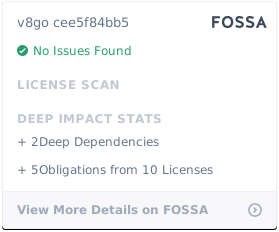
License
Development
Recompile V8 with debug info and debug checks
Aside from data races, Go should be memory-safe and v8go should preserve this property by adding the necessary checks to return an error or panic on these unsupported code paths. Release builds of v8go don't include debugging information for the V8 library since it significantly adds to the binary size, slows down compilation and shouldn't be needed by users of v8go. However, if a v8go bug causes a crash (e.g. during new feature development) then it can be helpful to build V8 with debugging information to get a C++ backtrace with line numbers. The following steps will not only do that, but also enable V8 debug checking, which can help with catching misuse of the V8 API.
- Make sure to clone the projects submodules (ie. the V8's
depot_toolsproject):git submodule update --init --recursive - Build the V8 binary for your OS:
deps/build.py --debug. V8 is a large project, and building the binary can take up to 30 minutes. - Build the executable to debug, using
go buildfor commands orgo test -cfor tests. You may need to add the-ldflags=-compressdwarf=falseoption to disable debug information compression so this information can be read by th
Related Skills
node-connect
338.0kDiagnose OpenClaw node connection and pairing failures for Android, iOS, and macOS companion apps
xurl
338.0kA CLI tool for making authenticated requests to the X (Twitter) API. Use this skill when you need to post tweets, reply, quote, search, read posts, manage followers, send DMs, upload media, or interact with any X API v2 endpoint.
frontend-design
83.4kCreate distinctive, production-grade frontend interfaces with high design quality. Use this skill when the user asks to build web components, pages, or applications. Generates creative, polished code that avoids generic AI aesthetics.
openai-whisper-api
338.0kTranscribe audio via OpenAI Audio Transcriptions API (Whisper).
