
Byok
A bare-metal x86 Forth interpreter & compiler
Install / Use
/learn @rm-hull/ByokREADME
BYOK - a bare-metal x86 Forth OS
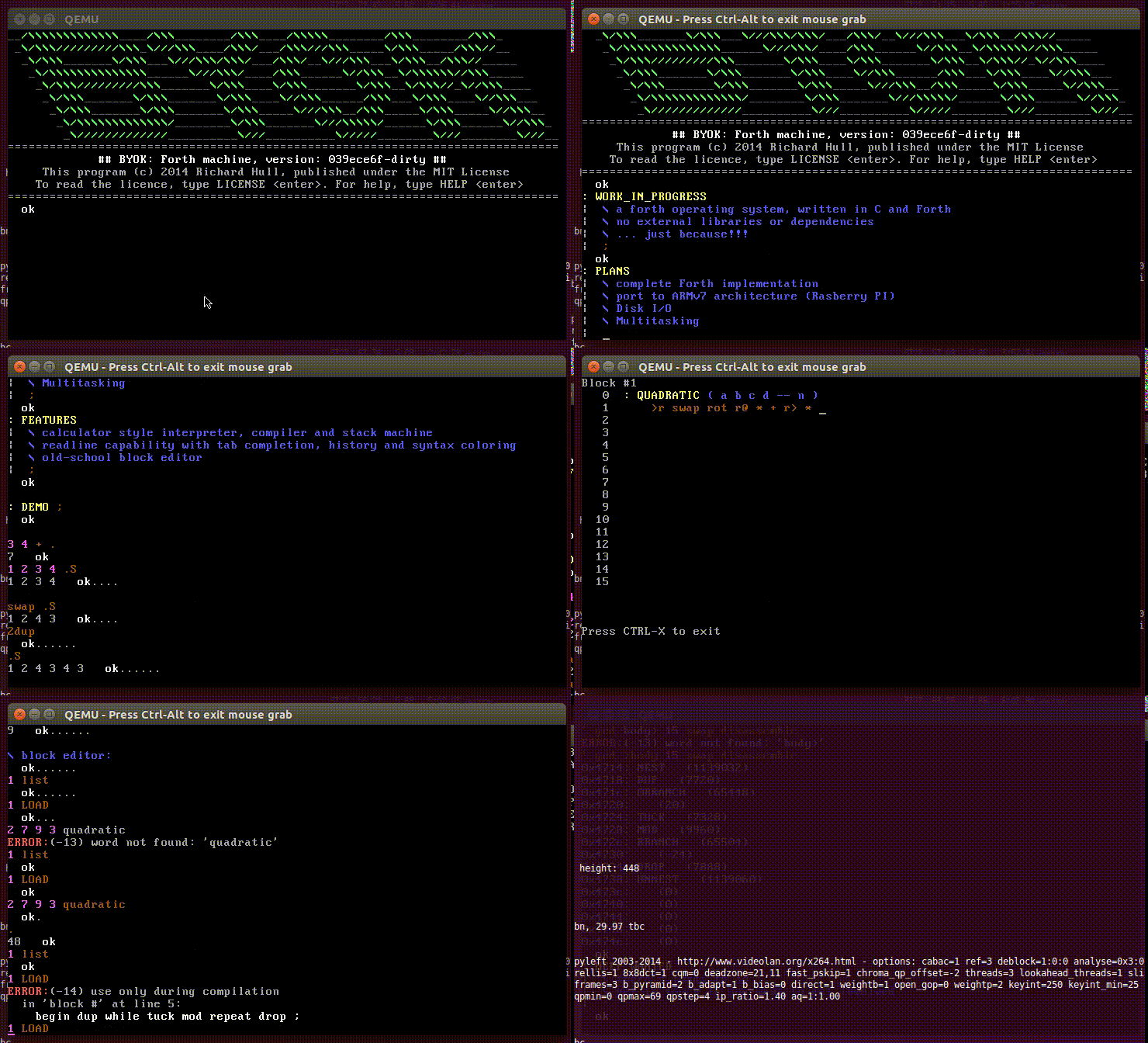
A hobby implementation of a Forth interpreter and compiler, running directly on top of an x86 machine. The screencast below has been sped up, to offset my slow typing.
Setup / Building
For development and testing, using QEMU is recommended. Using bochs, virtual box or VMware should equally work.
From Ubuntu command line (older OS versions may need qemu-kvm instead of qemu-system-i386):
$ sudo apt-get install qemu-system-x86 ghex nasm xorriso make grub-pc-bin
Building requires a barebones i686-elf or ARMv7 cross compiler installing first. Follow the instructions on that page, and then check it works by running:
$ i686-elf-gcc --version
i686-elf-gcc (GCC) 4.9.1
Copyright (C) 2014 Free Software Foundation, Inc.
This is free software; see the source for copying conditions.  There is NO
warranty; not even for MERCHANTABILITY or FITNESS FOR A PARTICULAR PURPOSE.
Next, to completely rebuild the kernel:
$ make clean
$ make build
To build an ISO image of the kernel:
$ make iso
This may then either be burned onto a CD-ROM, or loaded onto a USB stick. Alternatively, running it in qemu:
$ make qemu
Debugging
From the ubuntu command line install gdb and nemiver:
$ sudo apt-get install gdb nemiver
Build an iso image and then launch qemu, making it wait for the debugger to attach:
$ make iso qemu-gdb
In a separate terminal, launch gdb (or nemiver) and at the GDB prompt, connect to the suspended QEMU and load the symbols from the kernel image:
$ gdb

(gdb) target remote localhost:1234
Remote debugging using localhost:1234
0x0000fff0 in ?? ()

(gdb) symbol-file kernel/byok.kernel
Reading symbols from kernel/byok.kernel...done.
Next, pick a function to break on, and continue/step/inspect as normal:
(gdb) break repl
Breakpoint 1 at 0x101e30: file src/stack_machine/repl.c, line 69.

(gdb) cont
Continuing.

Breakpoint 1, repl () at src/stack_machine/repl.c:69
69	{

(gdb) next
72	    history_t *hist = init_history(READLINE_HISTSIZ);

(gdb) info registers
eax            0xffffffff	-1
ecx            0xe	14
edx            0x0	0
ebx            0x400	1024
esp            0x114988	0x114988
ebp            0x0	0x0
esi            0x0	0
edi            0x0	0
eip            0x101e3a	0x101e3a <repl+10>
eflags         0x200206	[ PF IF ID ]
cs             0x8	8
ss             0x10	16
ds             0x10	16
es             0x10	16
fs             0x10	16
gs             0x10	16
Implemented Words
forth/src/primitives/arithmetics.c
| Word | Stack Effect | Description | |------|--------------|-------------| | * | ( x1 x2 -- x3 ) | multiplies x1 with x2, leaves result x3. | | */ | ( n1 n2 n3 -- n4 ) | multiplies then divides (n1 x n2) / n3. | | /MOD | ( n1 n2 n3 -- n4 n5) | multiplies then divides (n1 x n2) / n3, returning the remainder n n4 and quotient in n5. | | + | ( x1 x2 -- x3 ) | adds x1 and x2, leaves result x3. | | - | ( x1 x2 -- x3 ) | subtracts x2 from x1, leaves result x3. | | / | ( x1 x2 -- x3 ) | divides x1 by x2, leaves result x3. | | /MOD | ( n1 n2 -- n-rem n-quot ) | calculates and returns remainder and quotient of division n1/n2. | | 1+ | ( x1 -- x2 ) | increments x1 by 1. | | 1- | ( x1 -- x2 ) | decrements x1 by 1. | | 2 | ( x1 -- x2 ) | multiply x1 by 2. | | 2+ | ( x1 -- x2 ) | increments x1 by 2. | | 2- | ( x1 -- x2 ) | decrements x1 by 2. | | 2/ | ( n1 -- n2 ) | divide n1 by 2. | | ABS | ( n -- u ) | return absolute value of n. | | MAX | ( n1 n2 -- n3 ) | return the greater of the two signed numbers n1 and n2. | | MIN | ( n1 n2 -- n3 ) | return the lesser of the two signed numbers n1 and n2. | | MOD | ( n1 n2 -- n3 ) | calculates and returns remainder of division n1/n2. | | NEGATE | ( n1 -- n2 ) | change sign of n1. |
forth/src/primitives/bit_logic.c
| Word | Stack Effect | Description | |------|--------------|-------------| | AND | ( x1 x2 -- x3 ) | bitwise and x1 with x2, return result x3. | | INVERT | ( x1 -- x2 ) | return the bitwise complement of x1. | | LSHIFT | ( u1 u2 -- u3 ) | logical shift left u1 by u2 bits. | | OR | ( x1 x2 -- x3 ) | bitwise or x1 with x2, return result x3. | | RSHIFT | ( u1 u2 -- u3 ) | logical shift right u1 by u2 bits. | | XOR | ( x1 x2 -- x3 ) | bitwise exclusive-or x1 with x2, return result x3. |
forth/src/primitives/comparison.c
| Word | Stack Effect | Description | |------|--------------|-------------| | 0< | ( n -- f ) | return a true flag if value of n is negative. | | 0<> | ( x -- f ) | return a true flag if value of x is not zero. | | 0= | ( x -- f ) | return a true flag if value of x is zero. | | 0> | ( n -- f ) | return a true flag if value of x is greater than zero. | | < | ( n1 n2 -- f ) | compares signed numbers n1 with n2, returns true if n1 is less then n2. | | <> | ( x1 x2 -- f ) | compares top two stack elements, returns true flag if different, false otherwise. | | = | ( x1 x2 -- f ) | compares top two stack elements, returns true flag if equal, false otherwise. | | > | ( n1 n2 -- f ) | compares signed numbers n1 with n2, returns true if n1 is greater then n2. | | U< | ( u1 u2 -- f ) | compares unsigned numbers u1 with u2, returns true if n1 is lower then n2. | | U> | ( u1 u2 -- f ) | compares unsigned numbers u1 with u2, returns true if n1 is higher then n2. | | WITHIN | ( x1 x2 x3 -- f ) | return a true flag if x1 is in the range of x2 ... x3-1. |
forth/src/primitives/io.c
| Word | Stack Effect | Description | |------|--------------|-------------| | . | ( n -- ) | convert signed number n to string of digits, and output. | | .S | ( -- ) | display stack contents. | | CLS | ( -- ) | clear screen. | | CURSOR | ( start end -- ) | | | EMIT | ( ascii -- ) | outputs ascii as character. | | KEY | ( -- ascii ) | waits for key, returns ascii. | | LIST | ( block -- ) | | | LOAD | ( block -- ) | | | PAGE | ( -- ) | clear screen. | | SPACES | ( u -- ) | outputs u space characters. | | TYPE | ( addr n -- ) | outputs the contents of addr for n bytes. | | U. | ( u -- ) | convert unsigned number n to string of digits, and output. |
forth/src/primitives/memory.c
| Word | Stack Effect | Description |
|------|--------------|-------------|
| ! | ( x a-addr -- ) | Store x at a-addr. |
| ' | ( <spaces>name" -- xt )" | Skip leading space delimiters. Parse name delimited by a space. Find name and return xt, the execution token for name. |
| (LIT) | | |
| +! | ( x a-addr -- ) | Adds x to the single cell number at a-addr. |
| , | ( x -- ) | Reserve one cell of data space and store x in the cell. |
| 0BRANCH | ( x -- ) | |
| : | ( C: <spaces>name" -- colon-sys )" | Enter compilation state and start the current definition, producing colon-sys. |
| ; | ( C: colon-sys -- ) | End the current definition, allow it to be found in the dictionary and enter interpretation state, consuming colon-sys. |
| >BODY | ( xt -- pfa ) | pfa is the parameter field address corresponding to xt. |
| >IN | ( -- a-addr ) | a-addr is the address of a cell containing the offset in characters from the start of the input buffer to the start of the parse area. |
| ?ERROR | | |
| @ | ( a-addr -- x ) | x is the value stored at a-addr. |
| ALLOT | ( n -- ) | If n is greater than zero, reserve n address units of data space. If n is less than zero, release |n| address units of data space. If n is zero, leave the data-space pointer unchanged. |
| BRANCH | ( -- ) | |
| C! | ( char c-addr -- ) | Store char at c-addr. |
| C@ | ( c-addr -- x ) | Fetch the character stored at c-addr. |
| CELLS | ( n1 -- n2 ) | n2 is the size in address units of n1 cells. |
| CMOVE | ( a1 a2 u -- ) | |
| CONSTANT | ( x <spaces>name" -- )" | Skip leading space delimiters. Parse name delimited by a space. Create a definition for name with the execution semantics: name Execution: ( -- x ), which places x on the stack. |
| CREATE | ( <spaces>name" -- )" | Skip leading space delimiters. Parse name delimited by a space. Create a definition for name with the execution semantics: name Execution: ( -- a-addr ) |
| DISASSEMBLE | ( len a-addr -- ) | |
| EXECUTE | ( ix xt -- jx ) | Remove xt from the stack and perform the semantics identified by it. Other stack effects are due to the word EXECUTEd. |
| EXIT | Execution: ( -- ) ( R: nest-sys -- ) | Return control to the calling definition specified by nest-sys. Before executing EXIT within a do-loop, a program shall discard the loop-control parameters by executing UNLOOP. |
| HERE | ( -- addr ) | addr is the data-space pointer. |
| IMMEDIATE | ( -- ) | Make the most recent definition an immediate word. |
| LATEST | ( -- xt ) | |
| LITERAL | Compilation: ( x -- ), Runtime: ( -- x ) | Append the run-time semantics to the current definition. |
| MOVE | ( a1 a2 u -- ) | |
| NAME> | ( xt -- len a-addr) | the address and length of the name of the execution token. |
| PARSE | ( char \ccc<char>" -- c-addr u )" | Parse ccc delimited by the delimiter char. c-addr is the address (within the input buffer) and u is the length of the parsed string. If the parse area was empty, the resulting string has a zero length. |
| SOURCE | ( -- c-addr u ) | c-addr is the address of, and u is the number of characters in, the input buffer. |
| THROW | ( i*x -- ) | |
| VARIABLE | ( <spaces>name" -- )" | Skip leading space delimiters. Parse name delimited by a space. Create a definition for name with the execution semantics: name Execution: ( -- a-addr ). Reserve one cell of data space at an aligned address. |
| WORD | ( char <chars>ccc<char>" -- c-addr )" | Skip leading delim
Related Skills
node-connect
349.0kDiagnose OpenClaw node connection and pairing failures for Android, iOS, and macOS companion apps
frontend-design
109.4kCreate distinctive, production-grade frontend interfaces with high design quality. Use this skill when the user asks to build web components, pages, or applications. Generates creative, polished code that avoids generic AI aesthetics.
openai-whisper-api
349.0kTranscribe audio via OpenAI Audio Transcriptions API (Whisper).
qqbot-media
349.0kQQBot 富媒体收发能力。使用 <qqmedia> 标签,系统根据文件扩展名自动识别类型(图片/语音/视频/文件)。
