
Workmux
git worktrees + tmux windows for zero-friction parallel dev
Install / Use
/learn @raine/WorkmuxREADME
Giga opinionated zero-friction workflow tool for managing git worktrees and tmux windows as isolated development environments. Perfect for running multiple AI agents in parallel without conflict.
Philosophy: Build on tools you already use. tmux/zellij/kitty/etc. for windowing, git for worktrees, your agent for coding — workmux orchestrates the rest.
<sup><sub>* Also supports <a href="https://workmux.raine.dev/guide/kitty">kitty</a>, <a href="https://workmux.raine.dev/guide/wezterm">WezTerm</a>, and <a href="https://workmux.raine.dev/guide/zellij">Zellij</a> as alternative backends.</sub></sup>
📚 See the full documentation for guides and configuration reference.
📖 New to workmux? Read the introduction blog post for a quick overview.
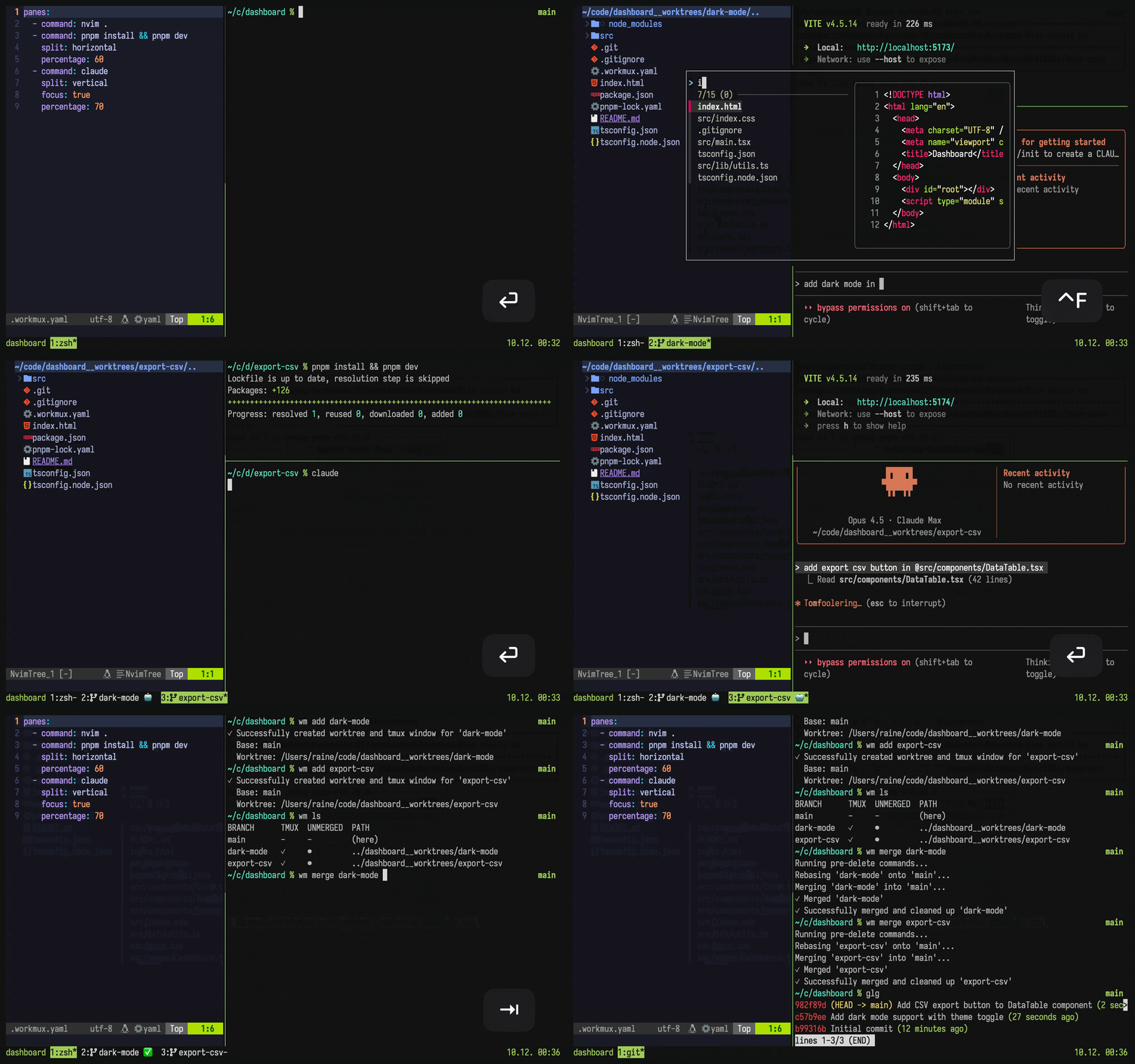
Why workmux?
Parallel workflows. Work on multiple features or hotfixes at the same time, each with its own AI agent. No stashing, no branch switching, no conflicts.
One window per task. A natural mental model. Each has its own terminal state, editor session, dev server, and AI agent. Context switching is switching tabs.
Automated setup. New worktrees start broken (no .env, no node_modules,
no dev server). workmux can copy config files, symlink dependencies, and run
install commands on creation.
One-command cleanup. workmux merge handles the full lifecycle: merge the
branch, delete the worktree, close the tmux window, remove the local branch.
Terminal workflow. Build on your terminal setup instead of yet another agentic GUI that won't exist next year. If you don't have one yet, tmux might be worth picking up.
New to worktrees? See Why git worktrees?
Features
- Create git worktrees with matching tmux windows in a single command (
add) - Merge branches and clean up everything (worktree, tmux window, branches) in
one command (
merge) - Dashboard for monitoring agents, reviewing changes, and sending commands
- Delegate tasks to worktree agents with the
/worktreeskill - Display Claude agent status in tmux window names
- Automatically set up your preferred tmux pane layout (editor, shell, watchers, etc.)
- Run post-creation hooks (install dependencies, setup database, etc.)
- Copy or symlink configuration files (
.env,node_modules) into new worktrees - Sandbox agents in containers or VMs for enhanced security
- Automatic branch name generation from prompts using LLM
- Shell completions
Hype
"I've been using (and loving) workmux which brings together tmux, git worktrees, and CLI agents into an opinionated workflow."
— @Coolin96 🔗
"Thank you so much for your work with workmux! It's a tool I've been wanting to exist for a long time."
— @rstacruz 🔗
"It's become my daily driver - the perfect level of abstraction over tmux + git, without getting in the way or obscuring the underlying tooling."
— @cisaacstern 🔗
Installation
Bash YOLO
curl -fsSL https://raw.githubusercontent.com/raine/workmux/main/scripts/install.sh | bash
Homebrew (macOS/Linux)
brew install raine/workmux/workmux
Cargo
Requires Rust. Install via rustup if you don't have it.
cargo install workmux
Nix
nix profile install github:raine/workmux
# or try without installing
nix run github:raine/workmux -- --help
See Nix guide for flake and home-manager setup.
For manual installation, see pre-built binaries.
Quick start
<!-- prettier-ignore -->[!NOTE] workmux requires a terminal multiplexer. Make sure you have tmux (or WezTerm / Kitty / Zellij) installed and running before you start. See My tmux setup if you need a starting point.
-
Initialize configuration (optional):
workmux initThis creates a
.workmux.yamlfile to customize your workflow (pane layouts, setup commands, file operations, etc.). workmux works out of the box with sensible defaults, so this step is optional. -
Create a new worktree and tmux window:
workmux add new-featureThis will:
- Create a git worktree at
<project_root>/../<project_name>__worktrees/new-feature - Copy config files and symlink dependencies (if configured)
- Run any
post_createsetup commands - Create a tmux window named
wm-new-feature(the prefix is configurable) - Set up your configured or the default tmux pane layout
- Automatically switch your tmux client to the new window
- Create a git worktree at
-
Do your thing
-
Finish and clean up
Local merge: Run
workmux mergeto merge into the base branch and clean up in one step.PR workflow: Push and open a PR. After it's merged, run
workmux removeto clean up.
Configuration
workmux uses a two-level configuration system:
- Global (
~/.config/workmux/config.yaml): Personal defaults for all projects - Project (
.workmux.yaml): Project-specific overrides
Project settings override global settings. When you run workmux from a
subdirectory, it walks upward to find the nearest .workmux.yaml, allowing
nested configs for monorepos. See the
Monorepos guide
for details. For post_create and file operation lists (files.copy,
files.symlink), you can use "<global>" to include global values alongside
project-specific ones. Other settings like panes are replaced entirely when
defined in the project config.
Global configuration example
~/.config/workmux/config.yaml:
nerdfont: true # Enable nerdfont icons (prompted on first run)
merge_strategy: rebase # Make workmux merge do rebase by default
agent: claude

panes:
  - command: <agent> # Start the configured agent (e.g., claude)
    focus: true
  - split: horizontal # Second pane with default shell
Project configuration example
.workmux.yaml:
post_create:
  - '<global>'
  - mise use

files:
  symlink:
    - '<global>' # Include global symlinks (node_modules)
    - .pnpm-store # Add project-specific symlink

panes:
  - command: pnpm install
    focus: true
  - command: <agent>
    split: horizontal
  - command: pnpm run dev
    split: vertical
For a real-world example, see
workmux's own .workmux.yaml.
Configuration options
Most options have sensible defaults. You only need to configure what you want to customize.
Basic options
| Option | Description | Default |
| ---------------- | ---------------------------------------------------- | ----------------------- |
| main_branch | Branch to merge into | Auto-detected |
| base_branch | Default base branch for new worktrees | Current branch |
| worktree_dir | Directory for worktrees (absolute or relative) | <project>__worktrees/ |
| window_prefix | Prefix for tmux window/session names | wm- |
| mode | Tmux mode (window or session) | window |
| agent | Default agent for <agent> placeholder | claude |
| merge_strategy | Default merge strategy (merge, rebase, squash) | merge |
| theme | Dashboard color scheme | default (auto dark/light) |
Naming options
| Option | Description | Default |
| ----------------- | ------------------------------------------- | ------- |
| worktree_naming | How to derive names from branches | full |
| worktree_prefix | Prefix for worktree directories and windows | none |
worktree_naming strategies:
full: Use the full branch name (slashes become dashes)basename: Use only the part after the last/(e.g.,prj-123/feature→feature)
Panes
Define your tmux pane layout with the panes array. For multiple windows in
session mode, use windows instead (they are
mutually exclusive).
panes:
  - command: <agent>
    focus: true
  - command: npm run dev
    split: horizontal
    size: 15
Each pane supports:
| Option | Description | Default |
| ------------ | -------------------------------------------------------------- | ------- |
| command | Command to run (see [agent placeholders](#age
