
Transitions
A lightweight, object-oriented finite state machine implementation in Python with many extensions
Install / Use
/learn @pytransitions/TransitionsREADME
<a name="transitions-module"></a> transitions







A lightweight, object-oriented state machine implementation in Python with many extensions. Compatible with Python 2.7+ and 3.0+.
Installation
pip install transitions
... or clone the repo from GitHub and then:
python setup.py install
Table of Contents
- Quickstart
- Non-Quickstart
Quickstart
They say a good example is worth 100 pages of API documentation, a million directives, or a thousand words.
Well, "they" probably lie... but here's an example anyway:
from transitions import Machine
import random

class NarcolepticSuperhero(object):

    # Define some states. Most of the time, narcoleptic superheroes are just like
    # everyone else. Except for...
    states = ['asleep', 'hanging out', 'hungry', 'sweaty', 'saving the world']

    def __init__(self, name):

        # No anonymous superheroes on my watch! Every narcoleptic superhero gets
        # a name. Any name at all. SleepyMan. SlumberGirl. You get the idea.
        self.name = name

        # What have we accomplished today?
        self.kittens_rescued = 0

        # Initialize the state machine
        self.machine = Machine(model=self, states=NarcolepticSuperhero.states, initial='asleep')

        # Add some transitions. We could also define these using a static list of
        # dictionaries, as we did with states above, and then pass the list to
        # the Machine initializer as the transitions= argument.

        # At some point, every superhero must rise and shine.
        self.machine.add_transition(trigger='wake_up', source='asleep', dest='hanging out')

        # Superheroes need to keep in shape.
        self.machine.add_transition('work_out', 'hanging out', 'hungry')

        # Those calories won't replenish themselves!
        self.machine.add_transition('eat', 'hungry', 'hanging out')

        # Superheroes are always on call. ALWAYS. But they're not always
        # dressed in work-appropriate clothing.
        self.machine.add_transition('distress_call', '*', 'saving the world',
                         before='change_into_super_secret_costume')

        # When they get off work, they're all sweaty and disgusting. But before
        # they do anything else, they have to meticulously log their latest
        # escapades. Because the legal department says so.
        self.machine.add_transition('complete_mission', 'saving the world', 'sweaty',
                         after='update_journal')

        # Sweat is a disorder that can be remedied with water.
        # Unless you've had a particularly long day, in which case... bed time!
        self.machine.add_transition('clean_up', 'sweaty', 'asleep', conditions=['is_exhausted'])
        self.machine.add_transition('clean_up', 'sweaty', 'hanging out')

        # Our NarcolepticSuperhero can fall asleep at pretty much any time.
        self.machine.add_transition('nap', '*', 'asleep')

    def update_journal(self):
        """ Dear Diary, today I saved Mr. Whiskers. Again. """
        self.kittens_rescued += 1

    @property
    def is_exhausted(self):
        """ Basically a coin toss. """
        return random.random() < 0.5

    def change_into_super_secret_costume(self):
        print("Beauty, eh?")
There, now you've baked a state machine into NarcolepticSuperhero. Let's take him/her/it out for a spin...
>>> batman = NarcolepticSuperhero("Batman")
>>> batman.state
'asleep'

>>> batman.wake_up()
>>> batman.state
'hanging out'

>>> batman.nap()
>>> batman.state
'asleep'

>>> batman.clean_up()
MachineError: "Can't trigger event clean_up from state asleep!"

>>> batman.wake_up()
>>> batman.work_out()
>>> batman.state
'hungry'

# Batman still hasn't done anything useful...
>>> batman.kittens_rescued
0

# We now take you live to the scene of a horrific kitten entreement...
>>> batman.distress_call()
'Beauty, eh?'
>>> batman.state
'saving the world'

# Back to the crib.
>>> batman.complete_mission()
>>> batman.state
'sweaty'

>>> batman.clean_up()
>>> batman.state
'asleep'   # Too tired to shower!

# Another productive day, Alfred.
>>> batman.kittens_rescued
1
While we cannot read the mind of the actual batman, we surely can visualize the current state of our NarcolepticSuperhero.
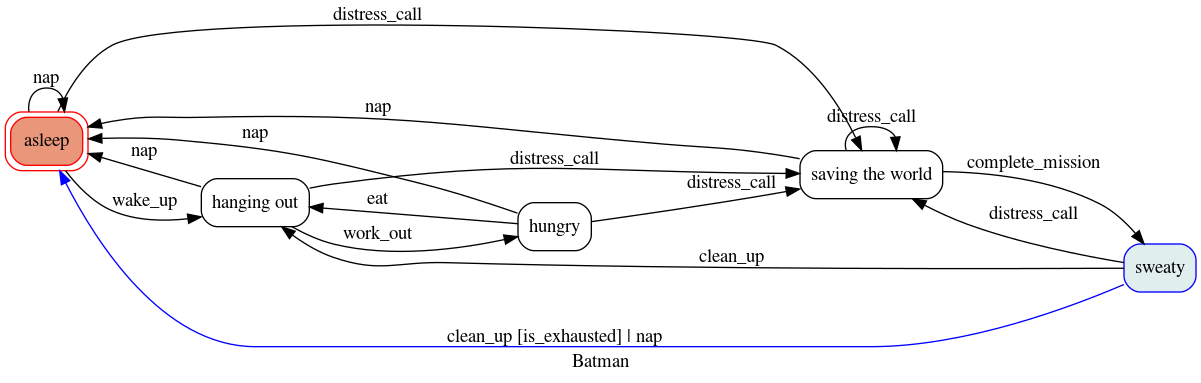
Have a look at the Diagrams extensions if you want to know how.
The non-quickstart
A state machine is a model of behavior composed of a finite number of states and transitions between those states. Within each state and transition some action can be performed. A state machine needs to start at some initial state. When using transitions, a state machine may consist of multiple objects where some (machines) contain definitions for the manipulation of other (models). Below, we will look at some core concepts and how to work with them.
Some key concepts
-
State. A state represents a particular condition or stage in the state machine. It's a distinct mode of behavior or phase in a process.
-
Transition. This is the process or event that causes the state machine to change from one state to another.
-
Model. The actual stateful structure. It's the entity that gets updated during transitions. It may also define actions that will be executed during transitions. For instance, right before a transition or when a state is entered or exited.
-
Machine. This is the entity that manages and controls the model, states, transitions, and actions. It's the conductor that orchestrates the entire process of the state machine.
-
Trigger. This is the event that initiates a transition, the method that sends the signal to start a transition.
-
Action. Specific operation or task that is performed when a certain state is entered, exited, or during a transition. The action is implemented through callbacks, which are functions that get executed when some event happens.
Basic initialization
Getting a state machine up and running is pretty simple. Let's say you have the object lump (an instance of class Matter), and you want to manage its states:
class Matter(object):
    pass

lump = Matter()
You can initialize a (minimal) working state machine bound to the model lump like this:
from transitions import Machine
machine = Machine(model=lump, states=['solid', 'liquid', 'gas', 'plasma'], initial='solid')

# Lump now has a new state attribute!
lump.state
>>> 'solid'
An alternative is to not explicitly pass a model to the Machine initializer:
machine = Machine(states=['solid', 'liquid', 'gas', 'plasma'], initial='solid')

# The machine instance itself now acts as a model
machine.state
>>> 'solid'
Note that this time I did not pass the lump model as an argument. The first argument passed to Machine acts as a model. So whe
Related Skills
node-connect
339.3kDiagnose OpenClaw node connection and pairing failures for Android, iOS, and macOS companion apps
claude-opus-4-5-migration
83.9kMigrate prompts and code from Claude Sonnet 4.0, Sonnet 4.5, or Opus 4.1 to Opus 4.5
frontend-design
83.9kCreate distinctive, production-grade frontend interfaces with high design quality. Use this skill when the user asks to build web components, pages, or applications. Generates creative, polished code that avoids generic AI aesthetics.
model-usage
339.3kUse CodexBar CLI local cost usage to summarize per-model usage for Codex or Claude, including the current (most recent) model or a full model breakdown. Trigger when asked for model-level usage/cost data from codexbar, or when you need a scriptable per-model summary from codexbar cost JSON.
