
Kubesdk
Kubernetes client for Python + CRD<>API models (both ways) generator. Fast, fully typed, async.
Install / Use
/learn @puzl-cloud/KubesdkREADME






kubesdk
kubesdk is a modern, async-first Kubernetes client and API model generator for Python.
- Developer-friendly, with fully typed APIs so IDE auto-complete works reliably across built-in resources and your custom resources.
- Made for large multi-cluster workloads.
- Minimal external dependencies (client itself depends on
aiohttpandPyYAMLonly).
The project is split into three packages:
kubesdk
The core client library, which you install and use in your project.
kube-models
Pre-generated Python models for all upstream Kubernetes APIs, for every Kubernetes version 1.23+. All Kubernetes APIs are bundled under a single kube-models package version, so you don’t end up in model-versioning hell.
Separate models package gives you ability to use latest client version with legacy Kubernetes APIs and vice versa.
You can find the latest generated models here. They are automatically uploaded to an external repository to avoid increasing the size of the main kubesdk repo.
kubesdk-cli
CLI that generates models from a live cluster or OpenAPI spec, including your own CRDs.
Comparison with other Python clients
| Feature / Library | kubesdk | kubernetes-asyncio | Official client (kubernetes) | kr8s | lightkube |
|------------------------------------|-------------|-------------------|------------------------------|----------|----------|
| Async client | ✅ | ✅ | ✗ | ✅ | ✅ |
| IDE-friendly client methods typing | ✅ Full | ◑ Partial | ◑ Partial | ◑ Partial | ✅ Good |
| Typed models for all built-in APIs | ✅ | ✅ | ✅ | ◑ Partial | ✅ |
| Built-in multi-cluster ergonomics | ✅ | ◑ Manual | ◑ Manual | ◑ Manual | ◑ Manual |
| Easy API model generation (CLI) | ✅ | ✗ | ✗ | ◑ | ◑ |
| High-level JSON Patch helpers (typed) | ✅ | ✗ | ✗ | ✗ | ✗ |
| One API surface for core + CRDs | ✅ | ✗ | ✗ | ◑ | ✅ |
| Separated API models package | ✅ | ✗ | ✗ | ✗ | ✅ |
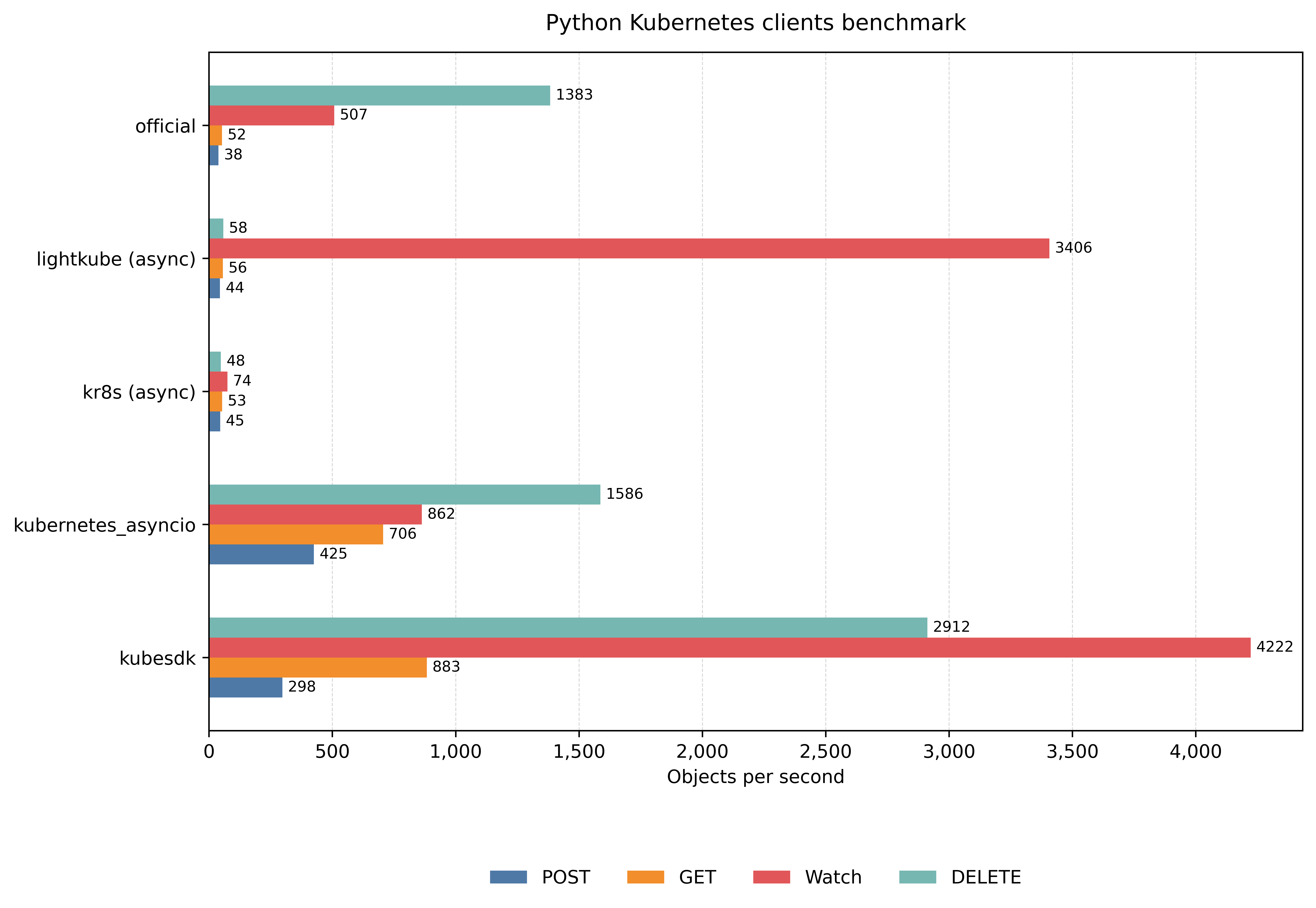
| Performance on large-scale workloads | ✅ >1000 RPS | ✅ >1000 RPS | <100 RPS | <100 RPS | <100 RPS |
Benchmark
Benchmark results were collected against kind (Kubernetes in Docker), which provides a fast, consistent local environment for comparing client overhead under the same cluster conditions.
Installation
pip install kubesdk[cli]
Quick examples
Create and read resource
import asyncio

from kube_models.apis_apps_v1.io.k8s.api.apps.v1 import (
    Deployment,
    DeploymentSpec,
    LabelSelector,
)
from kube_models.api_v1.io.k8s.api.core.v1 import (
    PodTemplateSpec,
    PodSpec,
    Container,
)
from kube_models.api_v1.io.k8s.apimachinery.pkg.apis.meta.v1 import ObjectMeta

from kubesdk import login, create_k8s_resource, get_k8s_resource


async def main() -> None:
    # Load available cluster config and establish cluster connection process-wide
    await login()

    deployment = Deployment(
        metadata=ObjectMeta(name="example-nginx", namespace="default"),
        spec=DeploymentSpec(
            replicas=2,
            selector=LabelSelector(matchLabels={"app": "example-nginx"}),
            template=PodTemplateSpec(
                metadata=ObjectMeta(labels={"app": "example-nginx"}),
                spec=PodSpec(
                    containers=[
                        Container(
                            name="nginx",
                            image="nginx:stable",
                        )
                    ]
                ),
            ),
        ),
    )

    # Create the Deployment
    await create_k8s_resource(deployment)

    # Read it back
    created = await get_k8s_resource(Deployment, "example-nginx", "default")

    # IDE autocomplete works here
    print("Container name:", created.spec.template.spec.containers[0].name)


if __name__ == "__main__":
    asyncio.run(main())
Watch resources
import asyncio

from kube_models.apis_apps_v1.io.k8s.api.apps.v1 import Deployment
from kubesdk import login, watch_k8s_resources


async def main() -> None:
    await login()

    async for event in watch_k8s_resources(Deployment, namespace="default"):
        deploy = event.object
        print(event.type, deploy.metadata.name)


if __name__ == "__main__":
    asyncio.run(main())
Delete resources
import asyncio

from kube_models.apis_apps_v1.io.k8s.api.apps.v1 import Deployment
from kubesdk import login, delete_k8s_resource


async def main() -> None:
    await login()
    await delete_k8s_resource(Deployment, "example-nginx", "default")


if __name__ == "__main__":
    asyncio.run(main())
Patch resource
from dataclasses import replace

from kube_models.api_v1.io.k8s.api.core.v1 import LimitRange, LimitRangeSpec, LimitRangeItem
from kube_models.api_v1.io.k8s.apimachinery.pkg.apis.meta.v1 import OwnerReference, ObjectMeta

from kubesdk import create_k8s_resource, update_k8s_resource, from_root_, path_, replace_


async def patch_limit_range() -> None:
    """
    Example: bump PVC min storage and add an OwnerReference in a single,
    server-side patch. kubesdk will compute the diff between `latest` and
    `updated` and pick the best patch type (strategic/merge) automatically.
    """
    # Create the initial LimitRange object.
    namespace = "default"
    initial_range = LimitRange(
        metadata=ObjectMeta(
            name="example-limit-range",
            namespace=namespace,
        ),
        spec=LimitRangeSpec(
            limits=[
                LimitRangeItem(
                    type="PersistentVolumeClaim",
                    min={"storage": "1Gi"},
                )
            ]
        ),
    )

    # The client returns the latest version from the API server.
    latest: LimitRange = await create_k8s_resource(initial_range)

    #
    # We want to make a few modifications, will do them one by one.
    # First, append a new OwnerReference.
    #
    # IDE autocomplete works here
    owner_ref_path = path_(from_root_(LimitRange).metadata.ownerReferences)
    updated_range = replace_(
        latest,

        # IDE autocomplete works here
        path=owner_ref_path,

        # Typecheck works here
        new_value=latest.metadata.ownerReferences + [
            OwnerReference(
                uid="9153e39d-87d1-46b2-b251-5f6636c30610",
                apiVersion="v1",
                kind="Secret",
                name="test-secret-1",
            ),
        ]
    )

    #
    # Then, set a new list of limits with updated PVC min storage.
    #
    # IDE autocomplete works here
    limits_path = path_(from_root_(LimitRange).spec.limits)
    updated_range = replace_(
        updated_range,

        # IDE autocomplete works here
        path=limits_path,

        # Typecheck works here
        new_value=[
            replace(lim, min={"storage": "3Gi"})
            if lim.type == "PersistentVolumeClaim" else lim
            for lim in latest.spec.limits
        ]
    )

    update_all_changed_fields = True
    # Let kubesdk compute the diff and patch everything that changed
    if update_all_changed_fields:
        await update_k8s_resource(updated_range, built_from_latest=latest)

    # Or, restrict the patch to specific paths only (optional)
    else:
        await update_k8s_resource(
            updated_range,
            built_from_latest=latest,
            paths=[owner_ref_path, limits_path],
        )
Working with multiple clusters
import asyncio
from dataclasses import replace

from kubesdk import login, KubeConfig, ServerInfo, watch_k8s_resources, create_or_update_k8s_resource, \
    delete_k8s_resource, WatchEventType
from kube_models.api_v1.io.k8s.api.core.v1 import Secret


async def sync_secrets_between_clusters(src_cluster: ServerInfo, dst_cluster: ServerInfo):
    src_ns, dst_ns = "default", "test-kubesdk"
    async for event in watch_k8s_resources(Secret, namespace=src_ns, server=src_cluster.server):
        if event.type == WatchEventType.ERROR:
            status = event.object
            raise Exception(f"Failed to watch Secrets: {status.data}")

        # Optional
        if event.type == WatchEventType.BOOKMARK:
            continue

        # Sync Secret on any other event
        src_secret = event.object
        if event.type == WatchEventType.DELETED:
            # Try to delete, skip if not found
            await delete_k8s_resou
