
ReplicaDB
ReplicaDB is open source tool for database replication, designed for efficiently transferring bulk data between relational and non-relational databases
Install / Use
/learn @osalvador/ReplicaDBREADME
<img src="https://img.shields.io/github/license/osalvador/replicadb?style=for-the-badge" alt="License"> <img src="https://img.shields.io/github/v/release/osalvador/replicadb?style=for-the-badge" alt="Last Version">
<img src="https://img.shields.io/docker/pulls/osalvador/replicadb.svg?style=for-the-badge&logo=docker" alt="Docker Pull">
<img src="https://img.shields.io/github/downloads/osalvador/replicadb/total?style=for-the-badge&logo=github" alt="Github Downloads">
<img src="https://img.shields.io/github/stars/osalvador/replicadb.svg?style=for-the-badge&logo=github" alt="Github Start">
ReplicaDB is a high-performance, open-source command-line tool for bulk data replication between heterogeneous databases. It enables efficient ETL/ELT workflows by transferring data in parallel between Oracle, PostgreSQL, MySQL, MongoDB, SQL Server, and other databases without requiring database agents or triggers.
ReplicaDB supports a wide range of data sources including relational databases (Oracle, PostgreSQL, MySQL, MariaDB, SQL Server, SQLite, IBM DB2 LUW and DB2 for i), NoSQL databases (MongoDB), data virtualization platforms (Denodo), file formats (CSV), cloud storage (Amazon S3), and streaming platforms (Kafka). Any JDBC-compliant database is also supported with some limitations.
The tool is cross-platform compatible with Windows, Linux, and macOS, and leverages parallel data transfer for optimal performance and system utilization during large-scale data migrations and synchronization tasks.
<br>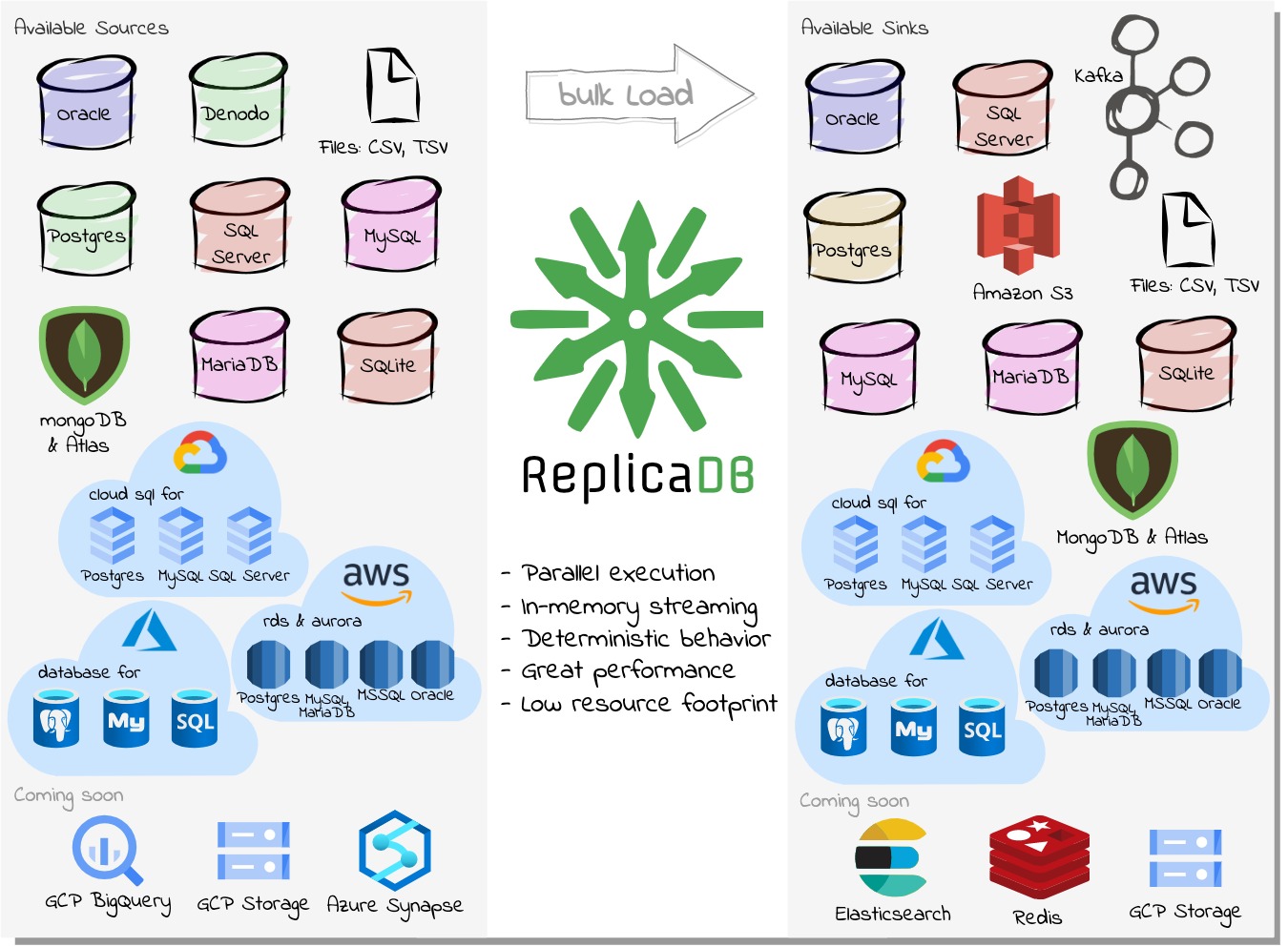
Why ReplicaDB
ReplicaDB addresses common gaps in existing database replication tools by providing:
- Open Source: Transparent development and community-driven improvements
- Cross-Platform: Java-based solution compatible with Linux, Windows, and macOS
- Heterogeneous Support: Works with SQL, NoSQL, and persistent stores like CSV, Amazon S3, or Kafka
- Simple Architecture: Standalone command-line tool without requiring database agents
- High Performance: Optimized for bulk data transfer with large datasets
- Non-Intrusive: Focused on batch replication without requiring database triggers or CDC installation
Comparison with Alternatives
Common alternatives and how ReplicaDB differs:
- SymmetricDS: A comprehensive CDC solution with database triggers. While feature-rich, it requires installation and maintenance of capture tables in source databases, making it more intrusive for batch replication scenarios.
- Sqoop: Designed specifically for Hadoop ecosystems, limiting its use in other environments where Hadoop infrastructure is not available.
- Pentaho and Talend: Full-featured ETL platforms that require custom development for each replication job, increasing complexity and maintenance overhead for straightforward data transfer tasks.
Feature Comparison
| Feature | SymmetricDS | Sqoop | Pentaho/Talend | ReplicaDB | |---------|-------------|-------|----------------|--------| | Database Agents Required | Yes | No | No | No | | Triggers in Source DB | Yes | No | No | No | | Heterogeneous Databases | Limited | No | Yes | Yes | | Hadoop Requirement | No | Yes | No | No | | Custom Development per Job | Low | Low | High | None | | Parallel Transfer | Yes | Yes | Yes | Yes | | Open Source | Yes | Yes | Yes | Yes |
Installation
Prerequisites
Before installing ReplicaDB, ensure you have:
- Java Runtime: Java JDK or JRE 11 or higher installed and configured
- Network Connectivity: Reliable network access to both source and sink databases
- Database Credentials: Appropriate permissions on both databases:
- Source database: SELECT permissions on tables to replicate
- Sink database: INSERT, UPDATE, DELETE, and CREATE TABLE permissions
- (Optional) Docker or Podman for containerized deployment
Stand Alone
System Requirements
ReplicaDB is written in Java and requires a Java Runtime Environment (JRE) Standard Edition (SE) or Java Development Kit (JDK) Standard Edition (SE) version 11 or above. The minimum system requirements are:
- Java SE Runtime Environment 11 or above
- Memory - 256 MB minimum, 1 GB recommended for large datasets
Install
Download the latest release from GitHub and extract the archive:
$ curl -o ReplicaDB-0.18.0.tar.gz -L "https://github.com/osalvador/ReplicaDB/releases/download/v0.18.0/ReplicaDB-0.18.0.tar.gz"
$ tar -xvzf ReplicaDB-0.18.0.tar.gz
$ ./bin/replicadb --help
JDBC Drivers
ReplicaDB already comes with all the JDBC drivers for the Compatible Databases. But you can use ReplicaDB with any JDBC-compliant database.
First, download the appropriate JDBC driver for the type of database you want to use, and install the .jar file in the $REPLICADB_HOME/lib directory. Each driver .jar file also has a specific driver class that defines the entry-point to the driver.
If your database is JDBC-compliant and not appear in the Compatible Databases list, you must set the driver class name in the configuration properties as extra JDBC parameter.
For example, to replicate a DB2 database table as both source and sink
######################## ReplicadB General Options ########################
mode=complete
jobs=1
############################# Source Options ##############################
source.connect=jdbc:db2://localhost:50000/testdb
source.user=${DB2USR}
source.password=${DB2PASS}
source.table=source_table
source.connect.parameter.driver=com.ibm.db2.jcc.DB2Driver
############################# Sink Options ################################
sink.connect=jdbc:db2://localhost:50000/testdb
sink.user=${DB2USR}
sink.password=${DB2PASS}
sink.table=sink_table
sink.connect.parameter.driver=com.ibm.db2.jcc.DB2Driver
Docker
For containerized deployments or environments without Java installed, ReplicaDB is available as a Docker image.
$ docker run \
    -v /tmp/replicadb.conf:/home/replicadb/conf/replicadb.conf \
    osalvador/replicadb
Visit the project homepage on Docker Hub for more information.
Podman
For Red Hat Enterprise Linux and Fedora environments, ReplicaDB provides a container image based on Red Hat Universal Base Image (UBI) 8, which is optimized for enterprise security and compliance.
$ podman run \
    -v /tmp/replicadb.conf:/home/replicadb/conf/replicadb.conf:Z \
    osalvador/replicadb:ubi8-latest
Note: The :Z flag relabels the volume for SELinux compatibility. See Podman documentation for details on volume mounting with SELinux.
Full Documentation
You can find the full ReplicaDB documentation here: Docs
Configuration Wizard
You can create a configuration file for a ReplicaDB process by filling out a simple form: ReplicaDB configuration wizard
Quick Start Examples
Oracle to PostgreSQL
Security Note: The examples below use environment variables for credentials. Never hard-code passwords in scripts or command history.
Prerequisites:
- Source table must exist and be accessible with SELECT permissions
- Sink table must exist with a compatible schema
- For
incrementalmode, sink table must have primary keys defined
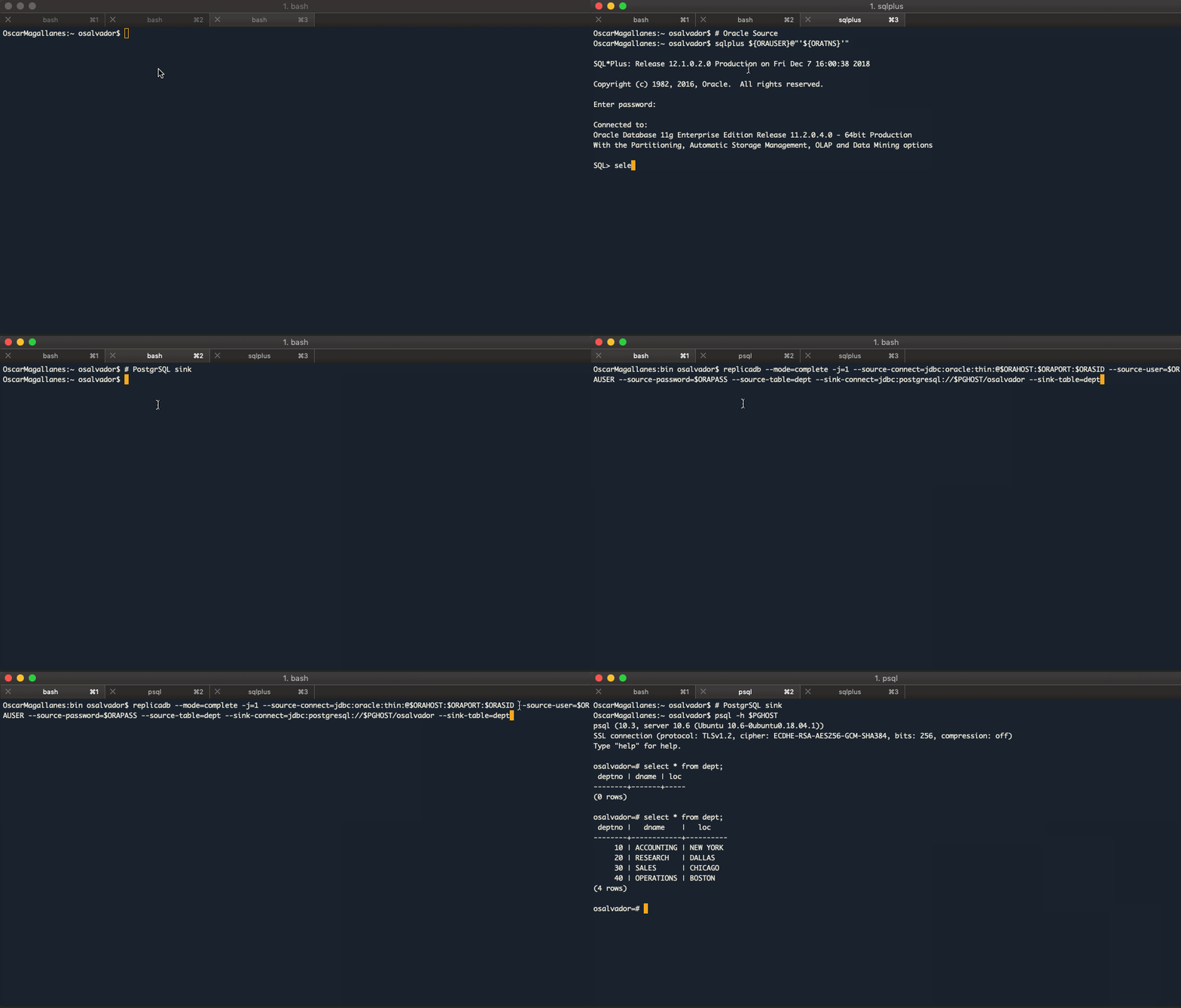
$ replicadb --mode=complete -j=1 \
--source-connect=jdbc:oracle:thin:@$ORAHOST:$ORAPORT:$ORASID \
--source-user=$ORAUSER \
--source-password=$ORAPASS \
--source-table=dept \
--sink-connect=jdbc:postgresql://$PGHOST/osalvador \
--sink-table=dept
2026-01-28 10:15:23,808 INFO  ReplicaTask:36: Starting TaskId-0
2026-01-28 10:15:24,650 INFO  SqlManager:197: TaskId-0: Executing SQL statement: SELECT /*+ NO_INDEX(dept)*/ * FROM dept where ora_hash(rowid,0) = ?
2026-01-28 10:15:24,650 INFO  SqlManager:204: TaskId-0: With args: 0,
2026-01-28 10:15:24,772 INFO  ReplicaDB:89: Total process time: 1302ms
Alternatively, use a configuration file to simplify repeated operations:
######################## ReplicadB General Options ########################
mode=complete
jobs=1
############################# Source Options ##############################
source.connect=jdbc:oracle:thin:@${ORAHOST}:${ORAPORT}:${ORASID}
source.user=${ORAUSER}
source.password=${ORAPASS}
source.table=dept
############################# Sink Options ################################
sink.connect=jdbc:postgresql://${PGHOST}/osalvador
sink.table=dept
$ replicadb --options-file replicadb.conf
PostgreSQL to Oracle
$ replicadb --mode=complete -j=1 \
--sink-connect=jdbc:oracle:thin:@$ORAHOST:$ORAPORT:$ORASID \
--sink-user=$ORAUSER \
--sink-password=$ORAPASS \
--sink-table=dept \
--source-connect=jdbc:postgresql://$PGHOST/osalvador \
--source-table=dept \
--source-columns=dept.*
2026-01-28 10:20:35,334 INFO  ReplicaTask:36: Starting TaskId-0
2026-01-28 10:20:35,440 INFO  SqlManager:131 TaskId-0: Executing SQL statement: SELECT  * FROM dept OFFSET ?
2026-01-28 10:20:35,441 INFO  SqlManager:204: TaskId-0: With args: 0,
2026-01-28 10:20:35,550 INFO  OracleManager:98 Inserting data with this command: INSERT INTO /*+APPEND_VALUES*/ ....
2026-01-2
Related Skills
oracle
337.1kBest practices for using the oracle CLI (prompt + file bundling, engines, sessions, and file attachment patterns).
prose
337.1kOpenProse VM skill pack. Activate on any `prose` command, .prose files, or OpenProse mentions; orchestrates multi-agent workflows.
Command Development
83.1kThis skill should be used when the user asks to "create a slash command", "add a command", "write a custom command", "define command arguments", "use command frontmatter", "organize commands", "create command with file references", "interactive command", "use AskUserQuestion in command", or needs guidance on slash command structure, YAML frontmatter fields, dynamic arguments, bash execution in commands, user interaction patterns, or command development best practices for Claude Code.
Plugin Structure
83.1kThis skill should be used when the user asks to "create a plugin", "scaffold a plugin", "understand plugin structure", "organize plugin components", "set up plugin.json", "use ${CLAUDE_PLUGIN_ROOT}", "add commands/agents/skills/hooks", "configure auto-discovery", or needs guidance on plugin directory layout, manifest configuration, component organization, file naming conventions, or Claude Code plugin architecture best practices.
