
Nubmq
A high performance key value cache built from first principles
Install / Use
/learn @nubskr/NubmqREADME

nubmq: a high performant key-value cache engine
A blazing-fast KV store written in pure Golang without any dependencies with native pub-sub support, engineered for high-frequency, contention-heavy workloads.
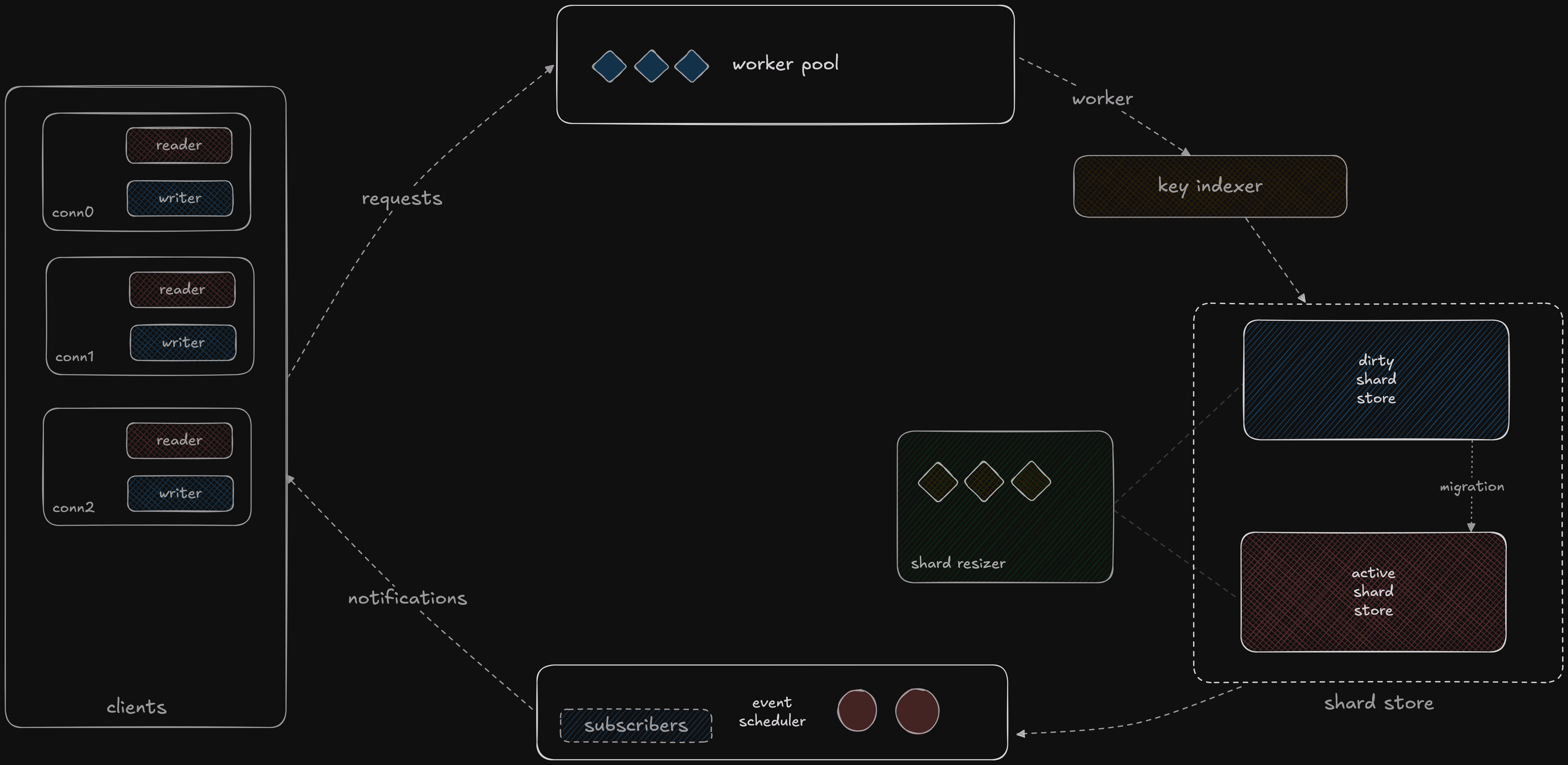
🧩 Adaptive Sharding: a self-managing, self-healing system
✨ The system starts from a single bucket and scales dynamically in real-time! When keys expire, they immediately stop being served and are removed during the next resizing.
- Exponential Shard Scaling: Ensures capacity grows logarithmically, preventing premature resource exhaustion.
- Zero Downtime Resizing: Live shard migration ensures uninterrupted operation. If one store is overloaded, the other takes its place seamlessly!
- True Elasticity: If load contention per shard increases, the engine scales up. If too many keys expire, it scales down.
- Two-Engine Model: Writes shift to a larger engine when contention grows too high while the old engine continues serving reads.
- Wait free Reads & Writes: Eliminates contention, enabling high-frequency write workloads.
- Just Run & Forget: Self-managing & self-healing—no babysitting required!
🔔 Event-Based Notification Scheduler
💡 nubmq is polling-free—notifications are delivered instantly! 📨, polling is for suckers
- Event Scheduler: No CPU-wasting polling, just pure event-driven updates!
- Supported Notifications:
- Key Expiry: Get notified the moment a key expires.
- Key Updates: Real-time updates whenever a key’s value changes.
- Subscription Model:
- Clients can subscribe to any key channel for updates.
- Listen to the
~Exchannel for key expiries.
- Highly Available, Non-Blocking Priority Message Delivery:
- When contention rises, SET/GET operations are prioritized over event notifications.
Event-Driven Connection Handling: No Bottlenecks, No Excuses
💡 Every connection gets its own read and write buffers to enable non-blocking I/O across concurrent requests!
- Hierarchical Write Queues: Critical operations (
SET,GET) always get priority. - Ultra-fast Non-blocking I/O: Every client interaction is measured in microseconds!
Expiry & Subscription Notifications: Real-time Without Polling! 🚀
🛠️ nubmq supports native pub-sub
- Automatic TTL-based eviction ensures memory efficiency without manual intervention.
- Event subscription notifications clients can subscribe for events/
- No-polling required! Uses SSE(server side events) for all notifications
- Garbage-Free Expiration Cleanup: Expired keys are soft deleted and permanently removed from engine during upscale/downscale operations.
🏗️ Dual-Store Model: Scaling Without Downtime
- 🏛️ Two-tier storage system:
- Each store consists of multiple shards.
- If a store gets congested, writes shift to a larger store.
- The old store keeps serving reads while data migrates.
- Zero downtime, no waiting! Clients never experience delays.
- Once migration is complete, the old store is removed from memory for garbage collection.
🛠 Features
- Hyperfast SET/GET operations
- Built-in Expiry with TTL
- Real-time Subscription Mechanism
- Pure Golang, No Dependencies
- High-Performance Cache or NoSQL Mode (Just increase memory limits)
📝 Command Support
SET <key> <value>
SET <key> <value> EX <expiry_time_in_seconds>
GET <key>
SUBSCRIBE <key>
Performance Beyond Limits 🏎️
nubmq squeezes every drop of performance from modern CPUs!
- Parallelized Goroutines: No single-threaded nonsense—everything runs concurrently.
- Atomic Operations: Ensures rock-solid data integrity.
- Benchmark Results: 900µs write latency, 500µs read latency under extreme load.
- Peak Throughput: 115,809 ops/sec with 100 concurrent clients on an M2 MacBook Air.
📊 nubmq vs. The Rest
| Feature | nubmq | Redis | Memcached | Etcd | |------------------------|----------------------|-------------------|-----------------|----------------| | Architecture | Adaptive Sharding | Single-threaded | Static Buckets | Raft Consensus | | Scalability | Auto-Scales Up/Down | Vertical Scaling | Horizontal Only | Limited | | Write Latency | 900µs | ~1.1ms | ~1.5ms | ~3ms | | Read Latency | 500µs | ~700µs | ~1ms | ~2ms | | Max Throughput | 178,766 ops/sec | ~85,000 ops/sec | ~60,000 ops/sec | ~20,000 ops/sec | | Pub/Sub Support | Yes, Instantaneous | Yes, Slow | No | No | | TTL Handling | Native, Optimized | Yes, but Heavy | No | No | | Lock-Free Reads | Yes | No | Yes | No | | Memory Efficiency | High, Dynamic GC | Medium | High | Low | | Dependencies | None (Pure Go) | Libevent, Lua | Libevent | Raft |
📌 Figures from testing on M2 Air or from official sources
📈 Benchmarks
I recently replaced sync.map for buckets to a custom hashtable implementation and got a ~40 percent performance gain!

Benchmarked on a 8 core fanless M2 air (all cores maxed out under load)
- Concurrent Clients: 100
- Peak Throughput: 178,766 ops/sec
- Average Throughput: 133,333.33 ops/sec
- Dataset Size: 1,000,000 unique keys
- Total Operations: 20,000,000 requests
- Total Time Tracked: 150 seconds
Would love it if someone can test on a better machine and post the results
How to run
first start the server with:
make build
run the benchmark with:
make test
or start the client with:
cd ./client
go run main.go
now just play around with commands like you do in redis-cli
🔨 WIP (Work in Progress)
- Parallelized Shard Store resizing: would make shard store resizing faster
- Clustering: currently only supports single nodes 🤖
nubmq is still a work in progress and is in no way perfect,there are still some data races here and there and a few unhandled errors feel free to report bugs and contributions in forms of issues and PRs are welcome
Related Skills
xurl
337.3kA CLI tool for making authenticated requests to the X (Twitter) API. Use this skill when you need to post tweets, reply, quote, search, read posts, manage followers, send DMs, upload media, or interact with any X API v2 endpoint.
notion
337.3kNotion API for creating and managing pages, databases, and blocks.
feishu-drive
337.3k|
things-mac
337.3kManage Things 3 via the `things` CLI on macOS (add/update projects+todos via URL scheme; read/search/list from the local Things database)
