
Ggrain
{package} Make beautiful Raincloud plots in R!
Install / Use
/learn @njudd/GgrainREADME





ggrain - Raincloud Plots
ggrain is an R-package that allows you to create Raincloud plots - following the 'Grammar of Graphics' (i.e., ggplot2) - that are:
- Highly customizable
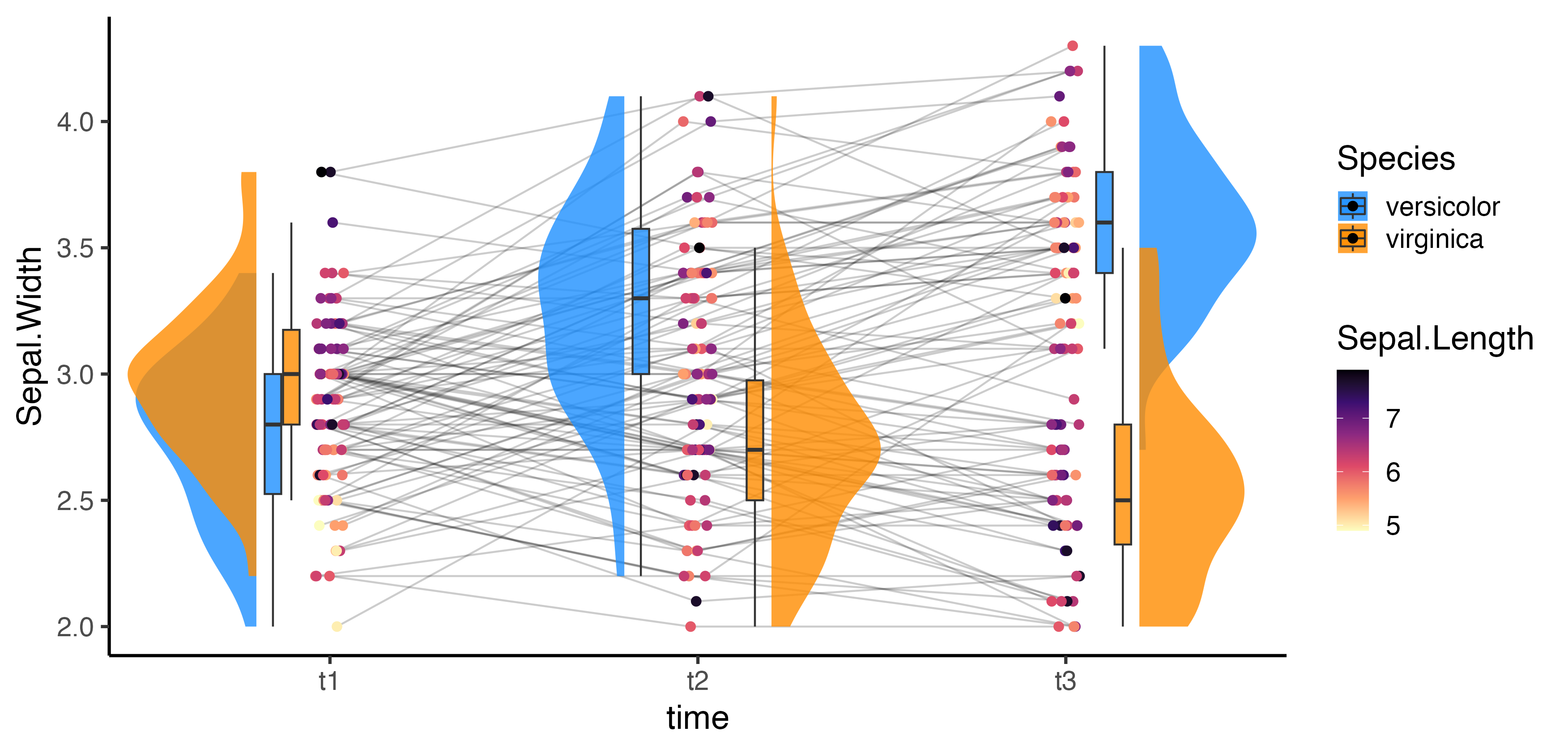
- Connect longitudinal observations
- Handles Likert data
- Allows mapping of a covariate.
Citation
ggrain was developed by Nicholas Judd, Jordy van Langen, Micah Allen, and Rogier Kievit.
Example
ggplot(iris, aes(x = 1, y = Sepal.Length)) +
  geom_rain()
Installation
There are two ways to install this package.
- Download the CRAN version
install.packages("ggrain")

library(ggrain)
- Download through GitHub
if (!require(remotes)) {
    install.packages("remotes")
}
remotes::install_github('njudd/ggrain')

library(ggrain)
Simple examples
-
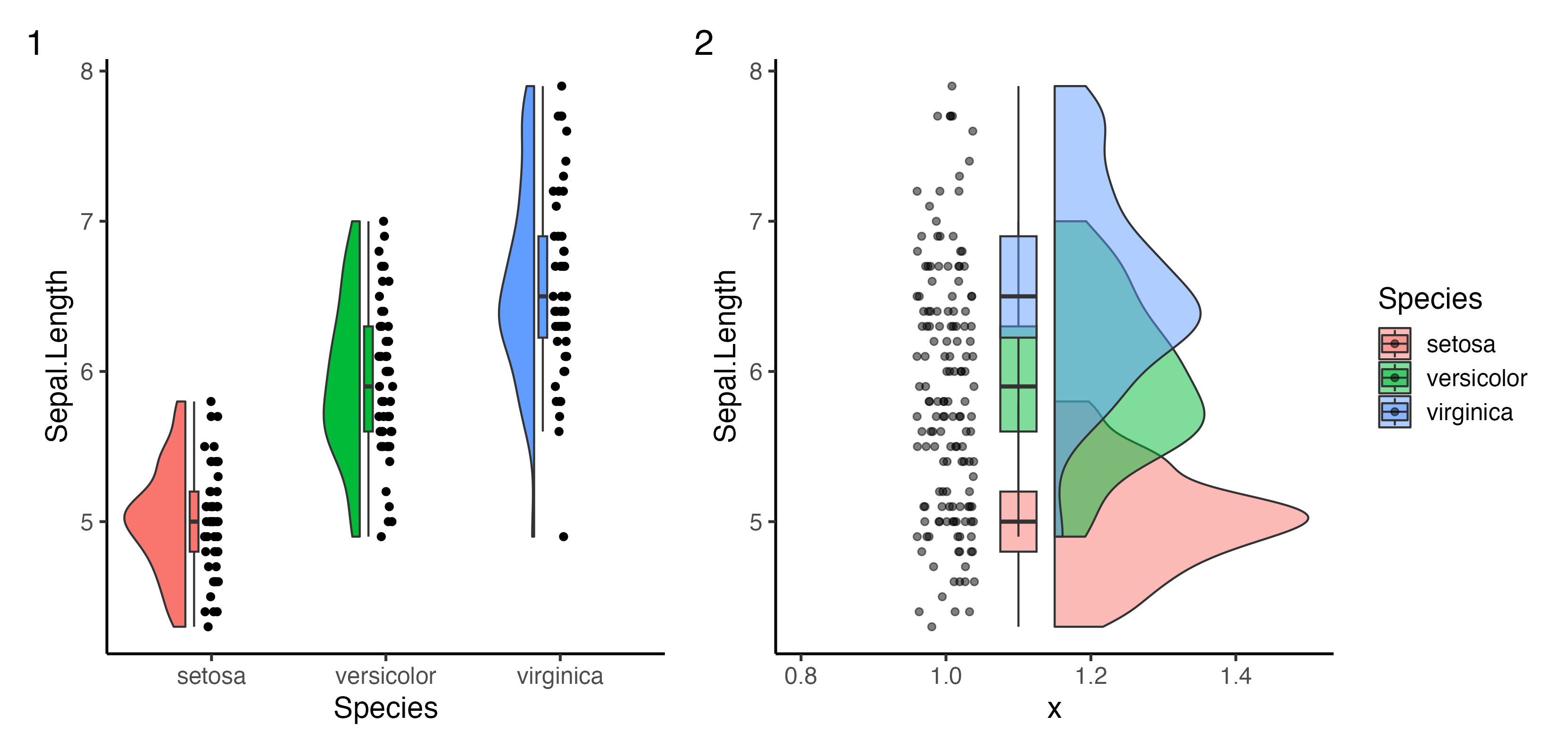
Raincloud per group
ggplot(iris, aes(x = Species, y = Sepal.Length, fill = Species)) + geom_rain(rain.side = 'l') -
Different groups overlapped
ggplot(iris, aes(x = 1, y = Sepal.Length, fill = Species)) +
	geom_rain(alpha = .5)
Vignette
For a complete overview of ggrain such as a 2-by-2 raincloud plot or multiple repeated measures, please see our Vignette.
ggrain specific features
geom_rain is a combination of 4 different ggplot2 geom's (i.e., point, line, boxplot & violin).
id.long.var: a grouping variable to connect the lines bycov: a covariate to remap the color of the pointsLikert:TrueorFalseresponse which adds y jitteringrain.side: Which side to display the rainclouds: 'l' for left, 'r' for right and 'f' for flanking
Specific geom arguments can be passed with a list to any of the 4 geom's with the argument {point/line/boxplot/violin}.args.
Position-related arguments (e.g., jittering, nudging & width) can be passed with {point/line/boxplot/violin}.args.pos, see the help file of ?geom_rain for defaults
Contributions / Issues
We warmly welcome all contributions. You can open an issue or make a pull request if you would like to add something new!
Scientific papers that used & cited 👏 ggrain
<pre>
<b>*</b> Yulugkural, Z., Yildiz, M., Topcu, E., Elmaslar Mert, H. T., & Temiz, A. (2026).
Epigenetic Modulation of IL‐7 and IL‐10: Toward Personalized Immune Therapies in Viral Epidemics.
<b>Journal of Immunology Research, 2026(1), 9467657.</b>
<a href="https://doi.org/10.1155/jimr/9467657">https://doi.org/10.1155/jimr/9467657</a>
<b>*</b> Birdsey, L. P., Brown, S., Dos’ Santos, T., Evans, D., Runacres, A., Weston, M., & Field, A. (2026).
National‐Standard Middle‐Distance Runners Maintain 1500 m Time Trial Running Performance on Successive Days.
<b>European journal of sport science, 26(3), e70142.</b>
<a href="https://doi.org/10.1002/ejsc.70142">https://doi.org/10.1002/ejsc.70142</a>
<b>*</b> Yin, C., Kindt, A., Harms, A., Hartman, R., Hankemeier, T., & De Lange, E. (2026).
Lipidomic fingerprints reveal sex-, age-, and disease-dependent differences in the TgF344-AD transgenic rats.
<b>Metabolomics, 22(1), 9.</b>
<a href="https://doi.org/10.1007/s11306-025-02350-z">https://doi.org/10.1007/s11306-025-02350-z</a>
<b>*</b> Weston, K. L., Burn, N. L., Goroski, A., Weston, M., Galna, B., Glossop, R., ... & Basterfield, L. (2026).
Feasibility of a school-based peer-led high-intensity interval training intervention: the Young Fitness Leaders project.
<b>BMC Public Health, 26, 799.</b>
<a href="10.1186/s12889-026-26543-w">10.1186/s12889-026-26543-w</a>
<b>*</b> Pawel, S., & Held, L. (2026).
Bayes Factor Group Sequential Designs.
<b>arXiv preprint arXiv:2601.02851.</b>
<a href="https://doi.org/10.48550/arXiv.2601.02851">https://doi.org/10.48550/arXiv.2601.02851</a>
<b>*</b> Dutschke, R., Thiele, G., Schoemann, M., Surrey, C., & Scherbaum, S.
Assessing complex belief structures with the triads task: Reliability and validity.
<b>OSF</b>
<a href="https://sciety.org/articles/activity/10.31234/osf.io/ubc85_v1">https://sciety.org/articles/activity/10.31234/osf.io/ubc85_v1</a>
<b>*</b> Urry, H. L., Plonski, P. E., Patel, P., Cathern, M. D., Taylor, H. A., & Brunyé, T. T. (2026).
Urgent, hurry up!!! Perceived time pressure affects fine motor performance via subjective distress in US adults.
<b>Journal of Experimental Psychology: Human Perception and Performance.</b>
<a href="https://doi.org/10.1037/xhp0001386">https://doi.org/10.1037/xhp0001386</a>
<b>*</b> Petit, Q., Lecoq, S., Congnard, F., Cronier, N., de Müllenheim, P. Y., Abraham, P., & Noury‐Desvaux, B. (2026).
Heart rate increase results in case of positional venous entrapment.
<b>Clinical Physiology and Functional Imaging, 46(1), e70041.</b>
<a href="https://doi.org/10.1111/cpf.70041">https://doi.org/10.1111/cpf.70041</a>
<b>*</b> Cruz, T. D. D., & de Lucena, M. A. (2026).
Training and oversight of algorithms in social decision-making: Algorithms with prescribed selfish defaults breed selfish decisions.
<b>Computers in Human Behavior, 108924.</b>
<a href="https://doi.org/10.1016/j.chb.2026.108924">https://doi.org/10.1016/j.chb.2026.108924</a>
<b>*</b> Selvakumar, J., Havdal, L. B., Brodwall, E. M., Sommen, S., Berven, L. L., Stiansen-Sonerud, T., ... & Wyller, V. B. B. (2025).
Risk factors for fatigue severity in the post-COVID-19 condition: A prospective controlled cohort study of nonhospitalised adolescents and young adults.
<b>Brain, Behavior, & Immunity-Health, 44, 100967.</b>
<a href="https://doi.org/10.1016/j.bbih.2025.100967">https://doi.org/10.1016/j.bbih.2025.100967</a>
<b>*</b> Garofalo, S., Finotti, G., Orsoni, M., Giovagnoli, S., & Benassi, M. (2024).
Testing Bayesian Informative Hypotheses in Five Steps With JASP and R.
<b>Advances in Methods and Practices in Psychological Science, 7(4), 25152459241260259.</b>
<a href="https://doi.org/10.1177/25152459241260259">https://doi.org/10.1177/25152459241260259</a>
<b>*</b> de Müllenheim, P. Y. (2024). Analyser des données avec R.
<a href="https://pydemull.github.io/Analyser-des-donnees-avec-R/Analyser-des-donn%C3%A9es-avec-R.pdf">https://pydemull.github.io/Analyser-des-donnees-avec-R/Analyser-des-donn%C3%A9es-avec-R.pdf</a>
<b>*</b> Robison, M. K., Celaya, X., Ball, B. H., & Brewer, G. A. (2024).
Task sequencing does not systematically affect the factor structure of cognitive abilities.
<b>Psychonomic Bulletin & Review, 31(2), 670-685.</b>
<a href="https://doi.org/10.3758/s13423-023-02369-0">https://doi.org/10.3758/s13423-023-02369-0</a>
<b>*</b> Han, C., Danzeng, Q., Li, L., Bai, S., & Zheng, C. (2024).
Machine learning reveals PANoptosis as a potential reporter and
prognostic revealer of tumour microenvironment in lung adenocarcinoma.
<b>The Journal of Gene Medicine, 26(1), e3599.</b>
<a href="https://doi.org/10.1002/jgm.3599">https://doi.org/10.1002/jgm.3599</a>
<b>*</b> Jiang, S., Shang, W. Z., Cui, J. Y., Yan, Y. Y., Yang, T., Hu, Y., ... & Wu, B. (2023).
Prevalence and Predictors of Hemorrhagic Foci on Long-term
Follow-up MRI of Recent Single Subcortical Infarcts.
<b>Translational Stroke Research, 1-11.</b>
<a href="https://doi.org/10.1007/s12975-023-01224-7">https://doi.org/10.1007/s12975-023-01224-7</a>
<b>*</b> Senftleben, U., Schoemann, M., & Scherbaum, S. (2024).
Choice repetition bias in intertemporal choice: An eye-tracking study.
<b>OSF (Open Science Framework) / PsyArXiv.</b>
<a href="https://doi.org/10.31234/osf.io/g3v9m">https://doi.org/10.31234/osf.io/g3v9m</a>
<b>*</b> Bognar, M., Gyurkovics, M., Aczel, B., & van Steenbergen, H. (2023).
The curve of control: Non-monotonic effects of task difficulty on cognitive control.
<b>PsyArXiv</b>
<a href="https://doi.org/10.31234/osf.io/ywup9">https://doi.org/10.31234/osf.io/ywup9</a>
</pre>
Funding
<img src="https
