
Ciscoconfparse2
Parse, Audit, Query, Build, and Modify Arista / Cisco / Juniper / Palo Alto / F5 configurations.
Install / Use
/learn @mpenning/Ciscoconfparse2README
[![logo][66]][66]
ciscoconfparse2
[![git commits][41]][42]  [
[][72]
 [![Hatch project][68]][69]
[![SonarCloud][51]][52] [![SonarCloud Maintainability Rating][53]][54] [![SonarCloud Lines of Code][55]][56] [![SonarCloud Bugs][59]][60] [![SonarCloud Code Smells][57]][58] [![SonarCloud Tech Debt][61]][62]
Introduction: What is ciscoconfparse2?
Summary
ciscoconfparse2 is the next generation of [ciscoconfparse][64], which was the primary development package from 2007 until 2023.
ciscoconfparse2 is similar to an advanced grep and diff that handles multi-vendor network configuration files (such as those from Arista, Cisco, F5, Juniper, Palo Alto, etc).
- Use ciscoconfparse2 to find configuration values without needing to ssh and use show commands.
- Use ciscoconfparse2 to build new configuration files.
Example - Find shutdown interfaces
Assume you have a bunch of interfaces in a configuration. How do you find which ones are shutdown?
One way is manually reading the whole Cisco IOS-XE configuration. Another option is ciscoconfparse2
>>> from ciscoconfparse2 import CiscoConfParse
>>>
>>> parse = CiscoConfParse("/path/to/config/file")
>>> intf_cmds = parse.find_parent_objects(["interface", "shutdown"])
>>>
>>> shut_intf_names = [" ".join(cmd.split()[1:]) for cmd in intf_cmds]
>>>
>>> shut_intf_names
['GigabitEthernet1/5', 'TenGigabitEthernet2/2', 'TenGigabitEthernet2/3']
>>>
Example - Find EBGP peer addresses and AS Numbers
Assume you have this IOS-XR bgp configuration:
router bgp 65534
  bgp router-id 10.0.0.100
  address-family ipv4 unicast
  !
  neighbor 10.0.0.37
    remote-as 64000
    route-policy EBGP_IN in
    route-policy EBGP_OUT out
  !
  neighbor 10.0.0.1
    remote-as 65534
    update-source Loopback0
    route-policy MANGLE_IN in
    route-policy MANGLE_OUT out
      next-hop-self
  !
  neighbor 10.0.0.34
    remote-as 64000
    route-policy EBGP_IN in
    route-policy EBGP_OUT out
You can generate the list of EBGP peers pretty quickly with this script:
from ciscoconfparse2 import CiscoConfParse

parse = CiscoConfParse(
    "/path/to/config/file"
)  # Or read directly from a list of strings

# Get all neighbor configuration branches
branches = parse.find_object_branches(("router bgp", "neighbor", "remote-as"))

# Get the local BGP ASN
bgp_cmd = branches[0][0]
local_asn = bgp_cmd.split()[-1]

# Find EBGP neighbors for any number of peers...
for branch in branches:

    # Extract individual instances for each BGP neighbor "branch"
    neighbor_obj = branch[1]
    remote_asn_obj = branch[2]

    # Use the BaseCfgLine().split() method to get the peer address and ASN
    neighbor_addr = neighbor_obj.split()[-1]
    remote_asn = remote_asn_obj.split()[-1]

    # Only grab EBGP neighbors...
    if local_asn != remote_asn:
        print(f"EBGP NEIGHBOR {neighbor_addr}, ASN {remote_asn}")
When you run that, you'll see:
$ python example.py
EBGP NEIGHBOR 10.0.0.37, ASN 64000
EBGP NEIGHBOR 10.0.0.34, ASN 64000
$
Tutorial
Many things are possible; see the tutorial.
CLI Tool
ciscoconfparse2 distributes a [CLI tool][67] that will diff and grep various network configuration or text files.
API Examples
The API examples are [documented on the web][70]
Why
ciscoconfparse2 is a Python library that helps you quickly search for questions like these in your router / switch / firewall / load-balancer / wireless text configurations:
- What interfaces are shutdown?
- Which interfaces are in trunk mode?
- What address and subnet mask is assigned to each interface?
- Which interfaces are missing a critical command?
- Is this configuration missing a standard config line?
It can help you:
- Audit existing router / switch / firewall / wlc configurations
- Modify existing configurations
- Build new configurations
Speaking generally, the library examines a text network config and breaks it into a set of linked parent / child relationships. You can perform complex queries about these relationships.
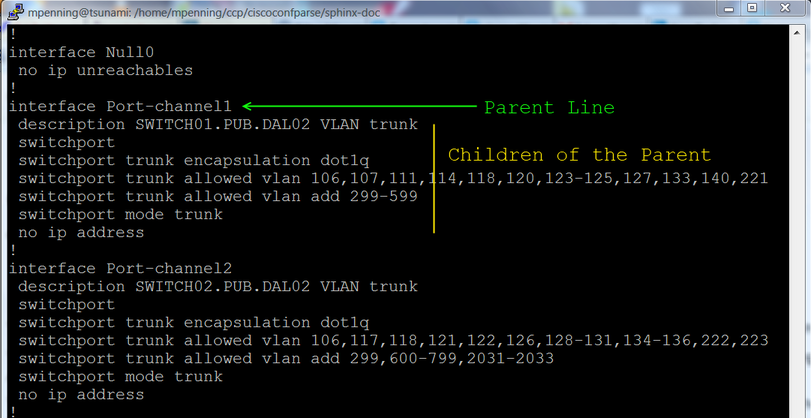
What changed in ciscoconfparse2?
In late 2023, I started a rewrite because [ciscoconfparse][64] is too large and has some defaults that I wish it didn't have. I froze [ciscoconfparse][64] PYPI releases at [version 1.9.52][65]; there will be no more [ciscoconfparse][64] PYPI releases.
I recommend that you upgrade to ciscoconfparse2.
Here's why, it:
- Streamlines the API towards a simpler user interface.
- Removes legacy and flawed methods from the original (this could be a breaking change for old scripts).
- Can search for parents and children using an arbitrary list of ancestors
- Is better at handling multiple-child-level configurations (such as IOS XR and JunOS)
- Adds string methods to
BaseCfgLine()objects - Defaults
ignore_blank_lines=False(this could be a breaking change for old scripts). - Includes a [CLI command][67] (which can grep for mac addresses and IPv4 / IPv6 subnets in text files)
- Adds the concept of change commits; this is a config-modification performance feature that [ciscoconfparse][64] lacks
- Adds an
auto_commitkeyword, which defaults True - Documents much more of the API
- Intentionally requires a different import statement to minimize confusion between the original and ciscoconfparse2
- Vastly improves Cisco IOS diffs
Cisco and Other Vendor-Specific factory parsers
Years ago, I introduced a beta-quality feature called factory, where
I built vendor-specific syntax parsers to extract values from Cisco and other
vendor configs.
This feature turned out to be a bad design decision; however, it's also much more popular than I imagined.
Going forward I strongly discourage people from using factory features. There
will be no further development on vendor-specific factory parsers (such as
[models_cisco.py][71]).
I truly apologize for any disappointment.
Docs, Installation, and Dependencies
- The latest copy of the docs are archived on the web
Installation and Downloads
-
Use
pipfor Python3.x... :python -m pip install ciscoconfparse2
Dependencies
- Python 3
- attrs
- libpass
- dnspython
hier_configPyYAMLmacaddresspyparsingtraitletsrichtypeguardloguru
Pre-requisites
The ciscoconfparse2 python package requires Python versions 3.10+.
What is the pythonic way of handling script credentials?
- Never hard-code credentials
- Use python-dotenv
Other Resources
- Dive into Python3 is a good way to learn Python
- [Team CYMRU][30] has a [Secure IOS Template][29], which is especially useful for external-facing routers / switches
- [Cisco's Guide to hardening IOS devices][31]
- [Center for Internet Security Benchmarks][32] (An email address, cookies, and javascript are required)
Are you releasing licensing besides GPLv3?
I will not. however, if it's truly a problem for your company, there are commercial solutions available (to include purchasing the project, or hiring me).
Bug Tracker and Support
- Please report any suggestions, bug reports, or annoyances with a [github bug report][24].
- If you're having problems with general python issues, consider searching for a solution on [Stack Overflow][33]. If you can't find a solution for your problem or need more help, you can [ask on Stack Overflow][34] or [reddit/r/Python][39].
- If you're having problems with your Cisco devices, you can contact:
- [Cisco TAC][28]
- [reddit/r/Cisco][35]
- [reddit/r/networking][36]
- [NetworkEngineering.se][23]
License and Copyright
ciscoconfparse2 is licensed GPLv3
- Copyright (C) 2026 David Michael Pennington
The word "Cisco" is a registered trademark of [Cisco Systems][27].
Author
ciscoconfparse2 was written by [David Michael Pennington][25] and other contributors.
Related Skills
imsg
342.5kiMessage/SMS CLI for listing chats, history, and sending messages via Messages.app.
node-connect
342.5kDiagnose OpenClaw node connection and pairing failures for Android, iOS, and macOS companion apps
oracle
342.5kBest practices for using the oracle CLI (prompt + file bundling, engines, sessions, and file attachment patterns).
lobster
342.5kLobster Lobster executes multi-step workflows with approval checkpoints. Use it when: - User wants a repeatable automation (triage, monitor, sync) - Actions need human approval before executing (s
