
Regorus
Regorus - A fast, lightweight Rego (OPA policy language) interpreter written in Rust.
Install / Use
/learn @microsoft/RegorusREADME
Regorus
Regorus is
- Rego-Rus(t) - A fast, light-weight Rego interpreter written in Rust.
- Rigorous - A rigorous enforcer of well-defined Rego semantics.
Regorus is also
-
cross-platform - Written in platform-agnostic Rust.
-
no_std compatible - Regorus can be used in
no_stdenvironments too. Most of the builtins are supported. -
current - We strive to keep Regorus up to date with latest OPA release. Regorus defaults to
v1of the Rego language. -
compliant - Regorus is mostly compliant with the latest OPA release v1.2.0. See OPA Conformance for details. Note that while we behaviorally produce the same results, we don't yet support all the builtins.
-
extensible - Extend the Rego language by implementing custom stateful builtins in Rust. See add_extension. Support for extensibility using other languages coming soon.
-
polyglot - In addition to Rust, Regorus can be used from C, C++, C#, Golang, Java, Javascript, Python, and Ruby. This is made possible by the excellent FFI tools available in the Rust ecosystem. See bindings for information on how to use Regorus from different languages.
To try out a Javascript(WASM) compiled version of Regorus from your browser, visit Regorus Playground.
Regorus is available as a library that can be easily integrated into your Rust projects. Here is an example of evaluating a simple Rego policy:
fn main() -> anyhow::Result<()> {
    // Create an engine for evaluating Rego policies.
    let mut engine = regorus::Engine::new();

    let policy = String::from(
        r#"
       package example

       allow if {
          ## All actions are allowed for admins.
          input.principal == "admin"
       } else if {
          ## Check if action is allowed for given user.
          input.action in data.allowed_actions[input.principal]
       }
	"#,
    );

    // Add policy to the engine.
    engine.add_policy(String::from("policy.rego"), policy)?;

    // Add data to engine.
    engine.add_data(regorus::Value::from_json_str(
        r#"{
     "allowed_actions": {
        "user1" : ["read", "write"],
        "user2" : ["read"]
     }}"#,
    )?)?;

    // Set input and evaluate whether user1 can write.
    engine.set_input(regorus::Value::from_json_str(
        r#"{
      "principal": "user1",
      "action": "write"
    }"#,
    )?);

    let r = engine.eval_rule(String::from("data.example.allow"))?;
    assert_eq!(r, regorus::Value::from(true));

    // Set input and evaluate whether user2 can write.
    engine.set_input(regorus::Value::from_json_str(
        r#"{
      "principal": "user2",
      "action": "write"
    }"#,
    )?);

    let r = engine.eval_rule(String::from("data.example.allow"))?;
    assert_eq!(r, regorus::Value::Undefined);

    Ok(())
}
Regorus is designed with Confidential Computing in mind. In Confidential Computing environments, it is important to be able to control exactly what is being run. Regorus allows enabling and disabling various components using cargo features. By default all features are enabled.
The default build of regorus example program is 6.3M:
$ cargo build -r --example regorus; strip target/release/examples/regorus; ls -lh target/release/examples/regorus
-rwxr-xr-x  1 anand  staff   6.3M May 11 22:03 target/release/examples/regorus*
When all default features are disabled, the binary size drops down to 1.9M.
$ cargo build -r --example regorus --no-default-features; strip target/release/examples/regorus; ls -lh target/release/examples/regorus
-rwxr-xr-x  1 anand  staff   1.9M May 11 22:04 target/release/examples/regorus*
Regorus passes the OPA v1.2.0 test-suite barring a few builtins. See OPA Conformance below.
Bindings
Regorus can be used from a variety of languages:
- C: C binding is generated using cbindgen. corrosion-rs can be used to seamlessly use Regorous in your CMake based projects. See bindings/c.
- C freestanding: bindings/c_no_std shows how to use Regorus from C environments without a libc.
- C++: C++ binding is generated using cbindgen. corrosion-rs can be used to seamlessly use Regorous in your CMake based projects. See bindings/cpp.
- C#: C# binding is generated using csbindgen. See bindings/csharp for an example of how to build and use Regorus in your C# projects.
- Golang: The C bindings are exposed to Golang via CGo. See bindings/go for an example of how to build and use Regorus in your Go projects.
- Python: Python bindings are generated using pyo3. Wheels are created using maturin. See bindings/python.
- Java: Java bindings are developed using jni-rs. See bindings/java.
- Javascript: Regorus is compiled to WASM using wasmpack. See bindings/wasm for an example of using Regorus from nodejs. To try out a Javascript(WASM) compiled version of Regorus from your browser, visit Regorus Playground.
- Ruby: Ruby bindings are developed using magnus. See bindings/ruby.
To avoid operational overhead, we currently don't publish these bindings to various repositories. It is straight-forward to build these bindings yourself.
Getting Started
examples/regorus is an example program that shows how to integrate Regorus into your project and evaluate Rego policies.
To build and install it, do
$ cargo install --example regorus --path .
Check that the regorus example program is working
$ regorus
Usage: regorus <COMMAND>

Commands:
  ast    Parse a Rego policy and dump AST
  eval   Evaluate a Rego Query
  lex    Tokenize a Rego policy
  parse  Parse a Rego policy
  help   Print this message or the help of the given subcommand(s)

Options:
  -h, --help     Print help
  -V, --version  Print version
First, let's evaluate a simple Rego expression 1*2+3
$ regorus eval "1*2+3"
This produces the following output
{
  "result": [
    {
      "expressions": [
        {
           "value": 5,
           "text": "1*2+3",
           "location": {
              "row": 1,
              "col": 1
            }
        }
      ]
    }
  ]
}
Next, evaluate a sample policy and input (borrowed from Rego tutorial):
$ regorus eval -d examples/server/allowed_server.rego -i examples/server/input.json data.example
Finally, evaluate real-world policies used in Azure Container Instances (ACI)
$ regorus eval -b tests/aci -d tests/aci/data.json -i tests/aci/input.json data.policy.mount_overlay=x
Policy coverage
Regorus allows determining which lines of a policy have been executed using the coverage feature (enabled by default).
We can try it out using the regorus example program by passing in the --coverage flag.
$ regorus eval -d examples/server/allowed_server.rego -i examples/server/input.json data.example --coverage
It produces the following coverage report which shows that all lines are executed except the line that sets allow to true.
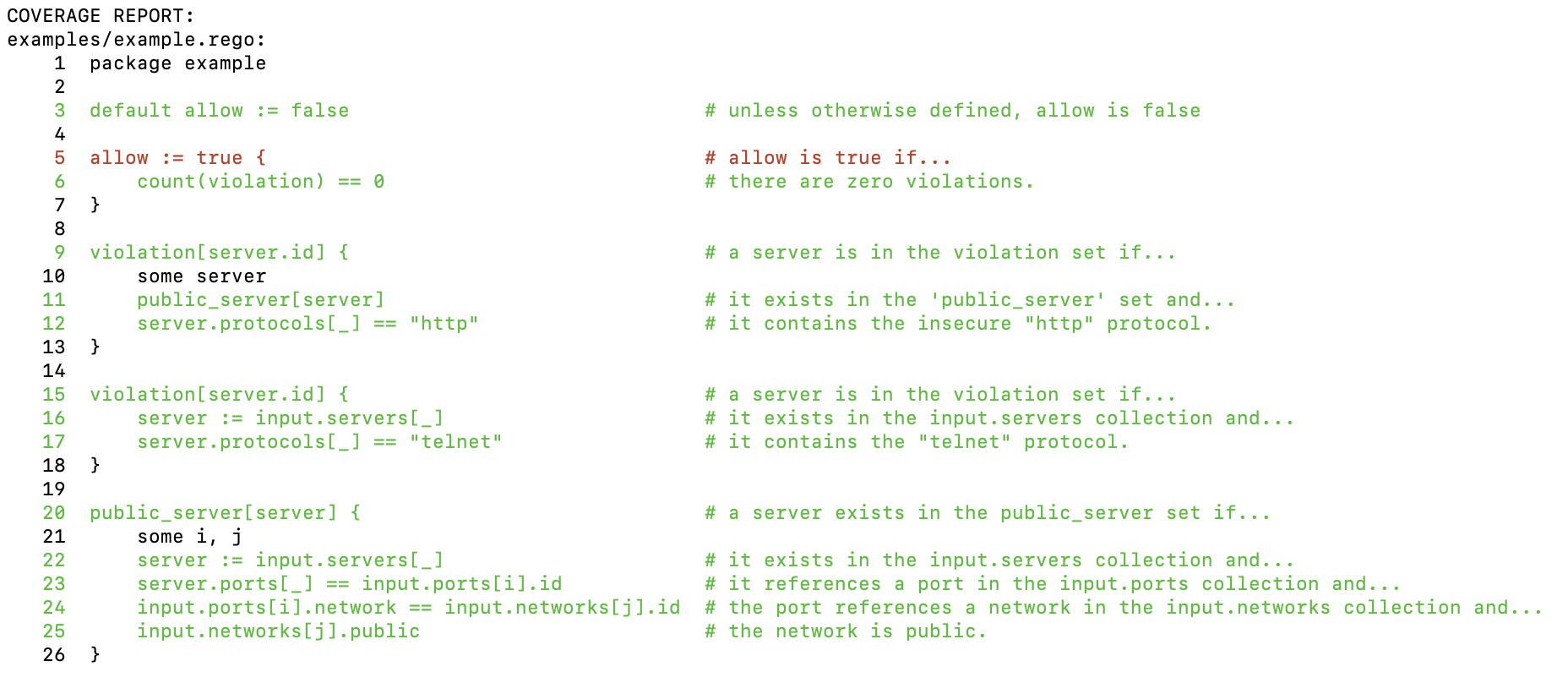
See Engine::get_coverage_report for details. Policy coverage information is useful for debugging your policy as well as to write tests for your policy so that all lines of the policy are exercised by the tests.
ACI Policies
Regorus successfully passes the ACI policy test-suite. It is fast and can run each of the tests in a few milliseconds.
$ cargo test -r --test aci
    Finished release [optimized + debuginfo] target(s) in 0.05s
    Running tests/aci/main.rs (target/release/deps/aci-2cd8d21a893a2450)
aci/mount_device                                  passed    3.863292ms
aci/mount_overlay                                 passed    3.6905ms
aci/scratch_mount                                 passed    3.643041ms
aci/create_container                              passed    5.046333ms
aci/shutdown_container                            passed    3.632ms
aci/scratch_unmount                               passed    3.631333ms
aci/unmount_overlay                               passed    3.609916ms
aci/unmo
