
Beelance
Autonomous and remotely connected weight scale for beehives 🐝
Install / Use
/learn @mathieucarbou/BeelanceREADME





- Beelance
- How to build
- How to install
- How to use
- Developer guide
- Contact
- Sponsors and partners
- Related projects, guides and articles
Beelance
Overview
Beelance comes from the French word "Balance" which means "weight scale".
Beelance is an autonomous and remotely connected weight scale for beehives 🐝. It can monitor the weight and temperature of beehives and send the data to a remote server or a Google Sheet (through IFTTT or alternative). Beelance supports 2 types of communication:
- either specific frequencies optimized for IoT devices (long-range, low bandwidth), called LTE-M and NB-IoT (especially useful for remote areas)
- or normal cellular phone frequencies with a normal SIM card using LTE / 4G
Device interface:
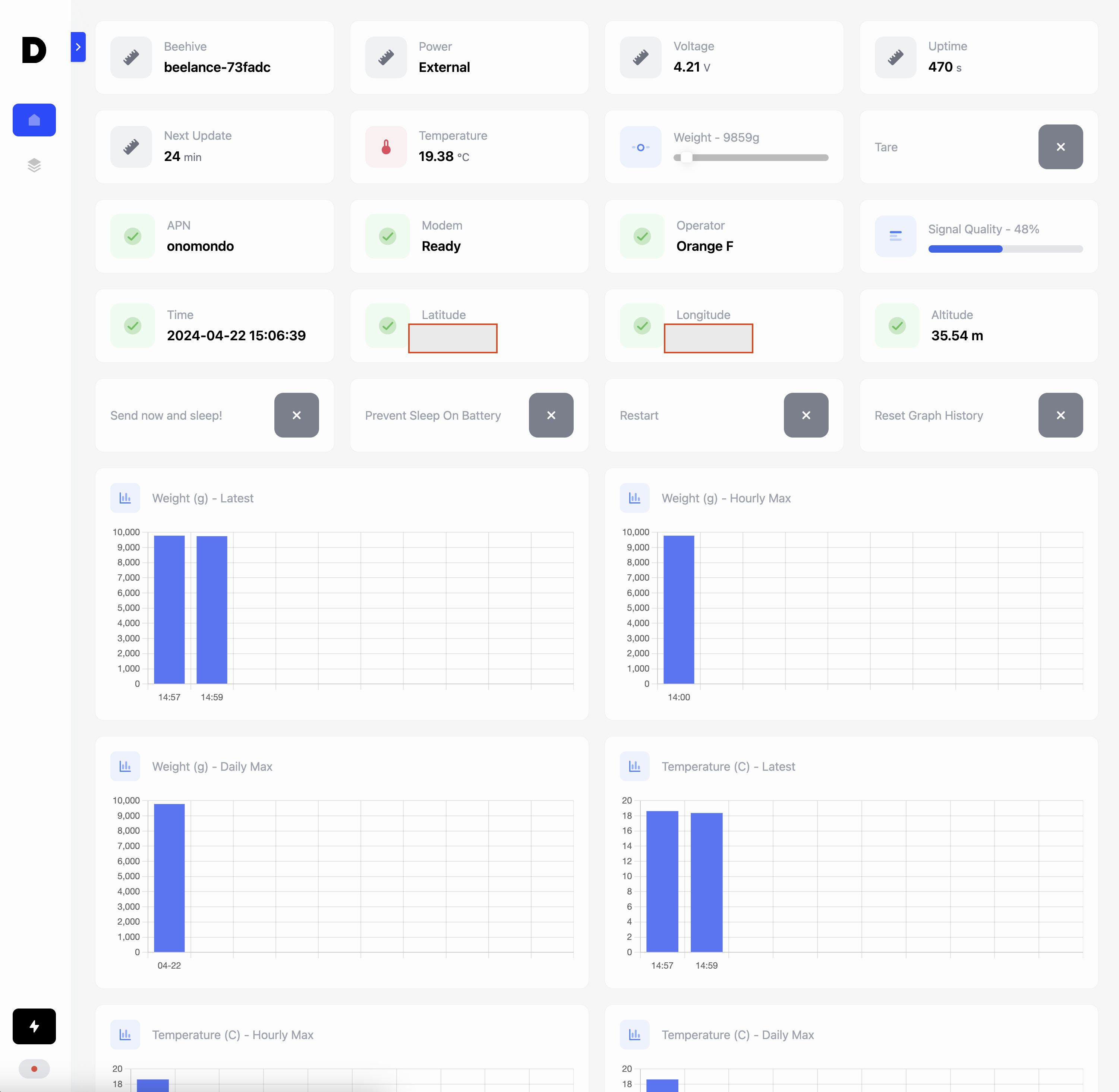
Example of Google Sheet receiving the data:
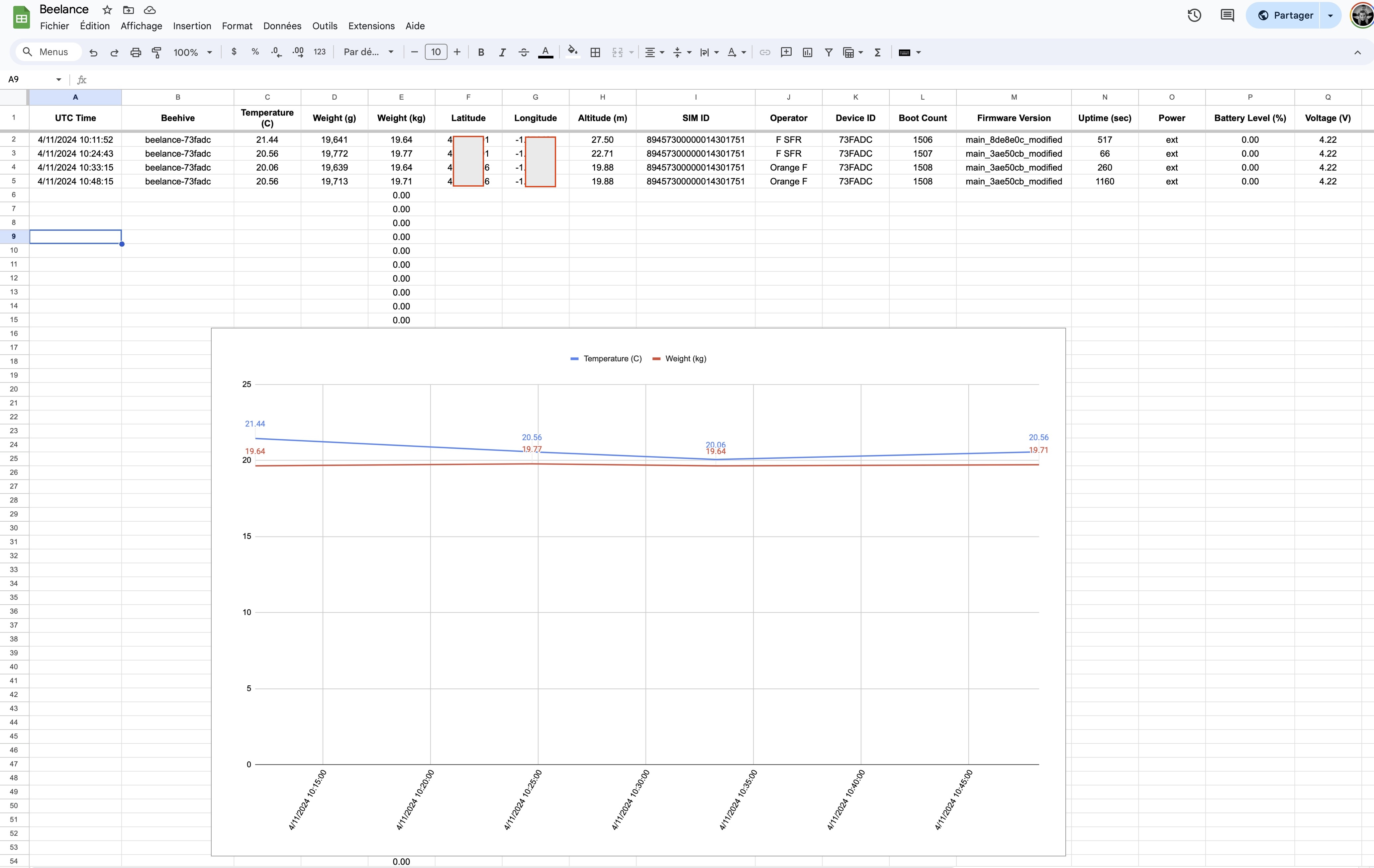
Features
Powering
Beelance can be powered by USB-C, USB-C Solar Panel or battery. On the field, it is recommended to use a Solar Panel to power the device. If a battery is used, the device will automatically switch to the battery when the solar panel is not providing enough power. Otherwise, the battery will be charged by the solar panel at the same time the solar panel powers the device.
Battery type: 3.7V 18650 LFP or Li-ion
Communication
Supported frequencies: CAT-M (LTE-M), NB-IOT, LTE, 4G
Normal cellular SIM cards or specialized M2M (IoT) SIM cards can be used.
Measurements
The device takes measurements and sends them periodically:
- Temperature (DS18B20 Temperature sensor)
- Weight of the beehive (with 4 load sensors and HX711 amplifier)
- GPS location and altitude
- Time
- Battery level and voltage
- Operator and SIM card information
It will also keep a local history of the 10 last measurements, the maximum values of the last 10 hours and the maximum values of the last 10 days, both for weight and temperature.
Configuration
The device has an access point, we can connect to it to:
- Access its dashboard to view the metrics and manage the device
- Update the firmware
- Backup and restore its configuration
- Configure the device:
- Beelance (beehive) name
- Time between each measurement push
- The URL to send the data to (optional)
- The APN of the connectivity provider
- The night hours to avoid sending data at night
- Activate Power saving mode (deep sleep between each push)
- etc
Integrations
The device can be configured to send its data to a remove server of your choice. It can also be an IFTTT webhook, which can then insert the data in a Google Sheet.
Downloads
Firmware downloads are available in the Releases page of the project.
Firmware files are named as follow:
Beelance-<VERSION>-<BOARD>.OTA.bin: the firmware used to update through web interfaceBeelance-<VERSION>-<BOARD>.FACTORY.bin: the firmware used to flash for the first time
Where:
VERSION: version, ormainfor the latest development buildBOARD: the board name
How to build
Connectivity provider
Beelance works with a SIM card, so you need to select your carrier:
- A IoT / M2M SIM card (with
LILYGO® T-SIM7080G S3 with GPS)- Cheaper if you have several beehives
- Better coverage: LTE-M and NB-IoT are special optimized bandwidth for IoT devices
- Requires to get SIM card from the right IoT / M2M provider
- A normal 4G SIM card from a traditional mobile operator (with
LILYGO® T-A7670G R2 with GPS)- Easier to setup (i.e. in France a cheap Free Mobile SIM card could work)
- Won't scale with many beehives, and can be more expensive
Here is a list of LTE-M / NB-IOT providers for France amd Europe:
-
- Supports all major carriers
- Compatible with T-SIM7080G-S3 for LTE-M and NB-IOT
- Compatible with T-A7670G R2 for 4G / LTE
-
- Supports all major carriers
- Compatible with T-SIM7080G-S3 for LTE-M and NB-IOT
- Compatible with T-A7670G R2 for 4G / LTE
- €1.60 / month / SIM + €0.30 / MB
-
- Supports all major carriers
- Compatible with T-SIM7080G-S3 for LTE-M and NB-IOT
- Compatible with T-A7670G R2 for 4G / LTE
- €0.01 / day / SIM + €0.005 / MB (Only pay for active SIMs. Disable or enable anytime, free of charge.)
-
- Supports all major carriers
- Compatible with T-SIM7080G-S3 for LTE-M and NB-IOT
- Compatible with T-A7670G R2 for 4G / LTE
- €1.10 / month / SIM + limit of 10 Mb/ month
-
- Supports all major carriers
- Compatible with T-SIM7080G-S3 for LTE-M and NB-IOT
- Compatible with T-A7670G R2 for 4G / LTE
- €10.00 once / SIM, once, valid for 10 years, includes 500 Mb
Here is a list of cheap standard mobile carrier providers for France amd Europe:
- Free Mobile
- €2.00 / month (free for Freebox users) + limit of 50 Mb / month
- Only 700 Mhz band
- Compatible with T-A7670G R2 for 4G / LTE
Beelance DATA consumption
The JSON payload sent from Beelance is more or less 250 bytes.
{
  "ts": 1731147105,
  "bh": "beelance-73fadc",
  "temp": 24.56,
  "wt": 0,
  "lat": 0,
  "long": 0,
  "alt": 0,
  "sim": "8944501905220523406f",
  "op": "Orange F",
  "dev": "73FADC",
  "boot": 36,
  "ver": "main_9203b08_modified",
  "up": 103,
  "pow": "ext",
  "bat": 0,
  "volt": 4.23,
  "eco": false
}
You also need to add the HTTP/HTTPS headers overhead, which can easily be at least 100 bytes.
content-length	238
content-type	application/json
user-agent	Arduino/2.2.0
host	webhook.site
HTTPS will also add more overhead because of the handshake and encryption. So it is recommended to use HTTP.
Beelance will send the data every 1 hour by default, and only between 5:00 AM and 11:00 PM. All these settings are configurable.
With the default settings on HTTP, Beelance will consume about 6300 bytes / day, so less than 200 Kb / month, so less than 3 Mb / year.
Shopping list
Hardware
- Pick one board:
- LTE-M / NB-IOT: LILYGO® T-SIM7080G S3 with GPS and PMU (AliExpress) - 42 euros
- LTE / 4G: LILYGO® T-A7670G R2 with GPS (AliExpress) - 47 euros
- Temperature Sensor: DS18B20 Cable + DS18B20 Adapter - 3 euros - SAMIORE Store
- Solar Panels - 33 euros for 2 items
- Weight scale: Set of 4x Load Sensors + HX711 - 6 euros - SAMIORE Store
- [Dupont Cable Kit](https://fr.aliexpress.com/item/169928
