
Lucid
Build scalable Laravel apps without compromising code quality and the least amount of technical debt. Effortless code navigation, onboarding and reviews. Tailored for Microservices and mindful of Monoliths.
Install / Use
/learn @lucidarch/LucidREADME
- Install: https://docs.lucidarch.site/installation
- Website: https://lucidarch.site
- Documentation: https://docs.lucidarch.site
- Social: we share updates & interesting content from the web
- Discord: Lucid
- Twitter: @lucid_arch & #lucidarch
- Reddit: /r/lucidarch
Table of Contents
About Lucid
Lucid is a software architecture to build scalable Laravel projects. It incorporates Command Bus and Domain Driven Design at the core, upon which it builds a stack of directories and classes to organize business logic. It also derives from SOA (Service Oriented Architecture) the notion of encapsulating functionality within a service and enriches the concept with more than the service being a class.
Use Lucid to:
- Write clean code effortlessly
- Protect your code from deterioriting over time
- Review code in fractions of the time typically required
- Incorporate proven practices and patterns in your applications
- Navigate code and move between codebases without feeling astranged
Concept
This architecture is in an amalgamation of best practices, design patterns and proven methods.
- Command Bus: to dispatch units of work. In Lucid terminology these units will be a
Feature,JoborOperation. - Domain Driven Design: to organize the units of work by categorizing them according to the topic they belong to.
- Service Oriented Architecture: to encapsulate and manage functionalities of the same purpose with their required resources (routes, controllers, views, datatbase migrations etc.)
If you prefer a video, watch the announcement at Laracon EU 2016:
<p align="center"> <a href="http://www.youtube.com/watch?v=wSnM4JkyxPw"> <img src="http://img.youtube.com/vi/wSnM4JkyxPw/0.jpg"> </a> </p>Table of Contents
Placement in Laravel
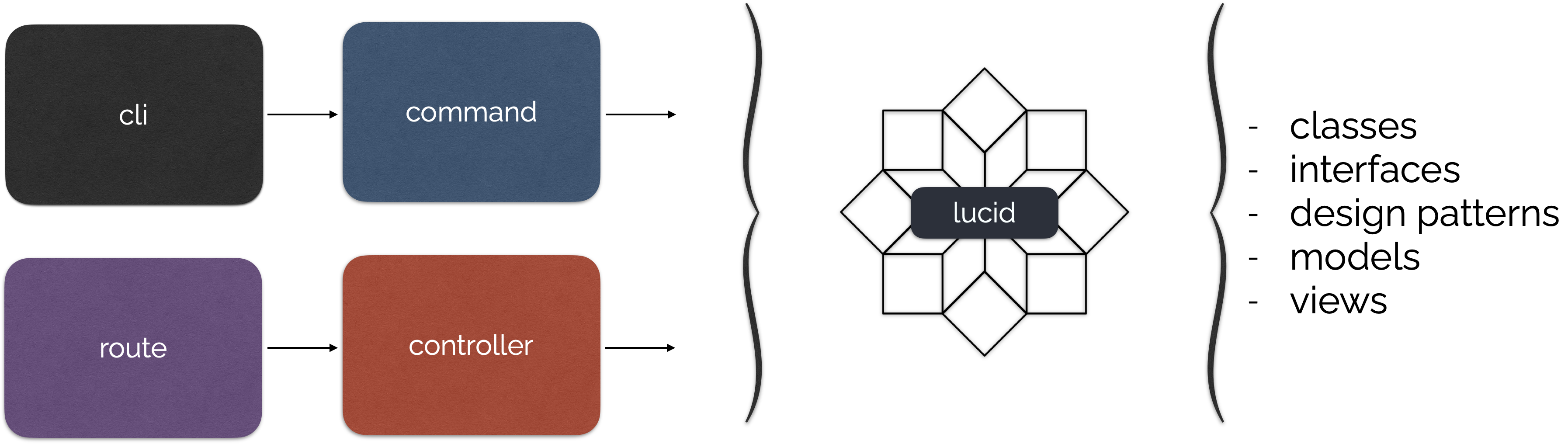
In a typical MVC application, Lucid will be the bond between the application's entrypoints and the units that do the work, securing code form meandring in drastic directions:
The Stack
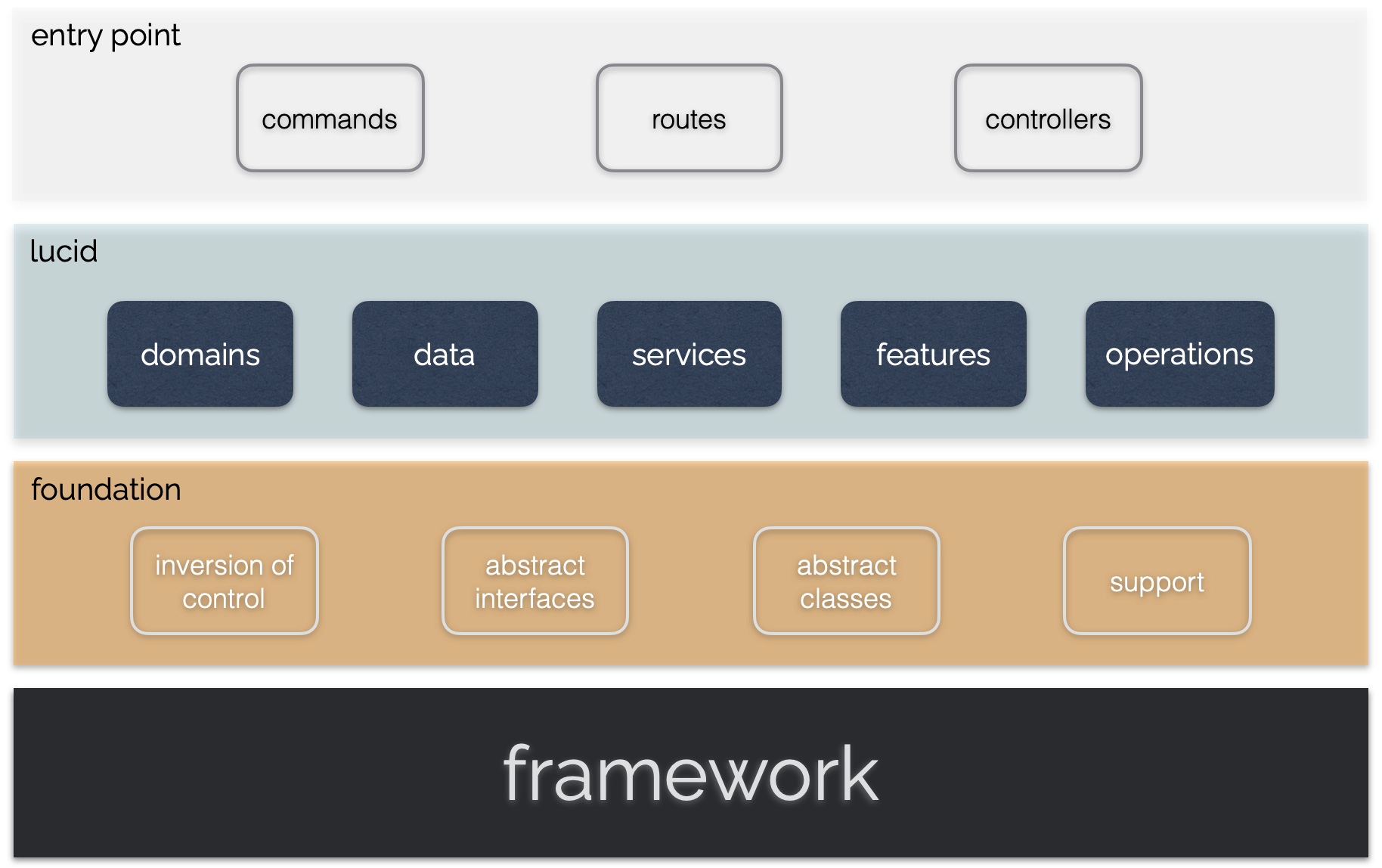
At a glance...
Framework
Provides the "kernel" to do the heavy lifting of the tedious stuff such as request/response lifecycle, dependency injection, and other core functionalities.
Foundation
Extends the framework to provide higher level abstractions that are custom to the application and can be shared across the entire stack rather than being case-specific.
Examples of what could go into foundation are:
DateTimea support class for common date and time functionsJsonSerializableInterfacethat is used to identify an object to be serializable from and to JSON format
Domains
Provide separation to categorize jobs and corresponding classes that belong to the same topic. A domain operates in isolation from other domains and exposes its functionalities to features and operations through Lucid jobs only.
Consider the structure below for an example on what a domain may look like:
app/Domains/GitHub
├── GitHubClient
├── Jobs
│   ├── FetchGitHubRepoInfoJob
│   └── LoginWithGitHubJob
├── Exceptions
│   ├── InvalidTokenException
│   └── RepositoryNotFoundException
└── Tests
    └── GitHubClientTest
    └── Jobs
        ├── FetchGitHubReposJobTest
        └── LoginWithGitHubJobTest
documentation contains more details on working with domains.
Services
Are directories rich in functionality, used to separate a [Monolith]({{<ref "/micro-vs-monolith/#monolith">}}) into areas of focus in a multi-purpose application.
Consider the example of an application where we enter food recipes and would want our members to have discussions in a forum, we would have two services: 1) Kitchen, 2) Forum where the kitchen would manage all that's related to recipes, and forum is obvious:
app/Services
├── Forum
└── Kitchen
and following is a single service's structure, highlighted are the Lucid specific directories:
<pre> app/Services/Forum ├── Console │ └── Commands ├── <strong>Features</strong> ├── <strong>Operations</strong> ├── Http │ ├── Controllers │ └── Middleware ├── Providers │ ├── KitchenServiceProvider │ ├── BroadcastServiceProvider │ └── RouteServiceProvider ├── <strong>Tests</strong> │ └── <strong>Features</strong> │ └── <strong>Operations</strong> ├── database │ ├── factories │ ├── migrations │ └── seeds ├── resources │ ├── lang │ └── views └── routes ├── api ├── channels ├── console └── web </pre>documentation has more examples of services and their contents.
Features
Represent a human-readable application feature in a class. It contains the logic that implements the feature but with the least amount of detail, by running jobs from domains and operations at the application or service level.
Serving the Feature class will be the only line in a controller's method (in MVC), consequently achieving the thinnest form of controllers.
class AddRecipeFeature extends Feature
{
    public function handle(AddRecipe $request)
    {
        $price = $this->run(CalculateRecipePriceOperation::class, [
            'ingredients' => $request->input('ingredients'),
        ]);

        $this->run(SaveRecipeJob::class, [
            'price' => $price,
            'user' => Auth::user(),
            'title' => $request->input('title'),
            'ingredients' => $request->input('ingredients'),
            'instructions' => $request->input('instructions'),
        ]);

        return $this->run(RedirectBackJob::class);
    }
}
documentation about features expands on how to serve them as classes from anywhere.
Operations
Their purpose is to increase the degree of code reusability by piecing jobs together to provide composite functionalities from across domains.
class NotifySubscribersOperation extends Operation
{
    private int $authorId;

    public function __construct(int $authorId)
    {
        $this->authorId = $authorId;
    }

    /**
     * Sends notifications to subscribers.
     *
     * @return int Number of notification jobs enqueued.
     */
    public function handle(): int
    {
        $author = $this->run(GetAuthorByIDJob::class, [
            'id' => $this->authorId,
        ]);

        do {

            $result = $this->run(PaginateSubscribersJob::class, [
                'authorId' => $this->authorId,
            ]);

            if ($result->subscribers->isNotEmpty()) {
                // it's a queueable job so it will be enqueued, no waiting time
                $this->run(SendNotificationJob::class, [
                    'from' => $author,
                    'to' => $result->subscribers,
                    'notification' => 'article.published',
                ]);
            }

        } while ($result->hasMorePages());

        return $result->total;
    }
}
documentation goes over this simple yet powerful concept.
Data
For a scalable set of interconnected data elements, we've created a place for them in app/Data,
because most likely over time writing the application there could develop a nee
Related Skills
node-connect
342.5kDiagnose OpenClaw node connection and pairing failures for Android, iOS, and macOS companion apps
frontend-design
85.3kCreate distinctive, production-grade frontend interfaces with high design quality. Use this skill when the user asks to build web components, pages, or applications. Generates creative, polished code that avoids generic AI aesthetics.
openai-whisper-api
342.5kTranscribe audio via OpenAI Audio Transcriptions API (Whisper).
qqbot-media
342.5kQQBot 富媒体收发能力。使用 <qqmedia> 标签,系统根据文件扩展名自动识别类型(图片/语音/视频/文件)。
