
LanczosNetwork
Lanczos Network, Graph Neural Networks, Deep Graph Convolutional Networks, Deep Learning on Graph Structured Data, QM8 Quantum Chemistry Benchmark, ICLR 2019
Install / Use
/learn @lrjconan/LanczosNetworkREADME
Lanczos Network
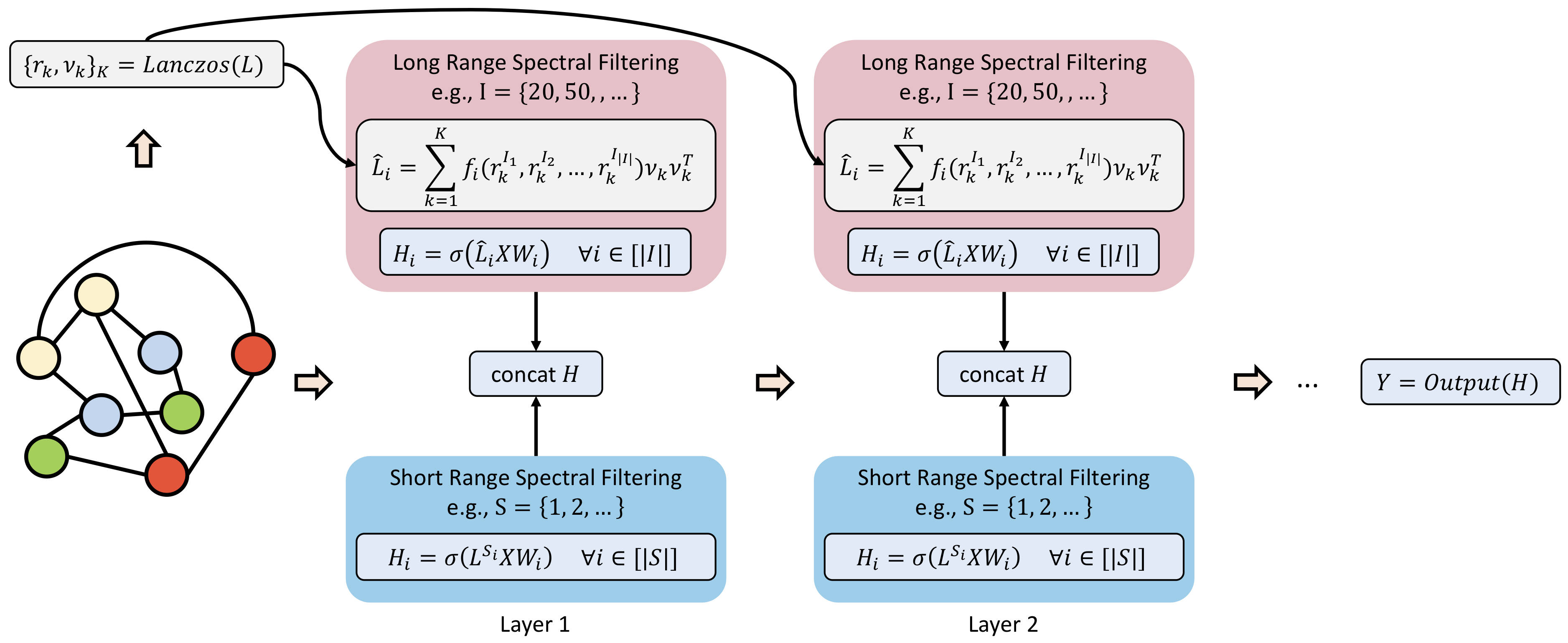
This is the PyTorch implementation of Lanczos Network as described in the following ICLR 2019 paper:
@inproceedings{liao2019lanczos,
  title={LanczosNet: Multi-Scale Deep Graph Convolutional Networks},
  author={Liao, Renjie and Zhao, Zhizhen and Urtasun, Raquel and Zemel, Richard},
  booktitle={ICLR},
  year={2019}
}
Visualization
Benchmark
We also provide our own implementation of 9 recent graph neural networks on the QM8 benchmark:
- graph convolution networks for fingerprint (GCN-FP)
- gated graph neural networks (GGNN)
- diffusion convolutional neural networks (DCNN)
- Chebyshev networks (ChebyNet)
- graph convolutional networks (GCN)
- message passing neural networks (MPNN)
- graph sample and aggregate (GraphSAGE)
- graph partition neural networks (GPNN)
- graph attention networks (GAT)
You should be able to reproduce the following results of weighted mean absolute error (MAE x 1.0e-3):
| Methods | Validation MAE | Test MAE | | ------------- |:----------------:|:----------------:| | GCN-FP | 15.06 +- 0.04 | 14.80 +- 0.09 | | GGNN | 12.94 +- 0.05 | 12.67 +- 0.22 | | DCNN | 10.14 +- 0.05 | 9.97 +- 0.09 | | ChebyNet | 10.24 +- 0.06 | 10.07 +- 0.09 | | GCN | 11.68 +- 0.09 | 11.41 +- 0.10 | | MPNN | 11.16 +- 0.13 | 11.08 +- 0.11 | | GraphSAGE | 13.19 +- 0.04 | 12.95 +- 0.11 | | GPNN | 12.81 +- 0.80 | 12.39 +- 0.77 | | GAT | 11.39 +- 0.09 | 11.02 +- 0.06 | | LanczosNet | 9.65 +- 0.19 | 9.58 +- 0.14 | | AdaLanczosNet | 10.10 +- 0.22 | 9.97 +- 0.20 |
Note:
- Above results are averaged over 3 runs with random seeds {1234, 5678, 9012}
Setup
To set up experiments, we need to download the preprocessed QM8 data and build our customized operators by running the following scripts:
./setup.sh
Note:
- We also provide the script
dataset/get_qm8_data.pyto preprocess the raw QM8 data which requires the installation of DeepChem. It will produce a different train/dev/test split than what we used in the paper due to the randomness of DeepChem. Therefore, we suggest using our preprocessed data for a fair comparison.
Dependencies
Python 3, PyTorch(1.0)
Other dependencies can be installed via
pip install -r requirements.txt
Run Demos
Train
-
To run the training of experiment
XwhereXis one of {qm8_lanczos_net,qm8_ada_lanczos_net, ...}:python run_exp.py -c config/X.yaml
Note:
- Please check the folder
configfor a full list of configuration yaml files. - Most hyperparameters in the configuration yaml file are self-explanatory.
Test
-
After training, you can specify the
test_modelfield of the configuration yaml file with the path of your best model snapshot, e.g.,test_model: exp/qm8_lanczos_net/LanczosNet_chemistry_2018-Oct-02-11-55-54_25460/model_snapshot_best.pth -
To run the test of experiments
X:python run_exp.py -c config/X.yaml -t
Run on General Graph Datasets
I provide an example code for a synthetic graph regression problem, i.e., given multiple graphs, each of which is accompanied with node embeddings, it is required to predict a real-valued graph embedding vector per graph.
-
To generate the synthetic dataset:
cd datasetPYTHONPATH=../ python get_graph_data.py -
To run the training:
python run_exp.py -c config/graph_lanczos_net.yaml
Note:
- Please read
dataset/get_graph_data.pyfor more information on how to adapt it to your own graph datasets. - I only add support to LanczosNet by slightly modifying the learnable node embedding to the input node embedding in
model/lanczos_net_general.py. It should be straightforward for you to add support to other models if you are interested.
Cite
Please cite our paper if you use this code in your research work.
Questions/Bugs
Please submit a Github issue or contact rjliao@cs.toronto.edu if you have any questions or find any bugs.
Related Skills
proje
Interactive vocabulary learning platform with smart flashcards and spaced repetition for effective language acquisition.
YC-Killer
2.7kA library of enterprise-grade AI agents designed to democratize artificial intelligence and provide free, open-source alternatives to overvalued Y Combinator startups. If you are excited about democratizing AI access & AI agents, please star ⭐️ this repository and use the link in the readme to join our open source AI research team.
API
A learning and reflection platform designed to cultivate clarity, resilience, and antifragile thinking in an uncertain world.
openclaw-plugin-loom
Loom Learning Graph Skill This skill guides agents on how to use the Loom plugin to build and expand a learning graph over time. Purpose - Help users navigate learning paths (e.g., Nix, German)
