
MiniSpark
Java implementation of a mini Spark-like framework named MiniSpark that can run on top of a HDFS cluster. MiniSpark supports operators including Map, FlatMap, MapPair, Reduce, ReduceByKey, Collect, Count, Parallelize, Join and Filter.
Install / Use
/learn @linzebing/MiniSparkREADME
Final Write Up Proposal and Checkpoint
Team member: Zebing Lin (zebingl)
Summary
I implemented a mini Spark-like framework named MiniSpark that can run on top of a HDFS cluster. MiniSpark supports operators including Map, FlatMap, MapPair, Reduce, ReduceByKey, Collect, Count, Parallelize, Join and Filter. The Github repo is https://github.com/linzebing/MiniSpark.
Rdd fault tolerance and worker fault tolerance are supported.
Background
Google's MapReduce has been very successful in implementing large-scale data-intensive applications, however it's deficient in iterative jobs/analytics, due to the fact that MapReduce has to write intermeidate results to HDFS, incurring sigificant performance penalty. By introducing the concepts of resilient distributed dataset (RDD), Spark reuses working sets of data across multiple parallel operations, therefore enhancing the overall performance.
Data locality of Spark lies in HDFS data locality and locality preserving in applying transformaitons on RDDs (more on this later). The parallelism of Spark comes from multi-machine parallelism and multi-core parallelism. To be more specific, see the graph below 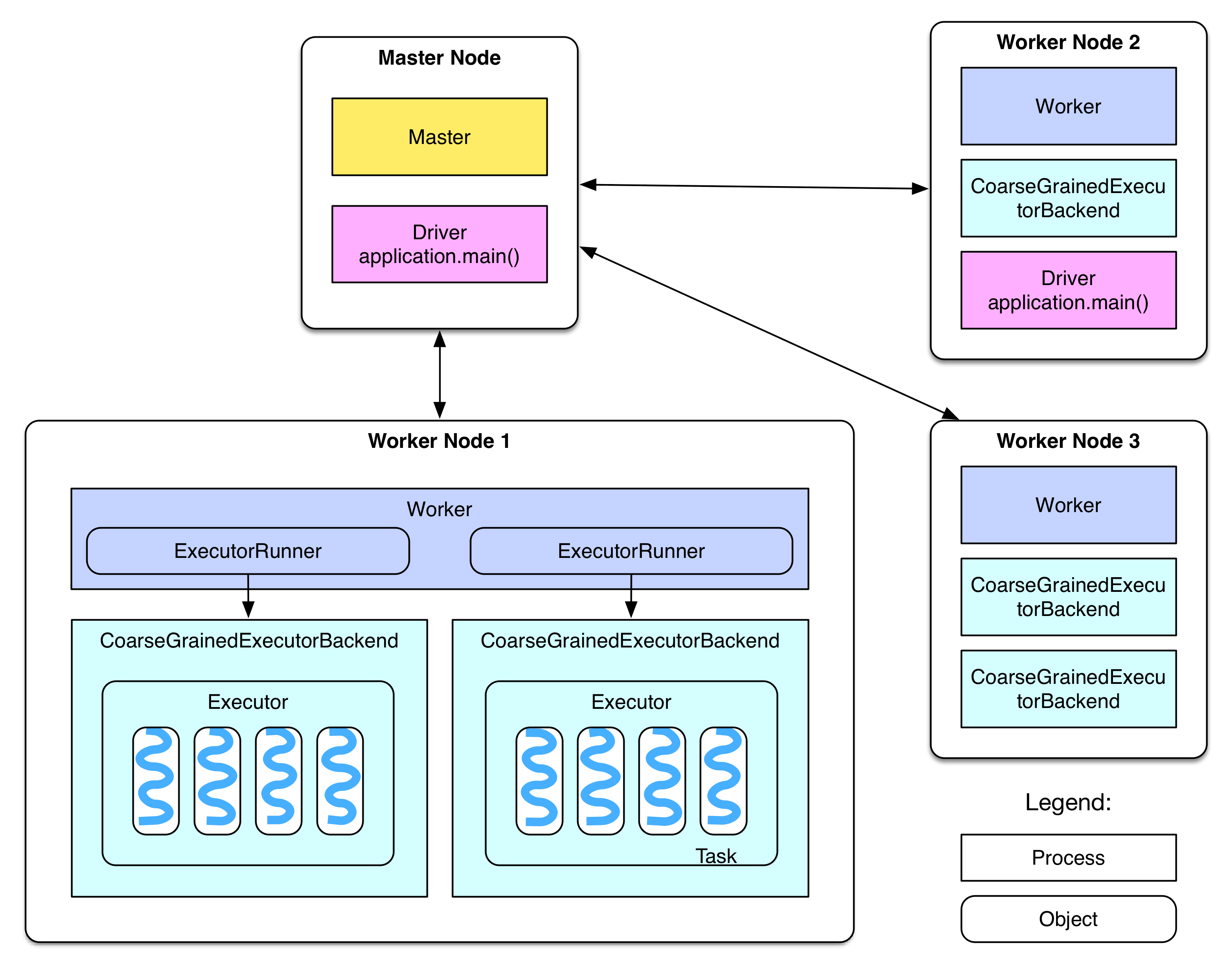
Spark Overview
Essentially, Spark's master node will manage a bunch of worker nodes, and inside each node, there are several executors (usually equal to the number of cores). The driver program on the master will distribute computations to the executors on these workers, therefore leveraging both levels of parallelism.
Data is abstracted into RDDs. More specifically, it's splited in some way into partitions in the workers' memory. Each executor's execution will be on the granularity of a partition. There are two dependency types between RDDs. Wide dependency means the partition relies on multiple partitions of its parent RDD, while Narrow dependency means the partition relies on a single partiton of its parent RDD.
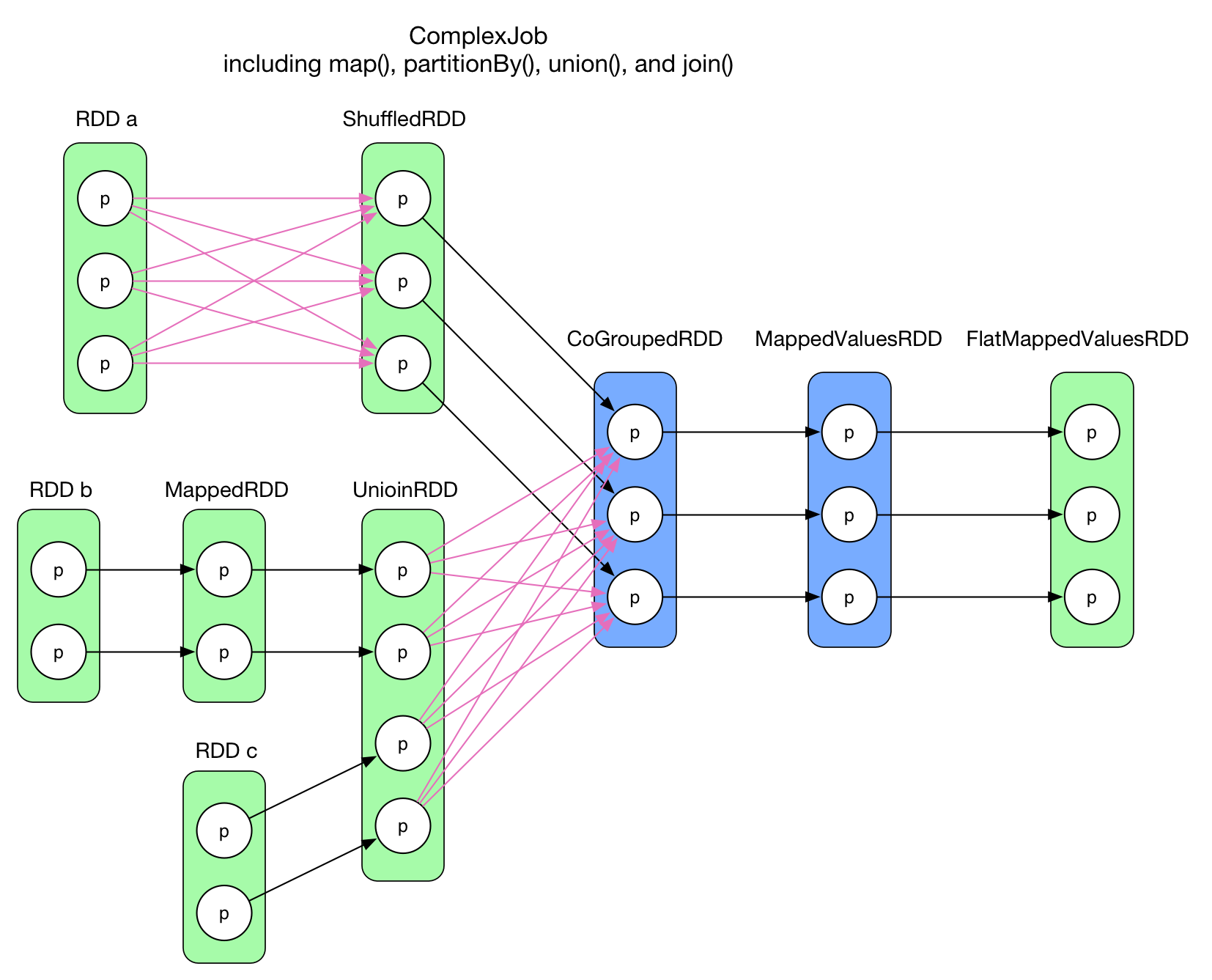
Spark Execution
Approach
 System Architecture of MiniSpark. Scheduler/Master is on the name node of the HDFS cluster. Each worker node is also a data node in the HDFS cluster.
RDD Data Abstraction
  class Partition {
    public int partitionId; // Unique identifier of a partition
    public String hostName; // Worker Machine DNS of the partition
  }

  public class Rdd {
    public DependencyType dependencyType; // Wide or Narrow
    public OperationType operationType; // Map, Reduce, FlatMap...
    public Rdd parentRdd; // Rdd that this current Rdd is derived from
    public int numPartitions; // Number of Partitions
    public String function; // Function name for Map, Reduce…
    public ArrayList<ArrayList<String>> hdfsSplitInfo;
    public ArrayList<Partition> partitions; // Partition Info
    ......
  }
The RDD data structure maintains parentRdd to track the RDD that this current RDD is derived from. function keeps the name of input function literal (I used reflection to pass function literals). partitions keeps track of partition information of the RDD, each with a unique paritition ID and its worker machine's host name.
Scheduler
Scheduler builds the lineages of RDDs and track the lineage across a wide range of transformations. When a RDD action is invoked, the scheduler will examine the full lineage of the RDD and identify an execution order.

Lineage Graph of a Spark Program
Scheduling process following the following steps:
- Extracting stages before a wide dependency. The RDD that is wide dependent on has to be materialized first to enable further operations.
- Trace back the dependent RDDs in a recursive fashion and aggregate lineages. As MiniSpark doesn't support union and join yet, therefore each RDD will only depend on one parent RDD. If MiniSpark has to support union and join, then we should build a DAG of the lineage, and apply transformation in topologically order.
- Send aggregated lineages, execute stages and apply partition transformations in parallel.
When scheduler has to assign a job, it will prefer worker with data stored on the machine.
Master
Master maintains status of workers and commmunicates with workers via RPC calls. I used Apache Thrift to enable RPC communication between master and workers (and workers and workers as well!). The master keeps states of jobs running on workers, and always try to allocate jobs to the least-loaded machine to achieve load balacning, while taking data locality into account.
Workers
Workers will read data from HDFS, parallelized arrays from master or shuffled partitions from other workers. It will perform computation according to the received lineages and store the results in memory. The workers' jobs are decided by scheduler and distributed by the master.
Each worker has a hash map, which maps partition ID to partition data. Note that to preserve data locality and reduce memory footprints, it will not materialize intermmediate RDDs unless being given a cache hint. It will find the most recent RDD that is still in memory, and apply transformations in a streamingly fashion. I used reflection to pass function literals.
Parallelization and Optimization
Multi-machine Parallelism
Thrfit RPC calls are synchronous. To enable cross-worker parallelism, I spawn a thread for each RPC call. As Thrift client calls are thread-unsafe, the same number of clients per machine are set up in advance, and each will be used by a RPC call at time. Generally, RPC call threads will wait to acquire locks of these clients, and the workers will always be fully loaded.
Multi-core Parallelism
Multi-core parallelism is provided by Thrift RPC server. It will automatically spawn threads for each RPC call:
TServer server = new TThreadPoolServer(new TThreadPoolServer.Args(serverTransport).processor(processor));
The scheduler will never be overloaded with more threads than #cores, guaranteed by the scheduler/master.
Optimization
The most important optimization is to process narrowly dependent RDDs in a streaming fashion, rather than invoke a RPC call for every transformation (which will materialize intermediate RDDs). This great benefits data locality and reduces memmory footprint, and will provide around 3-4x speedup if the lineage is long. Another optimization is to precompute the reflection methods instead of computing it in every iteration in traversal of a partition.
Results
Experiments were conducted on AWS using the r3.xlarge (4 vCPUs, 30GB memory) instance type. HDFS cluster was set up through AWS EMR.
Application 1: WordCount
WordCount is the most commonly used example of MapReduce/Spark. The following code counts the words that start/end with "15618" from a 22GB text file (source). It's both I/O intesnive and computation heavy.
  public static String toLower(String s) {
    return s.toLowerCase();
  }

  public static ArrayList<String> flatMapTest(String s) {
    return new ArrayList<String>(Arrays.asList(s.split(" ")));
  }

  public static double add(double a, double b) {
    return a + b;
  }

  public static boolean contains15618(String s) {
    return s.endsWith("15618") || s.startsWith("15618");
  }

  public static void WordCount() throws IOException, TException {
    SparkContext sc = new SparkContext("Example");
    Rdd lines = sc.textFile("webhdfs://ec2-52-204-239-211.compute-1.amazonaws.com/test.txt")
        .flatMap("flatMapTest").map("toLower").filter("contains15618")
        .mapPair("mapCount").reduceByKey("add");
    Long start = System.currentTimeMillis();
    List<StringNumPair> output = (List<StringNumPair>) lines.collect();
    for (StringNumPair pair: output) {
      System.out.println(pair.str + " " + (int) pair.num);
    }
    Long end = System.currentTimeMillis();
    System.out.println("Time elapsed: " + (end - start) / 1000.0 + "seconds");
    sc.stop();
  }

  public static StringNumPair mapCount(String s) {
    return new StringNumPair(s, 1);
  }
Application 2: Estimate π
Pi can be estimated using a Monte Carlo approach. The following code performs 20 billion Monte Carolo iterations. It's computational intensive. Note the use of ThreadLocalRandom, it's used to avoid contention on a single lock of Random.
  public static StringNumPair monteCarlo(String s) {
    Long start = System.currentTimeMillis();
    int total = 250000000;
    int cnt = 0;
    ThreadLocalRandom threadLocalRandom = ThreadLocalRandom.current();
    for (int i = 0; i < total; ++i) {
      double x = threadLocalRandom.nextDouble(1);
      double y = threadLocalRandom.nextDouble(1);
      if (x * x + y * y < 1) {
        ++cnt;
      }
    }
    Long end = System.currentTimeMillis();
    System.out.println("Time elapsed: " + (end - start) / 1000.0 + "seconds");
    return new StringNumPair(s, 4.0 * cnt / total);
  }

  public static void SparkPi() throws IOException, TException {
    int NUM_SAMPLES = 80;
    SparkContext sc = new SparkContext("SparkPi");
    ArrayList<String> l = new ArrayList<>(NUM_SAMPLES);
    for (int i = 0; i < NUM_SAMPLES; ++i) {
      l.add(String.valueOf(i));
    }
    Long start = System.currentTimeMillis();
    double sum = sc.parallelize(l).mapPair("monteCarlo").reduce("add");
    Long end = System.currentTimeMillis();
    System.out.println("Estimation of pi is: " + sum / NUM_SAMPLES);
    System.out.println("Time elapsed: " + (end - start) / 1000.0 + "seconds");
    sc.stop();
  }
Scalability
Sequential baseline version of WordCount i
