Infresnel
Computation of the Fresnel number for infrasound applications
Install / Use
/learn @liamtoney/InfresnelREADME
infresnel





infresnel is a Python package which facilitates computation of the Fresnel number for infrasound applications — specifically, propagation over topography at local to regional scales.
<p align="middle"> <img src="example_figures/yasur_dem_paths.png" height="430"/> <img src="example_figures/yasur_path_comparison.png" height="430"/> </p>Background and motivation
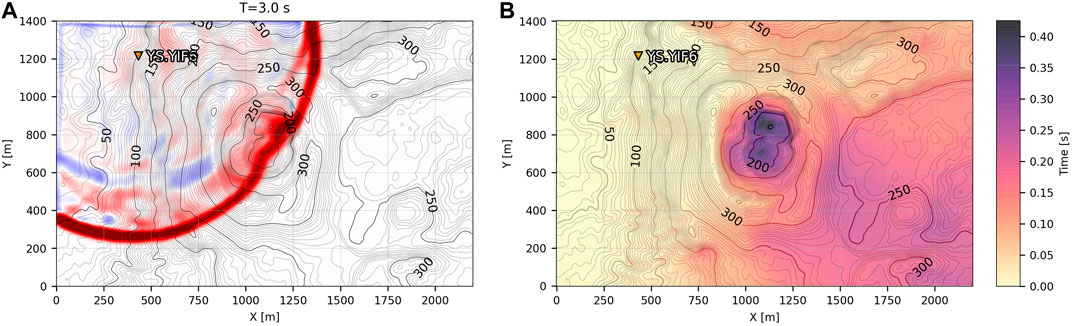
The dimensionless Fresnel number $N$ for an acoustic wave with wavelength $\lambda$ is given by $$N = \frac{(R_\mathrm{f} - R_\mathrm{d})}{\lambda / 2},$$ where $R_\mathrm{f}$ is the length of the shortest diffracted path over topography, and $R_\mathrm{d}$ the length of the direct path (i.e., line-of-sight slant distance), from source to receiver (Maher et al., 2021). In words, the Fresnel number is the extra distance a wave must travel due to topography, normalized by half a wavelength. The path length difference $(R_\mathrm{f} - R_\mathrm{d})$ can additionally be used to estimate travel time delays due to diffraction over topography. The travel time delay $\delta_\mathrm{f}$ is given by $$\delta_\mathrm{f} = \frac{(R_\mathrm{f} - R_\mathrm{d})}{c},$$ where $c$ is the estimated acoustic wavespeed assuming a homogenous atmosphere. $\delta_\mathrm{f}$ has been shown to be comparable to travel time differences computed using finite-difference time-domain simulations — e.g., see Fig. 2B in Fee et al. (2021).
$N$ can be used to estimate the loss of infrasound energy due to diffraction over topography — the "insertion loss" — via application of empirical scaling relationships. See Maher et al. (2021) for a thorough discussion of these various empirical relationships, and their limitations, in the context of volcano infrasound.
These are simple equations, but the practical computation of the quantity $(R_\mathrm{f} - R_\mathrm{d})$ is somewhat involved. The goal of infresnel is to make this computation as quick and convenient as possible.
Quickstart
-
Obtain
git clone https://github.com/liamtoney/infresnel.git cd infresnel -
Create environment, install, and activate (install conda first, if necessary)
conda env create conda activate infresnel -
Run using the Python interpreter
python
>>> from infresnel import calculate_paths
Usage
Interactive API reference documentation for infresnel can be found here.
Additionally, several interactive notebooks containing usage examples are
included in notebooks. To open the notebooks, with your conda
environment activated run
jupyter lab notebooks
Alternatively, you can run these notebooks in your browser — without installing infresnel — by navigating to the project's Binder.
Assumptions
infresnel calculates path length differences using elevation profiles. This means that all diffraction is assumed to take place in the vertical plane between source and receiver. One can easily construct scenarios where this assumption is violated. For example, consider a column of rock much taller than it is wide, located directly between source and receiver. For this scenario, infresnel would predict a large path length difference for waves traveling over the top of the column — but in reality, wavefronts diffract laterally around the column. The true travel time from source to receiver is thus much smaller than what infresnel predicts for this scenario.
Citing
If you use infresnel in research that leads to a published manuscript, please cite the tool:
Toney, L. (2025). infresnel (v0.3.1). Zenodo. https://doi.org/10.5281/zenodo.14872984
To cite a previous version of infresnel, go to the Zenodo page, select the version, and use the "Cite as" tool there.
Installation details
infresnel's dependencies are:
- colorcet (for perceptually accurate colormaps to use in the creation of GeoTIFF path length difference grids)
- ipympl
- ipywidgets
- joblib (for parallel processing)
- JupyterLab (for running the
interactive
.ipynbnotebooks) - Matplotlib (for applying colormaps to GeoTIFFs and for generally plotting results)
- Numba (for computational acceleration)
- pip
- PyGMT (for simplified SRTM data downloading and caching)
- rioxarray (for DEM file I/O, reprojection, and elevation profile interpolation)
- tqdm (for displaying progress bars)
These dependencies are listed in environment.yml, and they are
installed in step 2 above.
You might want to install infresnel into an existing conda environment, instead of making a new one. In this case, after step 1 above run
conda activate <existing_environment>
pip install --editable .
which uses pip to install infresnel's dependencies, if you don't already have them installed in your existing environment.
In either case, your installation will be "editable." This means that you can modify the
source code in your local infresnel directory — or run a git pull to update with
any new remote changes — and the installed package will be updated. To instead use a
specific release of infresnel, run
git switch -d vX.Y.Z
between steps 1 and 2, where vX.Y.Z is the release version (e.g., v0.1.0). You can
switch back with git switch main.
Contributing
If you notice a bug with infresnel (or if you'd like to request/propose a new
feature), please
create an issue on GitHub
(preferred) or email me at liam@liam.earth. You are also
welcome to create a
pull request.
To install infresnel's development packages, with your conda environment activated run
pip install --requirement requirements.txt
nbdime config-git --enable  # Configure Jupyter Notebook diffs
References
Fee, D., Toney, L., Kim, K., Sanderson, R. W., Iezzi, A. M., Matoza, R. S., De Angelis, S., Jolly, A. D., Lyons, J. J., & Haney, M. (2021). Local explosion detection and infrasound localization by reverse time migration using 3-D finite-difference wave propagation. Frontiers in Earth Science, 9. https://doi.org/10.3389/feart.2021.620813
Maher, S. P., Matoza, R. S., de Groot-Hedlin, C., Kim, K., & Gee, K. L. (2021). Evaluating the applicability of a screen diffraction approximation to local volcano infrasound. Volcanica, 4(1), 67–85. https://doi.org/10.30909/vol.04.01.6785
Acknowledgements
This work was supported by the Nuclear Arms Control Technology (NACT) program at the Defense Threat Reduction Agency (DTRA). Cleared for release.
Related Skills
node-connect
353.3kDiagnose OpenClaw node connection and pairing failures for Android, iOS, and macOS companion apps
frontend-design
111.7kCreate distinctive, production-grade frontend interfaces with high design quality. Use this skill when the user asks to build web components, pages, or applications. Generates creative, polished code that avoids generic AI aesthetics.
openai-whisper-api
353.3kTranscribe audio via OpenAI Audio Transcriptions API (Whisper).
qqbot-media
353.3kQQBot 富媒体收发能力。使用 <qqmedia> 标签,系统根据文件扩展名自动识别类型(图片/语音/视频/文件)。