
Kpt
Automate Kubernetes Configuration Editing
Install / Use
/learn @kptdev/KptREADME

kpt: Automate Kubernetes Configuration Editing
kpt is a package-centric toolchain that enables a WYSIWYG configuration authoring, automation, and delivery experience, which simplifies managing Kubernetes platforms and KRM-driven infrastructure (e.g., Config Connector, Crossplane) at scale by manipulating declarative Configuration as Data.
Configuration as Data is an approach to management of configuration which:
- makes configuration data the source of truth, stored separately from the live state
- uses a uniform, serializable data model to represent configuration
- separates code that acts on the configuration from the data and from packages / bundles of the data
- abstracts configuration file structure and storage from operations that act upon the configuration data; clients manipulating configuration data don’t need to directly interact with storage (git, container images).
See the FAQ for more details about how kpt is different from alternatives.
Use our public Dosu space to ask anything about kpt.
Why kpt?
kpt enables WYSIWYG editing and interoperable automation applied to declarative configuration data, similar to how the live state can be modified with imperative tools.
See the rationale for more background.
The best place to get started and learn about specific features of kpt is to visit the kpt website.
Install kpt
kpt installation instructions can be found on kpt.dev/installation/kpt-cli
kpt components
The kpt toolchain includes the following components:
-
kpt CLI: The kpt CLI supports package and function operations, and also deployment, via either direct apply or GitOps. By keeping an inventory of deployed resources, kpt enables resource pruning, aggregated status and observability, and an improved preview experience.
-
Function SDK: Any general-purpose or domain-specific language can be used to create functions to transform and/or validate the YAML KRM input/output format, but we provide SDKs to simplify the function authoring process in Go.
-
Function catalog: A catalog of off-the-shelf, tested functions. kpt makes configuration easy to create and transform, via reusable functions. Because they are expected to be used for in-place transformation, the functions need to be idempotent.
Roadmap
You can read about the big upcoming features in the roadmap doc.
Contributing
If you are interested in contributing please start with contribution guidelines.
Contact
We would love to keep in touch:
- Join our Slack channel. You'll need to join Kubernetes on Slack first.
- Join our Discussions
- Join our community meetings
License
Code is under the Apache License 2.0, documentation is CC BY 4.0.
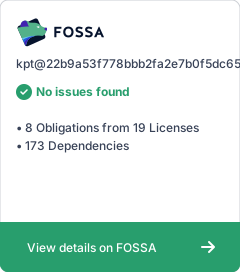
License scanning status
Governance
The governance of the kpt project and KRM Functiona Catalog are described in the governance repo.
Code of Conduct
The kpt project and the KRM Functions Catalog are following the CNCF Code of Conduct. More information and links about the CNCF Code of Conduct are here.
CNCF
The kpt project including the KRM Functions Catalog is a CNCF Sandbox project.
Related Skills
node-connect
334.1kDiagnose OpenClaw node connection and pairing failures for Android, iOS, and macOS companion apps
frontend-design
82.1kCreate distinctive, production-grade frontend interfaces with high design quality. Use this skill when the user asks to build web components, pages, or applications. Generates creative, polished code that avoids generic AI aesthetics.
openai-whisper-api
334.1kTranscribe audio via OpenAI Audio Transcriptions API (Whisper).
commit-push-pr
82.1kCommit, push, and open a PR
