
BodyPixSentis
BodyPix for Unity Sentis
Install / Use
npx skills add keijiro/BodyPixSentisInstalls into whichever agent you are using.
README
BodyPixSentis
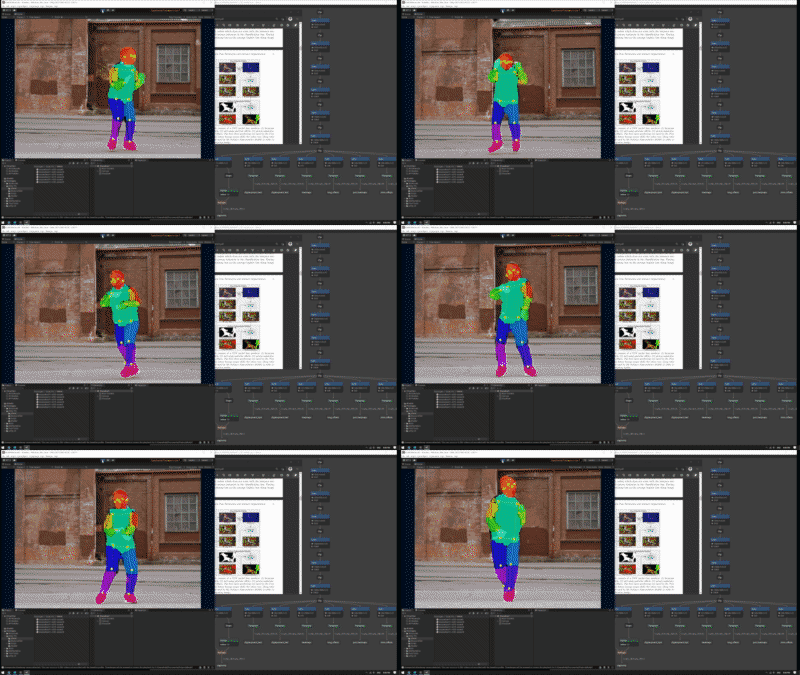

BodyPixSentis provides person segmentation and pose estimation based on the BodyPix model. It runs on Sentis, Unity's neural network runtime for real-time applications.
Requirements
- Unity 6.0 or newer
- GPU with compute shader support
BodyPixSentis uses GPU inference only. WebGL is not supported because it does not provide compute shader support.
Installation
Install the BodyPixSentis package (jp.keijiro.bodypix) from the "Keijiro"
scoped registry by using the Unity Package Manager. To add the registry to your
project, follow these instructions.
Sample Overview
The repository includes two sample scenes:
Assets/Visualizer.unity: Segmentation mask visualization.Assets/Keypoints.unity: Keypoint visualization.
These samples are configured to keep the main output path on the GPU. The
segmentation mask is consumed as RenderTexture and keypoints are available as
GraphicsBuffer, so rendering can proceed without mandatory CPU readback.
This GPU-only path is the primary reason for the high runtime performance.
API Usage
// Create a detector with a model resource set and processing dimensions.
var detector = new BodyPix.BodyDetector(resourceSet, 512, 384);

// Run inference on an input image texture.
detector.ProcessImage(inputTexture);

// Segmentation mask output texture.
var mask = detector.MaskTexture;

// Keypoint output GraphicsBuffer (GPU-side).
var keypointBuffer = detector.KeypointBuffer;

// Keypoint output data (with CPU readback).
var nose = detector.Keypoints[(int)BodyPix.Body.KeypointID.Nose];

// Dispose the detector and associated resources.
detector.Dispose();
detector = null;
Supported Models
The BodyPixSentis package includes lightweight MobileNet models:
- MobileNetV1-x050-stride8
- MobileNetV1-x050-stride16
- MobileNetV1-x075-stride8
- MobileNetV1-x075-stride16
- MobileNetV1-x100-stride8
- MobileNetV1-x100-stride16
The width multiplier (x050, x075, x100) controls model capacity. Larger
multipliers generally improve accuracy, but increase computation cost.
The stride value controls output resolution. stride8 usually produces more
detailed results than stride16, but requires more computation.
BodyPixSentis also supports ResNet-based models. These models provide higher accuracy, but they are larger and slower than MobileNet models. Because of GitHub and npm.js file size limits, ResNet ONNX files are not included in this repository. Download them from the Releases page.
Model Conversion
The original BodyPix model is distributed in TensorFlow.js format. Convert it to ONNX by using tfjs-to-tf and tf2onnx. For the detailed conversion procedure, refer to the Colab notebook.
After conversion, add preprocessing and postprocessing operations to the ONNX
models, then export baked models as .sentis files. For this step, refer to
the Fused Model baking tools in Assets/Editor.
Related Skills
node-connect
385.5kDiagnose OpenClaw Android, iOS, or macOS node pairing, QR/setup code, route, auth, and connection failures.
blender-python-addon
40.5kBlender Python add-on rules for operators, panels, properties, registration, testing, and API-safe scripting
flutter-development-guidelines-cursorrules-prompt-file
40.5kCursor rules for Flutter development with MVVM architecture, Riverpod state management, Material widgets, and Dart style guidelines.
commit-push-pr
140.7kCommit, push, and open a PR
