
Jidt
JIDT: Java Information Dynamics Toolkit for studying information-theoretic measures of computation in complex systems
Install / Use
/learn @jlizier/JidtREADME
Java Information Dynamics Toolkit (JIDT)
Copyright (C) 2012- Joseph T. Lizier; 2014- Ipek Özdemir; 2017- Pedro Mediano; 2019- Emanuele Crosato, Sooraj Sekhar, Oscar Huaigu Xu; 2022- David Shorten
JIDT provides a stand-alone, open-source code Java implementation (also usable in Matlab, Octave, Python, R, Julia and Clojure) of information-theoretic measures of distributed computation in complex systems: i.e. information storage, transfer and modification.
JIDT includes implementations:
- principally for the measures transfer entropy, mutual information, and their conditional variants, as well as active information storage, entropy, etc;
- for both discrete and continuous-valued data;
- using various types of estimators (e.g. Kraskov-Stögbauer-Grassberger estimators, box-kernel estimation, linear-Gaussian), as described in full at ImplementedMeasures.
JIDT is easy to use:
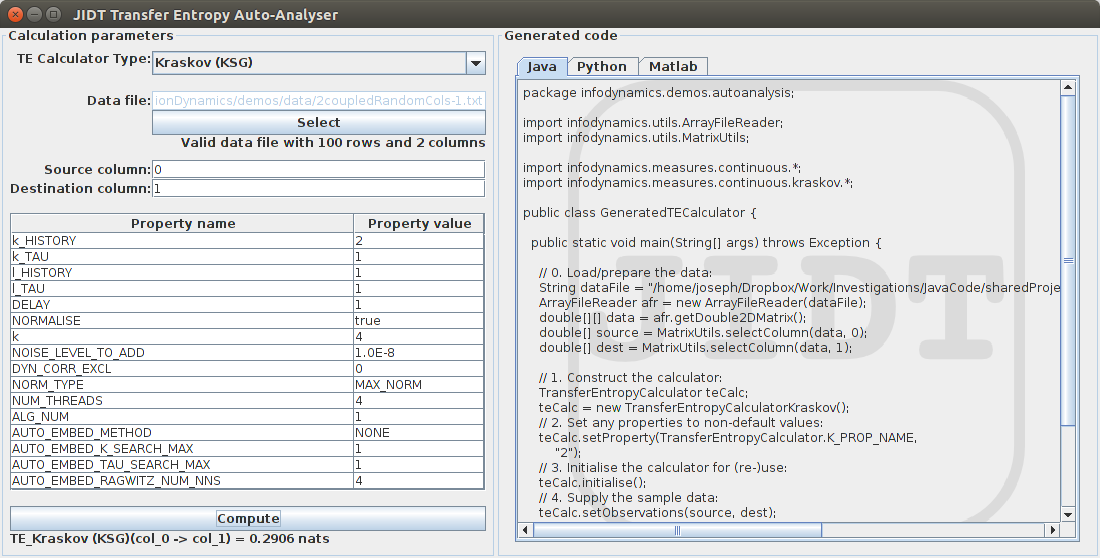
- It ships with a GUI application -- the AutoAnalyser, see picture below -- to facilitate point-and-click analysis, as well as code template generation for more complex analysis.
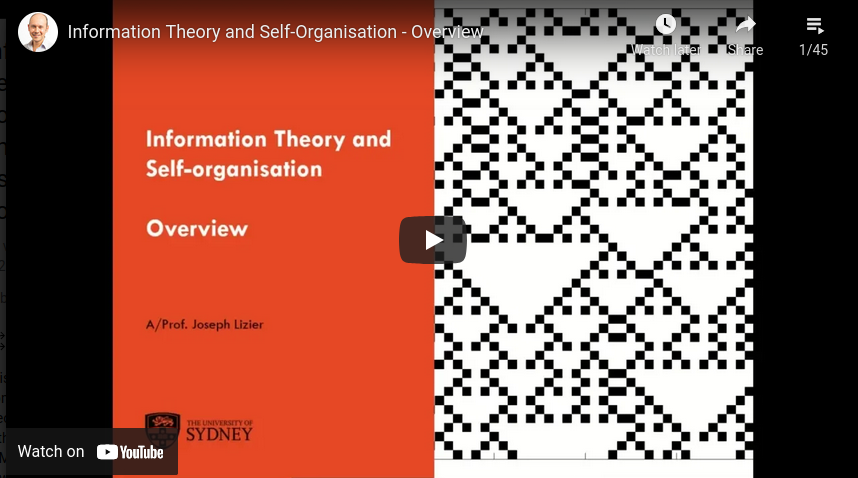
- We provide short video lectures and corresponding slides in a (beta) Course on how to understand using information-theoretic tools to analyse complex systems, and to implement such analysis with JIDT.
JIDT is distributed under the GNU GPL v3 license (or later).
Getting started
- Download and Installation is very easy!
- Quick start: take a
git clone(then build via AntScripts) OR download the latest v1.6.1 full distribution (suitable for all platforms) and see the readme.txt file therein.
- Quick start: take a
- Documentation including: the paper describing JIDT at arXiv:1408.3270 (distributed with the toolkit), a (beta) Course including short video lectures and a shorter Tutorial, and Javadocs (v1.6.1 here);
- Demos are included with the full distribution, including a GUI app for automatic analysis and code generation (see picture below), simple java demos and cellular automata (CA) demos.
- These Java tools can easily be used in Matlab/Octave, Python, R, Julia and Clojure! (click on each language here for examples)
For further information or announcements:
- Join our discussion group: http://groups.google.com/d/forum/jidt-discuss
- See also the FAQs
- Follow @infodynamicstkt on twitter
Citation
Please cite your use of this toolkit as:
Joseph T. Lizier, "JIDT: An information-theoretic toolkit for studying the dynamics of complex systems", Frontiers in Robotics and AI 1:11, 2014; doi:10.3389/frobt.2014.00011 (pre-print: arXiv:1408.3270)
And please let me know about any publications resulting from its use!
See other PublicationsUsingThisToolkit.
News
22/08/2023 - New full distribution files available for release v1.6.1; Changes for v1.6.1 include: Minor updates to supporting use in Python, including virtual environments; Minor tweaks to fish schooling examples (mostly comments).
5/09/2022 - New full distribution files available for release v1.6; Changes for v1.6 include: Adding Flocking/Schooling/Swarming demo; Included Pedro's code on IIT and O-/S-Information measures; Spiking TE estimator added from David; Fixed up AutoAnalyser to work well for Python3 and numpy; Links to lecture videos included in the beta wiki for the course; Added rudimentary effective network inference (simplified version of the IDTxl full algorithm) in demos/octave/EffectiveNetworkInference;
26/11/2018 - New jar and full distribution files available for release v1.5; Changes for v1.5 include: Added GPU (cuda) capability for KSG Conditional Mutual Information calculator (proper documentation to come), brief wiki page and unit tests included; Added auto-embedding for TE/AIS with multivariate KSG, and univariate and multivariate Gaussian estimator (plus unit tests), for Ragwitz criteria and Maximum bias-corrected AIS, and also added Maximum bias corrected AIS and TE to handle source embedding as well; Kozachenko entropy estimator adds noise to data by default; Added bias-correction property to Gaussian and Kernel estimators for MI and conditional MI, including with surrogates (only option for kernel); Enabled use of different bases for different variables in MI discrete estimator; All new above features enabled in AutoAnalyser; Added drop-down menus for parameters in AutoAnalyser; Included long-form lecture slides in course folder;
26/11/2017 - New jar and full distribution files available for release v1.4; Changes for v1.4 include: Major expansion of functionality for AutoAnalysers: adding Launcher applet and capability to double click jar to launch, added Entropy, CMI, CTE and AIS AutoAnalysers, also added binned estimator type, added all variables/pairs analysis, added statistical significance analysis, and ensured functionality of generated Python code with Python3; Added GPU (cuda) capability for KSG Mutual Information calculator (proper documentation and wiki page to come), including unit tests; Added fast neighbour search implementations for mixed discrete-continuous KSG MI estimators; Expanded Gaussian estimator for multi-information (integration); Made all demo/data files readable by Matlab.
17/12/2016 - New book out from J. Lizier et al., "An Introduction to Transfer Entropy: Information Flow in Complex Systems" published by Springer, which contains various examples using JIDT (distributed in our releases)
21/10/2016 - New jar and full distribution files available for release v1.3.1; Changes for v1.3.1 include: Major update to TransferEntropyCalculatorDiscrete so as to implement arbitrary source and dest embeddings and source-dest delay; Conditional TE calculators (continuous) handle empty conditional variables; Added new auto-embedding method for AIS and TE which maximises bias corrected AIS; Added getNumSeparateObservations() method to TE calculators to make reconstructing/separating local values easier after multiple addObservations() calls; Fixed kernel estimator classes to return proper densities, not probabilities; Bug fix in mixed discrete-continuous MI (Kraskov) implementation; Added simple interface for adding joint observations for MultiInfoCalculatorDiscrete Including compiled class files for the AutoAnalyser demo in distribution; Updated Python demo 1 to show use of numpy arrays with ints; Added Python demo 7 and 9 for TE Kraskov with ensemble method and auto-embedding respectively; Added Matlab/Octave example 10 for conditional TE via Kraskov (KSG) algorithm; Added utilities to prepare for enhancing surrogate calculations with fast nearest neighbour search; Minor bug patch to Python readFloatsFile utility.
19/7/2015 - New jar and full distribution files available for release v1.3; Changes for v1.3 include: Added AutoAnalyser (Code Generator) GUI demo for MI and TE; Added auto-embedding capability via Ragwitz criteria for AIS and TE calculators (KSG estimators); Added Java demo 9 for showcasing use of Ragwitz auto-embedding; Adding small amount of noise to data in all KSG estimators now by default (may be disabled via setProperty()); Added getProperty() methods for all conditional MI and TE calculators; Upgraded Python demos for Python 3 compatibility; Fixed bias correction on mixed discrete-continuous KSG calculators; Updated the tutorial slides to those in use for ECAL 2015 JIDT tutorial.
12/2/2015 - New jar and full distribution files available for release v1.2.1; Changes for v1.2.1 include: Added tutorial slides, description of exercises and sample exercise solutions; Made jar target Java 1.6; Added Schreiber TE heart-breath rate with KSG estimator demo code for Python.
28/1/2015 - New jar and full distribution files available for release v1.2; Changes for v1.2 include: Dynamic correlation exclusion, or Theiler window, added to all Kraskov estimators; Added univariate MI calculation to simple demo 6; Added Java code for Schreiber TE heart-breath rate with KSG estimator, ready for use as a template in Tutorial; Patch for crashes in KSG conditional MI algorithm 2.
20/11/2014 - New jar and full distribution files available for release v1.1; Changes for v1.1 include: Implemented Fast Nearest Neighbour Search for Kraskov-Stögbauer-Grassberger (KSG) estimators for MI, conditional MI, TE, conditional TE, AIS, Predictive info, and multi-information. This includes a general (multivariate) k-d tree implementation; Added multi-threading (using all available process
Related Skills
node-connect
335.2kDiagnose OpenClaw node connection and pairing failures for Android, iOS, and macOS companion apps
claude-opus-4-5-migration
82.5kMigrate prompts and code from Claude Sonnet 4.0, Sonnet 4.5, or Opus 4.1 to Opus 4.5
frontend-design
82.5kCreate distinctive, production-grade frontend interfaces with high design quality. Use this skill when the user asks to build web components, pages, or applications. Generates creative, polished code that avoids generic AI aesthetics.
model-usage
335.2kUse CodexBar CLI local cost usage to summarize per-model usage for Codex or Claude, including the current (most recent) model or a full model breakdown. Trigger when asked for model-level usage/cost data from codexbar, or when you need a scriptable per-model summary from codexbar cost JSON.
