
SAX
Java implementation of SAX, HOT-SAX, and EMMA
Install / Use
/learn @jMotif/SAXREADME
Time series symbolic discretization (approximation) with SAX





This code is released under GPL v.2.0 and implements in Java:
- Symbolic Aggregate approXimation (i.e., SAX) toolkit stack [1]
- EMMA (Enumeration of Motifs through Matrix Approximation) algorithm for time series motif discovery [2]
- HOT-SAX - a time series anomaly (discord) discovery algorithm [3]
- time series bitmap-related routines [4]
Note that the most of library's functionality is also available in R and Python as well...
[1] Lin, J., Keogh, E., Patel, P., and Lonardi, S., Finding Motifs in Time Series, The 2nd Workshop on Temporal Data Mining, the 8th ACM Int'l Conference on KDD (2002)
[2] Patel, P., Keogh, E., Lin, J., Lonardi, S., Mining Motifs in Massive Time Series Databases, In Proc. ICDM (2002)
[3] Keogh, E., Lin, J., Fu, A., HOT SAX: Efficiently finding the most unusual time series subsequence, In Proc. ICDM (2005)
[4] Kumar, N., Lolla, V.N., Keogh, E.J., Lonardi, S. and Chotirat (Ann) Ratanamahatana, Time-series Bitmaps: a Practical Visualization Tool for Working with Large Time Series Databases, In SDM 2005 Apr 21 (pp. 531-535).
Citing this work:
If you are using this implementation for you academic work, please cite our Grammarviz 3.0 paper:
[Citation] Senin, P., Lin, J., Wang, X., Oates, T., Gandhi, S., Boedihardjo, A.P., Chen, C., Frankenstein, S., GrammarViz 3.0: Interactive Discovery of Variable-Length Time Series Patterns, ACM Trans. Knowl. Discov. Data, February 2018.
an alternative solution for recurrent and anomalous patterns detection:
If you are interested in more advance techniques for time series pattern discovery -- the one which allows to discover recurrent and anomalous patterns of variable length -- please check out our new tool called GrammarViz 2.0. Based on symbolic discretization, Grammatical Inference, and algorithmic (i.e., Kolmogorv complexity) this new approach facilitates linear-time variable length motifs discovery and orders of magnitude faster than HOT-SAX discords discovery (but exactness is not guaranteed).
0.0 SAX transform in a nutshell
SAX is used to transform a sequence of rational numbers (i.e., a time series) into a sequence of letters (i.e., a string). An illustration of a time series of 128 points converted into the word of 8 letters:
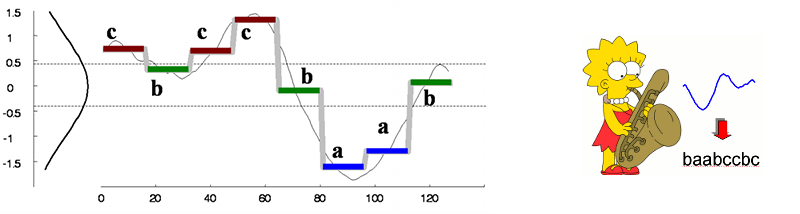
As discretization is probably the most used transformation in data mining, SAX has been widely used throughout the field. Find more information about SAX at its authors pages: SAX overview by Jessica Lin, Eamonn Keogh's SAX page, or at sax-vsm wiki page.
1.0 Building
The code is written in Java and I use maven to build it. Use the profile single to build an executable jar containing all the dependencies:
$ mvn package -P single

[INFO] Scanning for projects...
[INFO] ------------------------------------------------------------------------
[INFO] Building jmotif-sax
[INFO]    task-segment: [package]

...

[INFO] Building jar: /media/Stock/git/jmotif-sax/target/jmotif-sax-1.0.1-SNAPSHOT-jar-with-dependencies.jar
[INFO] ------------------------------------------------------------------------
[INFO] BUILD SUCCESSFUL
2.0 Time series to SAX conversion using CLI
The jar file can be used to convert a time series (represented as a single-column text file) to SAX via sliding window in command line:
$ java -jar target/jmotif-sax-0.1.1-SNAPSHOT-jar-with-dependencies.jar
Usage: <main class> [options]
Options:
		--alphabet_size, -a
		   SAX alphabet size, Default: 3
		--data, -d
		   The input file name
		--out, -o
   		   The output file name
		--strategy
   		   SAX numerosity reduction strategy
   		   Default: EXACT, Possible Values: [NONE, EXACT, MINDIST]
		--threads, -t
   		   number of threads to use, Default: 1
		--threshold
   		   SAX normalization threshold, Default: 0.01
		--window_size, -w
   		   SAX sliding window size, Default: 30
		--word_size, -p
   		   SAX PAA word size, Default: 4
When run, it prints the time series point index and a corresponding word:
$ java -jar "target/jmotif-sax-1.0.1-SNAPSHOT-jar-with-dependencies.jar" \
                      -d src/resources/test-data/ecg0606_1.csv -o test.txt
$ head test.txt
0, aabc
8, aacc
13, abcc
20, abcb
...
3.0 API usage
There two classes implementing end-to-end workflow for SAX. These are TSProcessor (implements time series-related functions) and SAXProcessor (implements the discretization). Below are typical use scenarios:
3.1 Discretizing time-series by chunking:
// instantiate classes
NormalAlphabet na = new NormalAlphabet();
SAXProcessor sp = new SAXProcessor();

// read the input file
double[] ts = TSProcessor.readFileColumn(dataFName, 0, 0);

// perform the discretization
String str = sp.ts2saxByChunking(ts, paaSize, na.getCuts(alphabetSize), nThreshold);

// print the output
System.out.println(str);
3.2 Discretizing time-series via sliding window:
// instantiate classes
NormalAlphabet na = new NormalAlphabet();
SAXProcessor sp = new SAXProcessor();

// read the input file
double[] ts = TSProcessor.readFileColumn(dataFName, 0, 0);

// perform the discretization
SAXRecords res = sp.ts2saxViaWindow(ts, slidingWindowSize, paaSize,
	na.getCuts(alphabetSize), nrStrategy, nThreshold);

// print the output
Set<Integer> index = res.getIndexes();
for (Integer idx : index) {
	System.out.println(idx + ", " + String.valueOf(res.getByIndex(idx).getPayload()));
}
3.3 Multi-threaded discretization via sliding window:
// instantiate classes
NormalAlphabet na = new NormalAlphabet();
SAXProcessor sp = new SAXProcessor();

// read the input file
double[] ts = TSProcessor.readFileColumn(dataFName, 0, 0);

// perform the discretization using 8 threads
ParallelSAXImplementation ps = new ParallelSAXImplementation();
SAXRecords res = ps.process(ts, 8, slidingWindowSize, paaSize, alphabetSize,
	nrStrategy, nThreshold);

// print the output
Set<Integer> index = res.getIndexes();
for (Integer idx : index) {
	System.out.println(idx + ", " + String.valueOf(res.getByIndex(idx).getPayload()));
}
3.4 Time series motif (recurrent pattern) discovery
Class EMMAImplementation implements a method for getting the most frequent structural patterns with EMMA algorithm:
// read the data
double[] series = TSProcessor.readFileColumn(DATA_FNAME, 0, 0);

// find the best motif with EMMA
MotifRecord motifsEMMA = EMMAImplementation.series2EMMAMotifs(series, MOTIF_SIZE,
				MOTIF_RANGE, PAA_SIZE, ALPHABET_SIZE, ZNORM_THRESHOLD);

// print motifs
System.out.println(motifsEMMA);
Class SAXRecords implements a method for getting the most frequent SAX words:
// read the data
double[] series = TSProcessor.readFileColumn(DATA_FNAME, 0, 0);

// instantiate classes
Alphabet na = new NormalAlphabet();
SAXProcessor sp = new SAXProcessor();

// perform discretization
saxData = sp.ts2saxViaWindow(series, WIN_SIZE, PAA_SIZE, na.getCuts(ALPHABET_SIZE),
    		NR_STRATEGY, NORM_THRESHOLD);

// get the list of 10 most frequent SAX words
ArrayList<SAXRecord> motifs = saxData.getMotifs(10);
SAXRecord topMotif = motifs.get(0);

// print motifs
System.out.println("top motif " + String.valueOf(topMotif.getPayload()) + " seen " +
	   		topMotif.getIndexes().size() + " times.");
3.5 Time series anomaly detection using brute-force search
The BruteForceDiscordImplementation class implements a brute-force search for discords, which is intended to be used as a reference in tests (HOTSAX and NONE yield exactly the same discords).
discordsBruteForce = BruteForceDiscordImplementation.series2BruteForceDiscords(series,
   WIN_SIZE, DISCORDS_TO_TEST, new LargeWindowAlgorithm());
