
genealogy-mcp
MCP family history toolkit: 114 archives & databases worldwide, historical province archive lookup, live search, multilingual guides, names, calendars, evidence checks, DNA kinship, research projects; GEDCOM audit & in-place editing with previews and backups; gene-archive integration with validated…
Install / Use
claude mcp add igormel81 -- npx -y github:igormel81/genealogy-mcpIf the server publishes to npm under a different name, use that package instead — check the repo README.
MCP Server
Model Context Protocol server
Quality Score
Category
AI & Machine LearningSupported Platforms
Our assessment of genealogy-mcp
genealogy-mcp scores 81/100 on our quality scale, 733rd of 950 AI & Machine Learning skills we index.
Its MCP Server is 18 KB long, well organised into 12 sections with 2 code examples: a thorough specification that gives an agent plenty to work with.
It has 3 GitHub stars, so there is little community track record yet; judge it on its content.
Maintenance, license and trust
- The repository was last updated 2 days ago, so genealogy-mcp is actively maintained.
- It is released under the MIT license, a permissive license that allows use, modification and commercial use with attribution.
- Its trust signals score 92/100, with 1 caution from licensing, adoption, age or documentation. These come from repository metadata, not a code audit — read the skill file before letting an agent act on it.
genealogy-mcp compared with similar skills
All 4 of these similar skills score higher than genealogy-mcp; compare them before choosing.
| Skill | Score | Stars | Updated | Format |
|---|---|---|---|---|
| genealogy-mcp (this skill)by igormel81 | 81 | 3 | 2d ago | MCP Server |
| claude-memby thedotmack | 100 | 101.4k | today | CLAUDE.md |
| Agent-Reachby Panniantong | 100 | 98.8k | 2d ago | CLAUDE.md |
| Understand-Anythingby Egonex-AI | 100 | 86.8k | 5d ago | CLAUDE.md |
| headroomby headroomlabs-ai | 100 | 75.6k | today | CLAUDE.md |
Frequently asked questions
- How do I install genealogy-mcp?
- Run
claude mcp add igormel81 -- npx -y github:igormel81/genealogy-mcp. The install tabs above show the steps for each supported agent. - Which AI agents does genealogy-mcp work with?
- It is written for Claude Code and Claude Desktop, as a MCP Server file. Other agents that read the same format can often use it too.
- Is genealogy-mcp safe to use?
- It is MIT-licensed and scores 92/100 on trust signals. Skills are instructions an agent will follow, so read the file before installing it and do not approve commands you do not understand.
- Is genealogy-mcp still maintained?
- The repository was last updated 2 days ago, so genealogy-mcp is actively maintained.
Skill content
View source on GitHubgenealogy-mcp — find your family history with any AI assistant
<!-- mcp-name: io.github.igormel81/genealogy-mcp -->




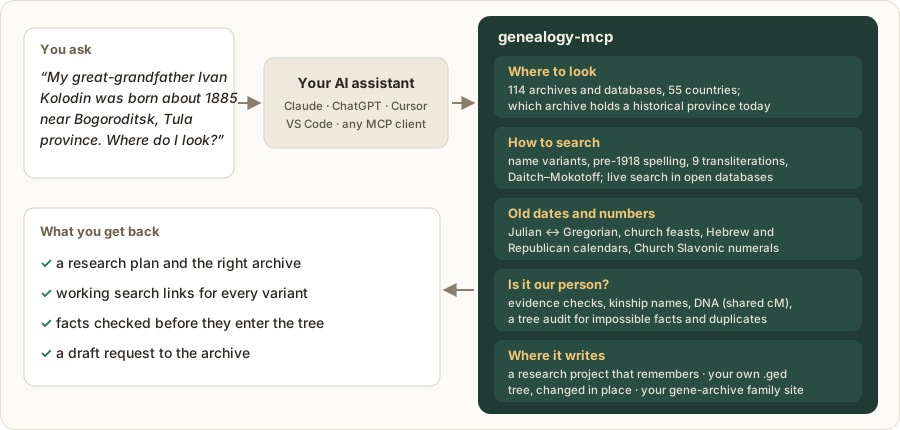
An MCP server that turns Claude, ChatGPT, Cursor or any MCP-capable assistant into a careful genealogist. It knows where the records of your ancestors are (114 archives and databases across Russia and the former USSR, Europe, the British Isles, the USA and Latin America), how to search them (name variants, transliterations, old spelling, the Julian calendar), and when a find really is your person — so the assistant gives you working links and a plan instead of confident guesses.
Built from years of real research for an open family archive powered by gene_archive: parish registers, revision lists, WWI and WWII databases, repression files, emigration records — and every trap we fell into along the way. The story behind it: an article on Habr (in Russian).
At a glance
- 114 archives and databases in 55 countries, each with what it holds and how to search it well — and which archive holds the records of a historical province today (borders moved; the answer is often not the obvious one).
- 24 tools for the real work of a genealogist: name variants and 9 transliteration systems, Daitch–Mokotoff, Julian, Hebrew and French Republican calendars, dates by church feasts, Church Slavonic numerals, kinship in three languages, DNA, evidence checks, a tree audit, live search in open databases, archive request drafts.
- It works on your tree, not beside it. Point it at the
.gedfile from MyHeritage, Ancestry, Gramps or RootsMagic and it reads, searches and changes it in place — only the changed lines, everything else byte for byte, a copy kept, every change shown first. Or at a gene-archive family website: changes go through the site's checks, logs and git history. - It remembers. Sources with full citations, open leads and every search — "nothing found" included — so nobody searches the same place twice.
- Honest by design. A namesake is not a relative: a find is linked only with two independent facts beyond the name.
- Private. Runs on your computer; goes online only for a search you ask for, and only to that one site.
- Any assistant: Claude Desktop (one-click install), Claude Code, ChatGPT, Cursor, VS Code, Windsurf, Cline.
- Guides in English, Russian and Ukrainian, the main ones also in Spanish, Portuguese, Polish and German.
Quick start
Claude Desktop: download genealogy-mcp-<version>.mcpb from the
latest release and open it.
Claude Code: claude mcp add genealogy -- uvx genealogy-mcp.
Anything else: uvx genealogy-mcp as the server command (details in Install).
Then just ask: "Help me find my great-grandfather. Here is what I know…"
What you can ask
My great-grandfather Ivan Kolodin was born about 1885 near Bogoroditsk, Tula province. Where do I look?
The assistant makes a plan for Russia 1880–1945, reads the record guides, builds the name forms (Колодин / Колодина / Колодинъ / Kolodin / Kołodin…), gives you search links for FamilySearch, the Internet Archive full text and the Russian war databases, tells you which archive holds the parish registers and drafts the request.
Is this baptism record the same Ivan? It says «Іоаннъ, father Петръ, 1887, Сынково».
check_match compares fact by fact with name variants and age tolerance: two independent facts beyond the name →
confirmed; one → probable; a contradiction → find a third document.
What is my grandmother's cousin's daughter to me? И как это по-русски?
kinship → «троюродная сестра… / first cousin once removed» — in Russian, English and Romanian, with the expected DNA share.
Check my tree. (a GEDCOM from Ancestry, MyHeritage, Gramps, Geni…)
audit_tree finds the impossible (born after the mother's death, a mother aged 10, death before birth), possible
duplicates and gaps — a to-do list for the next search.
The register says he was born «на Покров» 1885, the year is written ҂аѡ҃пе.
cyrillic_numerals reads the year (1885), feast_date gives 1 October (Julian) = 13 October 1885.
We share 230 cM with a match on MyHeritage. Who could she be?
dna_match: second cousin, first cousin twice removed, half first cousin… — and why only documents can decide.
Where are the parish registers of Volhynia governorate now?
where_are_records: the state archives of Zhytomyr (the consistory), Rivne and Volyn — borders moved, so it is not
always the archive of today's region.
Remember what we found, and continue next week.
A research project on your computer: people, sources with full citations, open leads and a log of every search — including "nothing found" — so nobody searches the same place twice. GEDCOM in and out.
Write what we found into our family site.
If your family archive is a gene-archive site, give the project tools the path of its folder: the assistant reads the archive itself — who is missing, which dates have no document — and every change it makes goes through the site's own checks, lands in its corrections and research logs, is committed to git under your name and rebuilds the site. It shows the change first and writes only after your yes.
Here is my tree — add what we found.
Or give it the GEDCOM file of the tree you keep in MyHeritage, Ancestry, Gramps, RootsMagic, Family Historian or webtrees: the assistant reads it, searches it and changes it in place. Only the lines of what changed are rewritten — your program's own tags, photos, notes and the header stay byte for byte; it shows those lines before writing, keeps a copy of the file, and keeps the search log, leads and corrections in a file next to it. Then import the file back into your program (Family Historian and webtrees work on GEDCOM directly). Files not in UTF-8 are read-only.
Why use it
| Without it | With genealogy-mcp | |---|---| | The assistant names two or three famous websites | 114 sources chosen by country, years and kind of record, each with "how to search it well" | | Searches one spelling | Spelling variants, pre-1918 orthography, male/female forms, 9 transliteration systems, given-name equivalents (Иван = Іоаннъ = Jan = Johann = Juan) | | Invented or broken URLs | Ready search links built from tested URL templates; a weekly job checks every site | | "This is probably your ancestor" | An explicit evidence rule: a namesake is not a relative | | Dates taken at face value | Julian ↔ Gregorian, birth years from ages with realistic drift, dates normalised to GEDCOM | | Generic advice | Record guides: parish registers, confession lists, revision lists, household books, WWI/WWII, repression files, passenger lists, censuses, European civil registration, Latin American records | | You write to archives from scratch | Request drafts for Russian ZAGS, state, military and FSB archives, and for any archive in English, Spanish or Portuguese | | It forgets everything between chats | A research project that remembers people, sources, leads and every search | | It cannot touch your tree | Reads and changes your own GEDCOM file in place, losing nothing, showing every change first | | It cannot read old numbers and dates | Church Slavonic numerals, church feasts, Julian, Hebrew and French Republican calendars | | "Search FamilySearch for your name" | Live search in the Internet Archive full text, WikiTree, Open Archives and Wikidata place history | | DNA matches are a mystery | Shared cM → the relationships it fits |
Most genealogy MCP servers connect the assistant to one service or one file. genealogy-mcp gives it the research method around them — where to look, how to search, how to read and weigh what it finds — and works on your own tree file too. It runs happily next to a server for a service you use, such as a FamilySearch client.
Everything runs on your computer. The server goes online only when the assistant runs a live search
(search_online, place_history), and then sends that query to that one site.
Coverage
- Worldwide: FamilySearch (records and the catalogue of unindexed images), Internet Archive full text, MyHeritage, Geni, WikiTree, Find a Grave, BillionGraves, Arolsen Archives, Yad Vashem, JewishGen, Matricula, Geneanet, Wikipedia.
- Russia and the USSR: Yandex Archive, archive guides, VGD forum, Pamyat Naroda, OBD Memorial, gwar.mil.ru, Open List, Immortal Barrack, Returned Names, PSTGU martyrs, Presidential and National Electronic Libraries, historical libraries, old maps, church history, RIA-1914, regional archives, ZAGS, TsAMO, RGVIA, RGIA, GARF.
- Ukraine, Belarus, Moldova, Romania, Poland, the Baltics: national archive portals and catalogues, TsDIAK, Geneteka, Szukajwarchiwach, epaveldas, Raduraksti, the Estonian archives.
- Europe: ICRC WWI prisoners, CWGC, Volksbund, ScotlandsPeople, FreeBMD, Irish civil and census records, Archion, GenWiki, FranceArchives, Mémoire des hommes, Antenati, PARES, Digitarq, Open Archives (NL), Belgian State Archives, Riksarkivet, Digitalarkivet, Danish Family Search, HisKi, Finnish Digital Archive, Hungaricana, Acta Publica (Czechia), Bulgarian state archives, FreeCEN, FreeREG, The National Archives, GRO, Welsh Newspapers.
- Germany and German-speaking lands: WWI casualty lists, GEDBAS, Online-OFB, German Digital Library, Bundesarchiv, Baltic Biographical Lexicon, Black Sea Germans (Odessa3), Poznań Project, Metryki.
- Jewish genealogy: JRI-Poland, Gesher Galicia, LitvakSIG, JewishGen, Yad Vashem, Steve Morse One-Step tools.
- Caucasus and Central Asia: National Archives of Georgia, the central state archives of Kazakhstan, Uzbekistan, Kyrgyzstan, Tajikistan and Turkmenistan.
- The Americas: FamilySearch Latin America, AGN Mexico, Arquivo Nacional and Museu da Imigração (Brazil), Hemeroteca Digital, CEMLA and AGN (Argentina), Archivo Nacional (Chile), NARA, Ellis Island, Chronicling America, USGenWeb, Library and Archives Canada, BAnQ (Quebec), Pier 21.
- Australia and New Zealand: Trove, National Archives of Australia, Papers Past, New Zealand BDM.
Record guides in English, Russian and Ukrainian, the main ones also in Spanish, Portuguese, Polish and German.
Install
Claude Desktop, one click: download genealogy-mcp-<version>.mcpb from the
latest release and open it — Claude Desktop installs
it and asks where to keep your research projects.
For the other ways you need uv (it fetches Python and the package by itself).
Claude Desktop, by hand — Settings → Developer → Edit Config, add:
{
  "mcpServers": {
    "genealogy": {
      "command": "uvx",
      "ar
Truncated for display — read the full file on GitHub.
Related Skills
claude-mem
101.4kPersistent Context Across Sessions for Every Agent – Captures everything your agent does during sessions, compresses it with AI, and injects relevant context back into future sessions. Works with Claude Code, OpenClaw, Codex, Gemini, Hermes, Copilot, OpenCode + More
Agent-Reach
98.8kGive your AI agent eyes to see the entire internet. Read & search Twitter, Reddit, YouTube, GitHub, Bilibili, XiaoHongShu — one CLI, zero API fees.
Understand-Anything
86.8kGraphs that teach > graphs that impress. Turn any code into an interactive knowledge graph you can explore, search, and ask questions about. Works with Claude Code, Codex, Cursor, Copilot, Gemini CLI, and more.
headroom
75.6kCompress tool outputs, logs, files, and RAG chunks before they reach the LLM. 20% fewer tokens for coding agents, 60-95% fewer tokens for JSON, same answers. Library, proxy, MCP server.

Languages
Trust signals
From repository metadata: license, adoption, age and documentation. Not a code audit — see the Safety scan above for what the skill file itself contains.