
Parakeet
Hepburn Romaji + Japanese lexical analysis & texifier.
Install / Use
/learn @foreverbell/ParakeetREADME
parakeet
Disclaimer
I know nothing about parsing, Haskell and Japanese. This repository is purely for fun, and serving as a test-bed for some Haskell experiments.
Introduction
Build the most convenient tool for Japanese beginners!
Input:
- https://raw.githubusercontent.com/foreverbell/parakeet/master/test-suite/Butter-fly/Butter-fly.j
- https://raw.githubusercontent.com/foreverbell/parakeet/master/test-suite/Butter-fly/Butter-fly.r
Output:
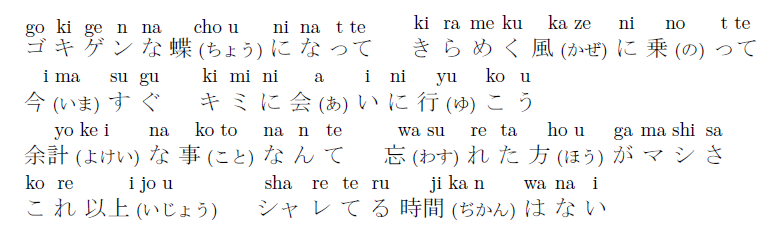
Full output:
- tex: https://raw.githubusercontent.com/foreverbell/miscellaneous/master/resource/parakeet/Butter-fly.tex
- pdf: https://raw.githubusercontent.com/foreverbell/miscellaneous/master/resource/parakeet/Butter-fly.pdf
Romaji should follow Hepburn romanization.
For an experimential online demo powered by GHCJS, see here for more details.
Installation
To build, at least ghc 7.10.2 is required.
$ cabal install parakeet.cabal
For stack users,
$ stack init
$ stack install
or
$ stack install --stack-yaml=stack-ghcjs.yaml
if you want to compile to JavaScript.
Development
$ cabal sandbox init
$ cabal install --only-dependencies
$ cabal build
Usage
- XeLaTex package dependencies: xeCJK, ruby
- Font dependencies: MS Mincho, MS Gothic
$ parakeet -j Butter-fly.j -r Butter-fly.r -o Butter-fly.tex
$ xelatex Butter-fly.tex
or directly,
$ parakeet -j Buffer-fly.j -r Buffer-fly.r -o Buffer-fly.pdf
You should guarantee that the two input files are encoded in UTF-8.
Limitations
- The parsing algorithm is essentially LL(infinity), it is an exponential algorithm of course! So the program may get extremely slow when there is a mistake in a long line of romaji. A proper use of separator
$can avoid this trap. - The long vowel
ōis ambiguous in Hepburn romanization, which is interpreted toouoroo. To resolve this, we always pick the former one. For example,東京(Tōkyō)is correctly translated toとうきょう, while大阪(Ōsaka)is wrongly translated toおうさか. - There are two
zus andjis in romanization, namelyずづandじぢin hiragana respectively. We always pickずじwhen translatingzuandjiinto furigana. If you wantづぢ, usedu(dzu)anddi(dji)instead. - Unfriendly parse error message.
Document
Since I haven't find any potential users, so there will be no document available, please create an issue if you have trouble using it.
TODO List
- Ambiguous
ōwarning. - Extended katakana support.
- Wiki for Japanese lexical rules.
Related Skills
node-connect
337.1kDiagnose OpenClaw node connection and pairing failures for Android, iOS, and macOS companion apps
frontend-design
83.1kCreate distinctive, production-grade frontend interfaces with high design quality. Use this skill when the user asks to build web components, pages, or applications. Generates creative, polished code that avoids generic AI aesthetics.
openai-whisper-api
337.1kTranscribe audio via OpenAI Audio Transcriptions API (Whisper).
commit-push-pr
83.1kCommit, push, and open a PR
