
Fmt
A modern formatting library
Install / Use
/learn @fmtlib/FmtREADME




{fmt} is an open-source formatting library providing a fast and safe alternative to C stdio and C++ iostreams.
If you like this project, please consider donating to one of the funds that help victims of the war in Ukraine: https://u24.gov.ua/.
Q&A: ask questions on StackOverflow with the tag fmt.
Try {fmt} in Compiler Explorer.
Features
- Simple format API with positional arguments for localization
- Implementation of C++20 std::format and C++23 std::print
- Format string syntax similar to Python's format
- Fast IEEE 754 floating-point formatter with correct rounding, shortness and round-trip guarantees using the Dragonbox algorithm
- Portable Unicode support
- Safe printf implementation including the POSIX extension for positional arguments
- Extensibility: support for user-defined types
- High performance: faster than common standard library
implementations of
(s)printf, iostreams,to_stringandto_chars, see Speed tests and Converting a hundred million integers to strings per second - Small code size both in terms of source code with the minimum
configuration consisting of just three files,
base.h,format.handformat-inl.h, and compiled code; see Compile time and code bloat - Reliability: the library has an extensive set of tests and is continuously fuzzed
- Safety: the library is fully type-safe, errors in format strings can be reported at compile time, automatic memory management prevents buffer overflow errors
- Ease of use: small self-contained code base, no external dependencies, permissive MIT license
- Portability with consistent output across platforms and support for older compilers
- Clean warning-free codebase even on high warning levels such as
-Wall -Wextra -pedantic - Locale independence by default
- Optional header-only configuration enabled with the
FMT_HEADER_ONLYmacro
See the documentation for more details.
Examples
Print to stdout (run)
#include <fmt/base.h>

int main() {
  fmt::print("Hello, world!\n");
}
Format a string (run)
std::string s = fmt::format("The answer is {}.", 42);
// s == "The answer is 42."
Format a string using positional arguments (run)
std::string s = fmt::format("I'd rather be {1} than {0}.", "right", "happy");
// s == "I'd rather be happy than right."
Print dates and times (run)
#include <fmt/chrono.h>

int main() {
  auto now = std::chrono::system_clock::now();
  fmt::print("Date and time: {}\n", now);
  fmt::print("Time: {:%H:%M}\n", now);
}
Output:
Date and time: 2023-12-26 19:10:31.557195597
Time: 19:10
Print a container (run)
#include <vector>
#include <fmt/ranges.h>

int main() {
  std::vector<int> v = {1, 2, 3};
  fmt::print("{}\n", v);
}
Output:
[1, 2, 3]
Check a format string at compile time
std::string s = fmt::format("{:d}", "I am not a number");
This gives a compile-time error in C++20 because d is an invalid
format specifier for a string.
Write a file from a single thread
#include <fmt/os.h>

int main() {
  auto out = fmt::output_file("guide.txt");
  out.print("Don't {}", "Panic");
}
This can be up to 9 times faster than fprintf.
Print with colors and text styles
#include <fmt/color.h>

int main() {
  fmt::print(fg(fmt::color::crimson) | fmt::emphasis::bold,
             "Hello, {}!\n", "world");
  fmt::print(fg(fmt::color::floral_white) | bg(fmt::color::slate_gray) |
             fmt::emphasis::underline, "Olá, {}!\n", "Mundo");
  fmt::print(fg(fmt::color::steel_blue) | fmt::emphasis::italic,
             "你好{}!\n", "世界");
}
Output on a modern terminal with Unicode support:
Benchmarks
Speed tests
| Library | Method | Run Time, s | |-------------------|---------------|-------------| | libc | printf | 0.66 | | libc++ | std::ostream | 1.63 | | {fmt} 12.1 | fmt::print | 0.44 | | Boost Format 1.88 | boost::format | 3.89 | | Folly Format | folly::format | 1.28 |
{fmt} is the fastest of the benchmarked methods, ~50% faster than
printf.
The above results were generated by building tinyformat_test.cpp on
macOS 15.6.1 with clang++ -O3 -DNDEBUG -DSPEED_TEST -DHAVE_FORMAT, and
taking the best of three runs. In the test, the format string
"%0.10f:%04d:%+g:%s:%p:%c:%%\n" or equivalent is filled 2,000,000
times with output sent to /dev/null; for further details refer to the
source.
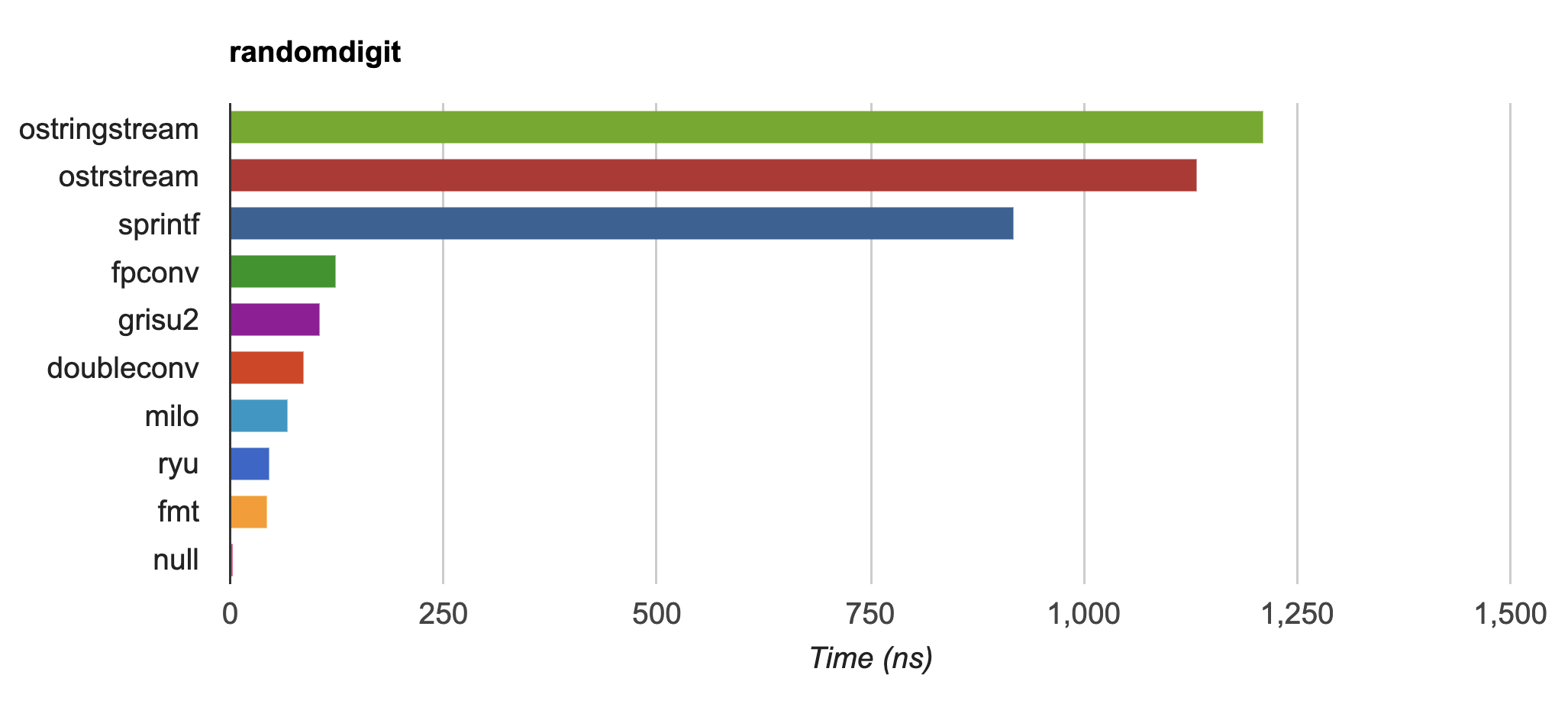
{fmt} is up to 20-30x faster than std::ostringstream and sprintf on
IEEE754 float and double formatting
(dtoa-benchmark) and faster
than double-conversion
and ryu:
Compile time and code bloat
The script bloat-test.py from format-benchmark tests compile
time and code bloat for nontrivial projects. It generates 100 translation units
and uses printf() or its alternative five times in each to simulate a
medium-sized project. The resulting executable size and compile time (Apple
clang version 15.0.0 (clang-1500.1.0.2.5), macOS Sonoma, best of three) is shown
in the following tables.
Optimized build (-O3)
| Method | Compile Time, s | Executable size, KiB | Stripped size, KiB |
|-----------------|-----------------|----------------------|--------------------|
| printf | 1.6 | 54 | 50 |
| IOStreams | 28.4 | 98 | 84 |
| {fmt} 1122268 | 5.0 | 54 | 50 |
| tinyformat | 32.6 | 164 | 136 |
| Boost Format | 55.0 | 530 | 317 |
{fmt} is fast to compile and is comparable to printf in terms of per-call
binary size (within a rounding error on this system).
Non-optimized build
| Method | Compile Time, s | Executable size, KiB | Stripped size, KiB |
|-----------------|-----------------|----------------------|--------------------|
| printf | 1.4 | 54 | 50 |
| IOStreams | 27.0 | 88 | 68 |
| {fmt} 1122268 | 4.7 | 87 | 84 |
| tinyformat | 28.1 | 185 | 145 |
| Boost Format | 38.9 | 678 | 381 |
libc, lib(std)c++, and libfmt are all linked as shared libraries
to compare formatting function overhead only. Boost Format is a
header-only library so it doesn't provide any linkage options.
Running the tests
Please refer to Building the library for instructions on how to build the lib
Related Skills
node-connect
334.5kDiagnose OpenClaw node connection and pairing failures for Android, iOS, and macOS companion apps
frontend-design
82.2kCreate distinctive, production-grade frontend interfaces with high design quality. Use this skill when the user asks to build web components, pages, or applications. Generates creative, polished code that avoids generic AI aesthetics.
openai-whisper-api
334.5kTranscribe audio via OpenAI Audio Transcriptions API (Whisper).
commit-push-pr
82.2kCommit, push, and open a PR
