
Osdev
A list of reference material to operating system development and administration and operating system history
Install / Use
/learn @felipenlunkes/OsdevREADME






Operating system history and reference material
<div align="justify">This repository aims to count and list the open source operating system projects in activity, in addition to cataloging bibliographic references and useful material for the development and administration of operating systems.
</div> <hr>For a list of active operating system and open source projects, visit the osdev-projects repository.
Summary
<div align="justify">This document is divided into a few sections to make it easier to search for a specific topic. You will find reference material on operating systems already consolidated, such as UNIX, Linux and Windows in a dedicated section, which will bring documents, papers, books and a short history of each one of them. In another section, you'll find material geared toward operating system development, reference material for systems administration, and more information about software licenses that you can use in your projects. In the third section, you'll find tutorials for operating system development, sorted by target architecture. These tutorials may be available on video, on YouTube, or in text, present or not in GitHub repositories. In the next section, you will find other sites with more information and useful curiosities. Finally, in the last section, you can learn more about testing older operating systems that don't run on current hardware using the SSH utility (Linux, Windows, and macOS).
A quick summary of the sections in this document:
- A brief history of Operating Systems
- Topics in hardware, system administration, applications and software licenses
- OSDev material: books, papers and tutorials
- Websites and other resources
- Test historical OSes via SSH
A brief history of Operating Systems
<div align="justify">This section will address several operating systems that have revolutionized computing over the decades, changing the way we relate to our computers. These mainline systems were responsible for influencing the development of modern alternatives, and many of them (in their various incarnations) are still a part of our lives. In each topic, you will find references to the source code (if available), manuals, papers, books and other pages with more information, as well as forums that discuss aspects of each operating system. You will also be able to obtain information on how to run these systems, natively or in emulators/simulators. Additionally, you will see new, modern operating systems that build on existing concepts but attempt to overcome their limitations or solve new problems in new ways. To get started, click on one of the options listed below!
This session addresses:
- [x] A quick resume on each operating system;
- [x] History of operating systems;
- [x] Interesting new operating systems;
- [x] Historical material;
- [x] Internal technical documentation (kernel, interfaces, etc);
- [x] Source code of historical operating systems;
- [x] User manuals;
- [x] Manuals for the development of each operating system;
- [x] Guides for administration of each operating system;
- [x] Documentation on operating systems development;
- [x] Hardware documentation.
</div> <div align="justify"> <details title="UNIX" align='left'> <summary align='left'>UNIX</summary> <hr> <p align="center"> <img src="https://upload.wikimedia.org/wikipedia/commons/8/8a/Simh-pdp11-unix-sysiii.png" width="400" height="200"> </p> <div align="justify">Click on each highlighted operating system to access material for that operating system.
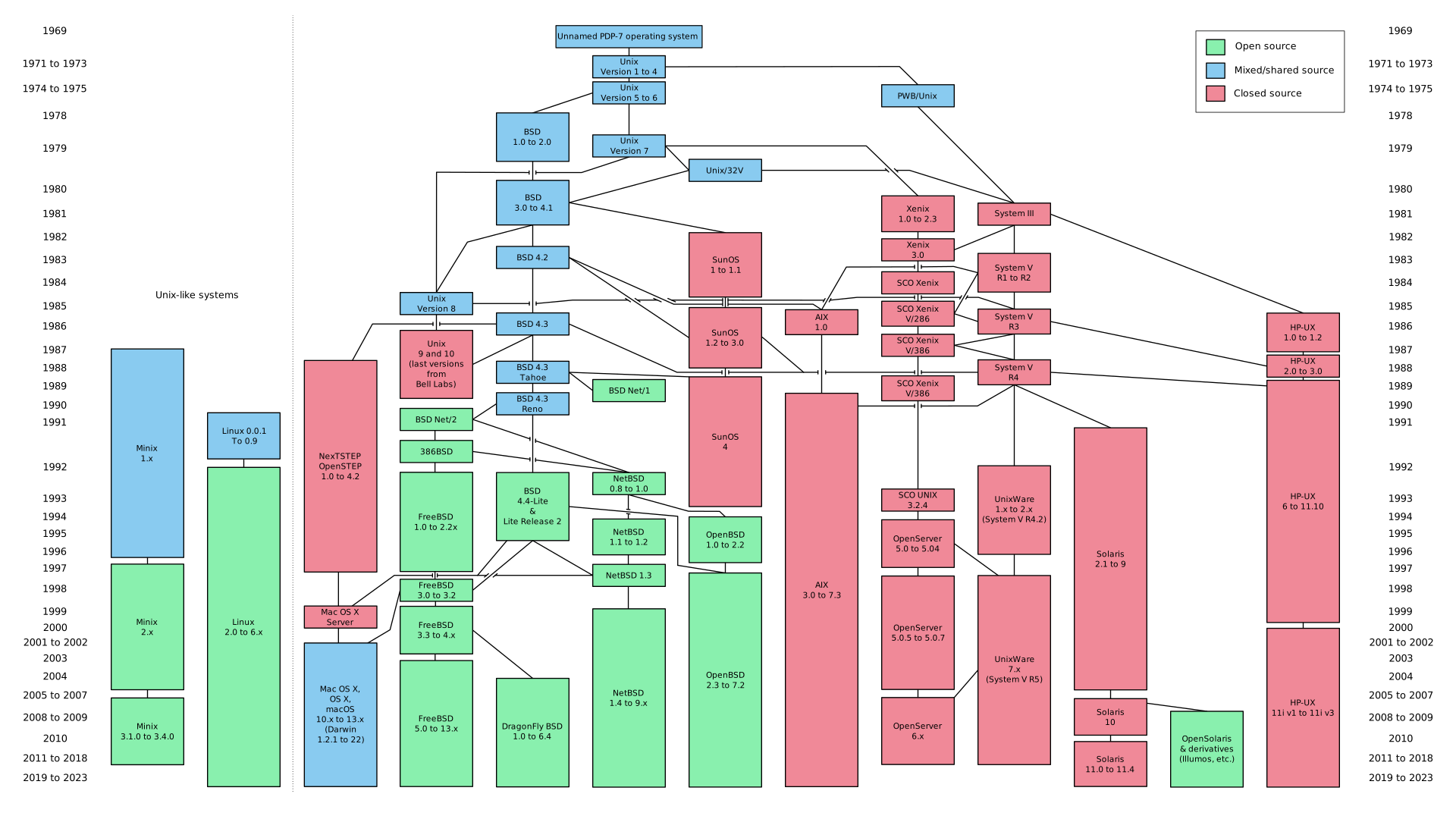
Have you ever heard of UNIX? UNIX was a revolutionary operating system, initially developed in 1969 by Ken Thompson, Dennis Ritchie and other employees of Bell Laboratories, owned by the American company AT&T. Initially developed as a hobby on an old unused PDP-7 computer, UNIX created countless foundations that define a modern operating system, influencing virtually all operating systems developed since then. UNIX instituted features such as support for multiple users and processes running at the same time (multitasking), implemented in a lightweight way (requiring few machine resources), and was initially written in Assembly language for PDP-7 and later rewritten in C language (developed by the same authors and used until today). Initially, the source code was distributed to Universities, including the University of California at Berkeley. At that University, UNIX was extensively studied and extended. Graduate students and researchers added advanced features to UNIX, such as virtual memory support, more modern file systems, and network support, leading to BSD (Berkeley Software Distribution) releases. The BSD were nothing more than the UNIX released by AT&T with improvements, then called BSD UNIX. With that, UNIX became very popular. UNIX was licensed to several companies, originating derived systems, such as Xenix, ULTRIX, Venix, Solaris and so on. The BSDs served as the basis for others, such as SunOS. Whereas the BSDs were distributed with a free license, AT&T's UNIX had a paid license. BSD then became the main free implementation of UNIX, giving rise to projects based on version 4.4 of BSD, now just called 4.4 BSD, FreeBSD, NetBSD and OpenBSD. FreeBSD is heavily used on servers these days, as well as forming the basis of macOS and iOS. Other companies' systems, such as Microsoft's MS-DOS and Windows, were heavily influenced by UNIX. UNIX was also an inspiration for the development of non-derived free systems, the so-called Unix-like, such as Minix and Linux itself.
Original source code
- The Unix Tree - The UNIX Heritage Society
- Research UNIX Version 1 - Version 7 source code (documentation)
- Research UNIX v10 source code (documentation)
- UNIX System V source code (documentation)
- Version 7 UNIX ported do x86 by Robert Nordier (BSD license)
- Old Unix XRef
Download the system (install in a virtual machine or use in an emulator)
- Apple A/UX
- IBM AIX
- AT&T System V Unix
- DELL Unix
- Digital UNIX
- HP-UX
- Intel Unix System V
- IRIX
- PC/IX
- Sun Solaris
- UnixWare
- Venix
- Xenix
Specifications, documentation, manuals and historical material
- UNIX History - Figure
- History of UNIX
- History and Timeline - UNIX.org
- Read The Single UNIX® Specification
- A Brief History of Everything UNIX
- UNIX releases
- About the Unix Boot Process
- UNIX Documentation at Stanford
- X Window System at Stanford
- A Brief History of Unix and How did Linux came into being
- Multics - The ancestor of UNIX
- UNIX® on the Game Boy Advance
- X.Org
Books and papers
- The Evolution of the Unix Time-sharing System - Dennis M. Ritchie (Bell Labs), 1984
- The Evolution of the UNIX Time-sharing System - PDF (same as above)
- Spinellis, D. A repository of Unix history and evolution. Empir Software Eng 22, 1372–1404 (2017)
- A COMMENTARY ON THE SIXTH EDITION UNIX OPERATING SYSTEM

Security Score
Audited on Mar 5, 2026