
Xctool
An extension for Apple's xcodebuild that makes it easier to test iOS and macOS apps.
Install / Use
/learn @facebookarchive/XctoolREADME
xctool
xctool is an extension for Apple's xcodebuild which makes it easier to test iOS and Mac products. It's especially helpful for continuous integration.

[ Features • Requirements • Usage • Continuous Integration • Reporters • Configuration • Contributing • Known Issues & Tips • License ]
Features
xctool is drop-in replacement for xcodebuild test that adds a few
extra features:
-
Faster, parallelized test runs.
xctool can optionally run all of your test bundles in parallel, speeding up your test runs significantly. At Facebook, we've seen 2x and 3x speed ups by parallelizing our runs.
Use the
-parallelizeoption with run-tests or test to enable. See Parallelizing Test Runs for more info. -
Structured output of test results.
xctool captures all test results as structured JSON objects. If you're building a continuous integration system, this means you don't have to regex parse xcodebuild output anymore.
Try one of the Reporters to customize the output or get the full event stream with the
-reporter json-streamoption. -
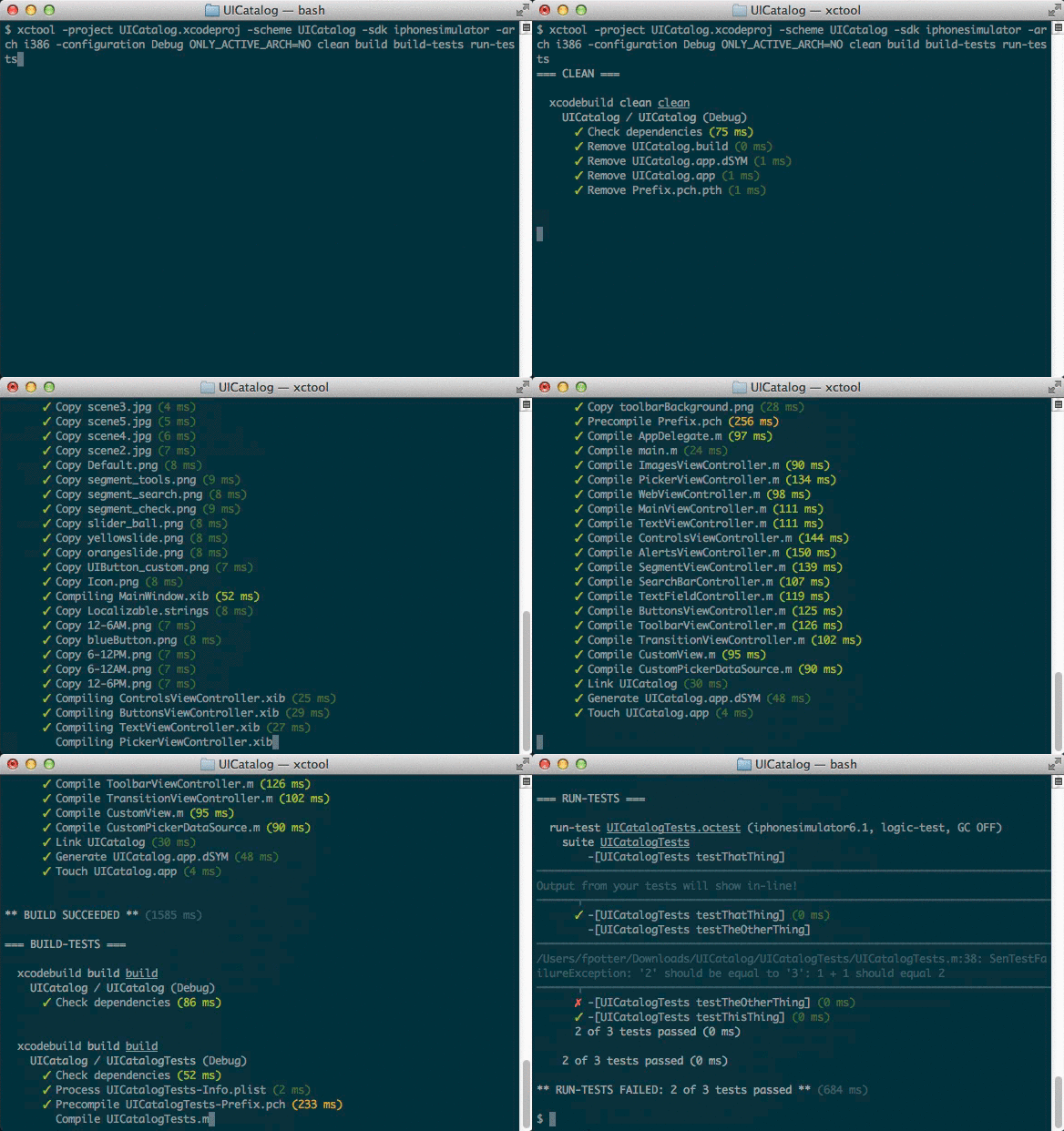
Human-friendly, ANSI-colored output.
xcodebuild is incredibly verbose, printing the full compile command and output for every source file. By default, xctool is only verbose if something goes wrong, making it much easier to identify where the problems are.
Example:
-
Written in Objective-C.
xctool is written in Objective-C. Mac OS X and iOS developers can easily submit new features and fix any bugs they may encounter without learning a new language. We very much welcome pull requests!
Note: Support for building projects with xctool is deprecated and will
not be updated to support future versions of Xcode. We suggest moving to
xcodebuild (with xcpretty) for
simple needs, or xcbuild for more
involved requirements. xctool will continue to support testing (see above).
Requirements
- Xcode 7 or higher
- You'll need Xcode's Command Line Tools installed. From Xcode, install via Xcode → Preferences → Downloads.
Installation
xctool can be installed from homebrew via
brew install xctool
or can be downloaded and run via the xctool.sh command.
Usage
xctool's commands and options are mostly a superset of xcodebuild's. In most cases, you can just swap xcodebuild with xctool and things will run as expected but with more attractive output.
You can always get help and a full list of options with:
path/to/xctool.sh -help
Testing
xctool has a run-tests action which knows how to run the tests in your scheme. You can optionally limit what tests are run or change the SDK they're run against.
To run all tests in your scheme, you would use:
path/to/xctool.sh \
  -workspace YourWorkspace.xcworkspace \
  -scheme YourScheme \
  run-tests
To run just the tests in a specific target, use the -only option:
path/to/xctool.sh \
  -workspace YourWorkspace.xcworkspace \
  -scheme YourScheme \
  run-tests -only SomeTestTarget
You can go further and just run a specific test class:
path/to/xctool.sh \
  -workspace YourWorkspace.xcworkspace \
  -scheme YourScheme \
  run-tests -only SomeTestTarget:SomeTestClass
Or, even further and run just a single test method:
path/to/xctool.sh \
  -workspace YourWorkspace.xcworkspace \
  -scheme YourScheme \
  run-tests -only SomeTestTarget:SomeTestClass/testSomeMethod
You can also specify prefix matching for classes or test methods:
path/to/xctool.sh \
  -workspace YourWorkspace.xcworkspace \
  -scheme YourScheme \
  run-tests -only SomeTestTarget:SomeTestClassPrefix*,SomeTestClass/testSomeMethodPrefix*
Alternatively, you can omit a specific item by prefix matching for classes or test methods:
path/to/xctool.sh \
  -workspace YourWorkspace.xcworkspace \
  -scheme YourScheme \
  run-tests -omit SomeTestTarget:SomeTestClass/testSomeMethodPrefix*
You can also run tests against a different SDK:
path/to/xctool.sh \
  -workspace YourWorkspace.xcworkspace \
  -scheme YourScheme \
  run-tests -test-sdk iphonesimulator5.1
Optionally you can specify -testTimeout when running tests. When an individual
test hits this timeout, it is considered a failure rather than waiting indefinitely.
This can prevent your test run from deadlocking forever due to misbehaving tests.
By default application tests will wait at most 30 seconds for the simulator
to launch. If you need to change this timeout, use the -launch-timeout option.
Building Tests
Before running tests you need to build them. You can use xcodebuild, xcbuild or Buck to do that.
For example:
xcodebuild \
  -workspace YourWorkspace.xcworkspace \
  -scheme YourScheme \
  build-for-testing
Xcode 7
If you are using Xcode 7 for building you can continue using xctool to build tests using build-tests or just use test actions to run tests.
For example:
path/to/xctool.sh \
  -workspace YourWorkspace.xcworkspace \
  -scheme YourScheme \
  build-tests
You can optionally just build a single test target with the -only option:
path/to/xctool.sh \
  -workspace YourWorkspace.xcworkspace \
  -scheme YourScheme \
  build-tests -only SomeTestTarget
Parallelizing Test Runs
xctool can optionally run unit tests in parallel, making better use of otherwise idle CPU cores. At Facebook, we've seen 2x and 3x gains by parallelizing our test runs.
To allow test bundles to run concurrently, use the -parallelize
option:
path/to/xctool.sh \
  -workspace YourWorkspace.xcworkspace \
  -scheme YourScheme \
  run-tests -parallelize
The above gives you parallelism, but you're bounded by your slowest test bundle. For example, if you had two test bundles ('A' and 'B'), but 'B' took 10 times as long to run because it contained 10 times as many tests, then the above parallelism won't help much.
You can get further gains by breaking your test execution into buckets
using the -logicTestBucketSize option:
path/to/xctool.sh \
  -workspace YourWorkspace.xcworkspace \
  -scheme YourScheme \
  run-tests -parallelize -logicTestBucketSize 20
The above will break your test execution into buckets of 20 test cases each, and those bundles will be run concurrently. If some of your test bundles are much larger than others, this will help even things out and speed up the overall test run.
Building (Xcode 7 only)
Note: Support for building projects with xctool is deprecated and isn't
supported in Xcode 8 and later. We suggest moving to xcodebuild (with
xcpretty) for
simple needs, or xcbuild for more
involved requirements. Alternatively, you can use Buck.
Building products with xctool is the same as building them with xcodebuild.
If you use workspaces and schemes:
path/to/xctool.sh \
  -workspace YourWorkspace.xcworkspace \
  -scheme YourScheme \
  build
If you use projects and schemes:
path/to/xctool.sh \
  -project YourProject.xcodeproj \
  -scheme YourScheme \
  build
All of the common options like -configuration, -sdk, -arch work
just as they do with xcodebuild.
NOTE: xctool doesn't support directly building targets using
-target; you must use schemes.
Continuous Integration
xctool is an excellent choice for running your tests under a continuous integration server such as Travis CI or Jenkins. To run tests within a continuous integration environment, you must create Shared Schemes for your application target and ensure that all dependencies (such as CocoaPods) are added explicitly to the Scheme. To do so:
- Open up the Manage Schemes sheet by selecting the Product menu > Schemes > Manage Schemes...
- Locate your application target in the list. Ensure that the Shared checkbox in far right hand column of the sheet is checked.
- If your application or test targets include cross-project dependencies such as CocoaPods, then you will need to ensure that they have been
configured as explicit dependencies. To do so:
- Highlight your application target and hit the Edit... button to open the Scheme editing sheet.
- Click the Build tab in the left-hand panel of the Scheme editor.
- Click the + button and add each dependency to the project. CocoaPods will appear as a static library named Pods.
- Drag the dependency above your application target so that it is built first.
You will now have a new file in the xcshareddata/xcschemes directory underneath your Xcode project. This is the shared Scheme that you just configured. Check this file into your repository and xctool will be able to find and execute your tests on the next CI build.
Example Travis CI Configuration
Travis CI is a very popular continuous
integration system offered for free to Open Source projects. It
integrates well with Github, and it now uses xctool as the default
build and test tool for Objective-C projects. Once you have set up your
shared Scheme for use with xctool, you will need to configure a
.travis.yml file.
If you're using workspaces, your .travis.yml might be:
language: objective-c
xcode_work
