
Apispec
APISpec - Generate OpenAPI 3.1 specs from Go code with intelligent framework detection and call graph analysis. Supports Gin, Echo, Chi, Fiber, and net/http.
Install / Use
/learn @ehabterra/ApispecREADME
APISpec: Generate OpenAPI from Go code







APISpec analyzes your Go code and automatically generates an OpenAPI 3.1 spec (YAML or JSON). It detects routes for popular frameworks (Gin, Echo, Chi, Fiber, net/http), follows call graphs to the final handlers, and infers request/response types from real code (struct tags, literals, generics, and more).
TL;DR: Point APISpec at your module. Get an OpenAPI spec and, optionally, an interactive call-graph diagram.
🎬 Demo Video
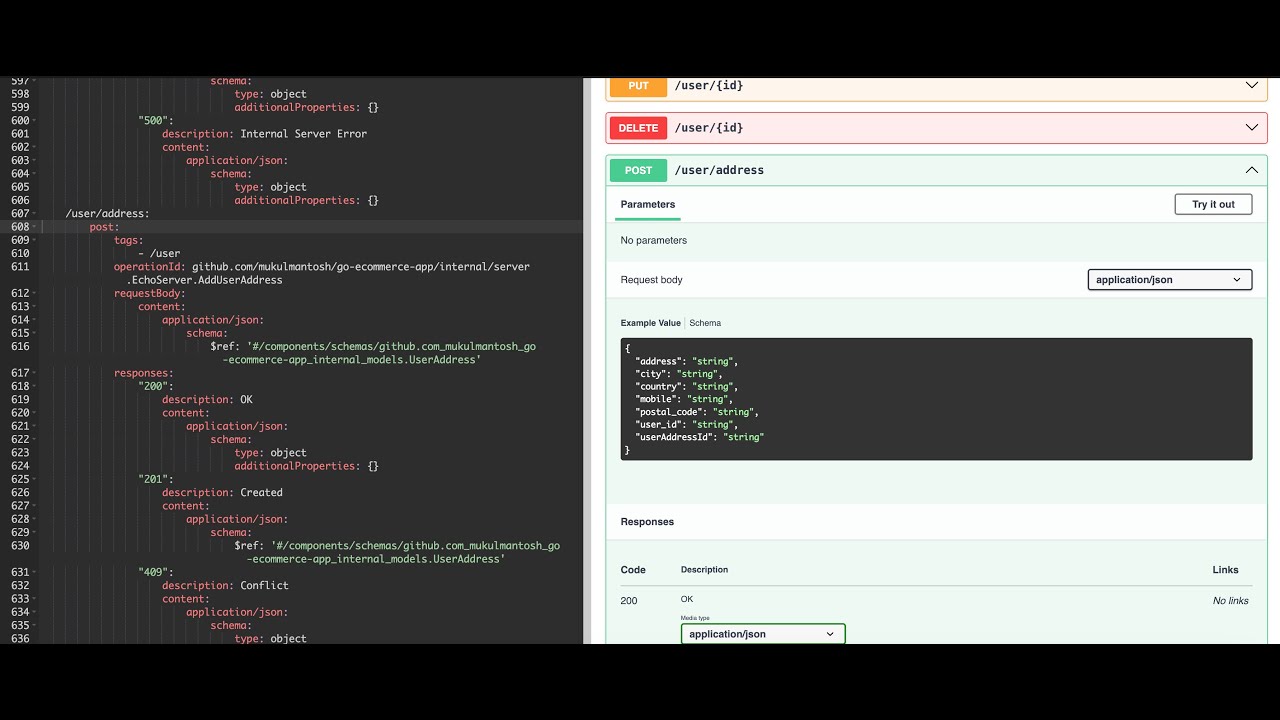
Click the image above to watch the full demo on YouTube
Features
- Automated OpenAPI: Generate OpenAPI 3.1 from real Go code.
- Framework-aware: Detects Gin, Echo, Chi, Fiber, and net/http automatically.
- Accurate by analysis: Builds a call graph to resolve handlers, parameters, bodies, and responses.
- Configurable: YAML config plus CLI flags; flags always win.
- Visualize: Optional HTML call-graph diagram for debugging.
- Extensible: Pattern-based framework config; add new frameworks without changing core logic.
- Smart Type Resolution: Automatically resolves underlying primitive types for aliases and enums.
- Array Type Support: Comprehensive handling of Go arrays including fixed-size arrays (
[16]byte) and variable-length arrays ([...]int). - External Type Resolution: Automatically resolves external package types to their underlying primitives while preserving internal project types.
- Validator Tag Support: Comprehensive support for go-playground/validator tags with automatic OpenAPI constraint mapping.
- Function Literal Analysis: Full support for anonymous functions in route handlers.
- Comprehensive Error Handling: Robust handling of edge cases and invalid inputs.
- Performance Profiling: Built-in CPU, memory, block, mutex, and trace profiling for performance analysis.
- Configurable Limits: Fine-tune analysis limits for large codebases with detailed warning messages.
- CGO Support: Skip CGO packages during analysis to avoid build errors.
Note: Generating call-graph diagrams and metadata files consumes additional resources and time.
Framework Support
Gorilla Mux
- [x] Route registration: Detects
HandleFuncandHandlecalls with path and handler arguments - [x] Handler function detection: Identifies handler functions passed as arguments to route registration
- [x] HTTP method extraction: Automatically extracts HTTP methods from handler function names or explicit method calls
- [x] Path parameter detection: Recognizes path parameters in route patterns (e.g.,
/users/{id}) - [x] Subrouter support: Handles nested routing with
PathPrefixandSubrouter - [ ] Parameter extraction: Path parameters are not yet fully resolved to handler function parameters
- [ ] Conditional routing: Dynamic route registration based on runtime conditions is not supported
Other Frameworks
- [x] Gin: Full support for route registration, and parameter handling
- [x] Chi: Full support for route mounting, grouping, parameter extraction, and render package integration
- [x] Echo: Full support for route registration, grouping, and parameter handling
- [x] Fiber: Full support for route registration, grouping, and parameter handling
- [x] Standard net/http: Basic support for
HandleFuncandHandlecalls
Golang Feature Support
APISpec focuses on practical coverage for real-world services. Current coverage includes:
- [x] Alias imports: supports import aliases in analysis.
- [x] Alias types: type aliases are detected and resolved to underlying primitive types.
- [x] Enum resolution: automatically resolves enum types to their underlying primitive types (string, int, etc.) from constants, enum tags, or oneof validator tags.
- [x] Assignment and alias tracking: short
:=,=, multi-assign, tuple returns, latest-wins resolution, alias chains, and shadowing. - [ ] Conditional methods: detecting HTTP methods set via switch/if around net/http
Handle/HandleFuncis not supported. - [x] Composite literals / maps / slices / arrays: recognizes literal and container types for schema mapping.
- [x] Array type support: comprehensive handling of fixed-size arrays (
[16]byte,[5]int) and variable-length arrays ([...]int). - [x] Dependency injection: supports route grouping mounted via dependency injection.
- [ ] Duplicate status codes: paths with the same status code and different schemas are not yet supported.
- [x] External type introspection: types from external packages are automatically resolved to their underlying primitives; complex external types can be defined via
externalTypesin config. - [x] Generics (functions): detects type parameters and maps concrete types at call sites.
- [ ] Generics (types): generic struct and type instantiation are partially supported.
- [ ] Inferred status codes: status codes assigned via variables are not inferred.
- [x] Interfaces: captures interface types and methods; unresolved dynamic values are represented generically.
- [x] Chain calls: efficiently processes method chaining and establishes parent-child relationships in the call graph.
- [x] Nested calls: handles chained/method calls and nested expressions.
- [x] Parameter tracing across calls: follows arguments across the call graph; maps function parameters to call arguments.
- [ ] Interface param resolution: interface type parameters in functions are not yet fully resolved to concrete types.
- [ ] Parent object type tracing: limited ability to trace the receiver/parent type;
Decodeon non-body targets may be misclassified. - [x] Pointers and dereference: detects
*Tand automatically dereferences when configured. - [x] Selectors and field access: resolves
pkg.Type.Fieldand nested selectors where possible. - [x] Struct fields: reads field types, embedded fields, and struct tags (
json,xml,form, etc.). - [x] Nested struct types: supports anonymous nested structs within struct fields, preserving complete type information for accurate schema generation.
- [x] Function and method return types: automatically resolves and captures return types from function signatures, enabling accurate type resolution in pattern matchers.
- [x] CGO support: includes a flag to skip CGO packages during analysis, useful for projects with complex C dependencies.
- [x] Function literals: supports anonymous functions (func literals) in route handlers and call analysis.
- [x] Validator tag support: comprehensive support for go-playground/validator tags including validation rules, constraints, and enum definitions.
Type Resolution Examples
APISpec automatically resolves underlying types for aliases and enums:
// Enum types are resolved to their underlying primitive type
type AllowedUserType string

const (
    UserTypeAdmin AllowedUserType = "admin"
    UserTypeCustomer AllowedUserType = "user"
)

// In your struct, AllowedUserTypes will be resolved to []string
type Permission struct {
    ID                string
    Resource          string
    Operation         string
    AllowedUserTypes  []domain.AllowedUserType  // Resolves to []string
}

// Generated OpenAPI schema:
// AllowedUserTypes:
//   type: array
//   items:
//     type: string
// Pointer aliases are also resolved
type UserID *int64

type User struct {
    ID UserID  // Resolves to integer
}

// Generated OpenAPI schema:
// ID:
//   type: integer
//   format: int64
Array Type Support
APISpec provides comprehensive support for Go arrays, including fixed-size arrays and variable-length arrays:
// Fixed-size byte arrays are converted to string with maxLength
type User struct {
    ID       [16]byte  // Converts to string with format: "byte", maxLength: 16
    Token    [32]byte  // Converts to string with format: "byte", maxLength: 32
    Scores   [5]int    // Converts to array with maxItems: 5, minItems: 5
    Tags     [10]string // Converts to array with maxItems: 10, minItems: 10
}

// Variable-length arrays
type Config struct {
    Values [...]int    // Converts to array without size constraints
}
Generated
Related Skills
vue-3d-experience-skill
A comprehensive learning roadmap for mastering 3D Creative Development using Vue 3, Nuxt, and TresJS.
next
A beautifully designed, floating Pomodoro timer that respects your workspace.
roadmap
A beautifully designed, floating Pomodoro timer that respects your workspace.
progress
A beautifully designed, floating Pomodoro timer that respects your workspace.
