
PairwiseListMatrices.jl
Symmetric matrix as a list of the values in its upper or lower triangular part. Useful for representing pairwise measures or comparisons when the used metric or distance satisfies the symmetry condition and for adjacency matrices of undirected graphs.
Install / Use
/learn @diegozea/PairwiseListMatrices.jlREADME
PairwiseListMatrices
Linux, OSX: 
Windows:
Code Coverage: 

Documentation


Description
This package allows you to use a pairwise list as a matrix:
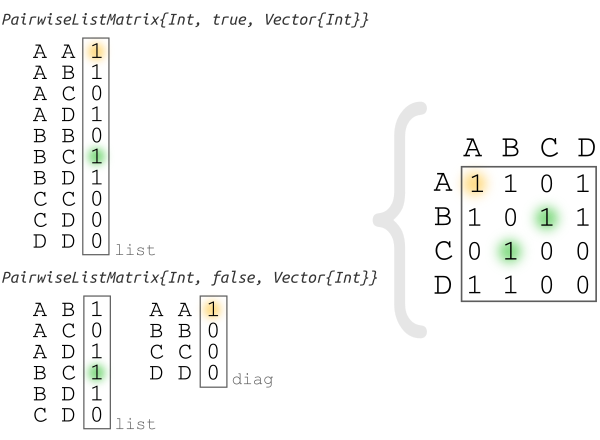
mutable struct PairwiseListMatrix{T,diagonal,VT} <: AbstractArray{T, 2}
    list::VT
    diag::VT
    nelements::Int
    ...
end
PairwiseListMatrix{T, diagonal, VT} is a (squared) symmetric matrix that stores a list
of type VT with values of type T for the pairwise comparison/evaluation of nelements.
If diagonal is true the first element of the list is 1, 1 otherwise is 1, 2.
If diagonal is false the diagonal values are stored in a vector on the diag field.
Features
Space
In pairwise calculations like cor() if results are saved as PairwiseListMatrix the
space is N(N+1)/2 instead of N*N. This is useful to compare a large number of elements,
because you are saving ~ 50% of the memory.
Time
PairwiseListMatrix is faster than a full matrix to make operatation like sum and
mean in the whole matrix, since it is cache efficient. However it is slower than a full
matrix for reducing along dimensions.
Example
julia> # Pkg.add("PairwiseListMatrices")

julia> using PairwiseListMatrices

julia> plm  = PairwiseListMatrix([1,2,3], false)
3×3 PairwiseListMatrices.PairwiseListMatrix{Int64,false,Array{Int64,1}}:
 0  1  2
 1  0  3
 2  3  0

julia> nplm  = setlabels(plm, ["a","b","c"])
3×3 Named PairwiseListMatrices.PairwiseListMatrix{Int64,false,Array{Int64,1}}
A ╲ B │ a  b  c
──────┼────────
a     │ 0  1  2
b     │ 1  0  3
c     │ 2  3  0

julia> table = to_table(nplm)
6×3 Matrix{Any}:
 "a"  "a"  0
 "a"  "b"  1
 "a"  "c"  2
 "b"  "b"  0
 "b"  "c"  3
 "c"  "c"  0

julia> from_table(table, true)
3×3 Named PairwiseListMatrix{Any, true, Vector{Any}}
A ╲ B │ a  b  c
──────┼────────
a     │ 0  1  2
b     │ 1  0  3
c     │ 2  3  0
