
MxNet.Sharp
.NET Standard bindings for Apache MxNet with Imperative, Symbolic and Gluon Interface for developing, training and deploying Machine Learning models in C#. https://mxnet.tech-quantum.com/
Install / Use
/learn @deepakkumar1984/MxNet.SharpREADME
Work In Progress version 2.0.
There are many breaking change as per RFC: https://github.com/apache/incubator-mxnet/issues/16167. With this change we are introducing NumPy-compatible coding experience into MXNet


Apache MXNet (incubating) for Deep Learning
Apache MXNet (incubating) is a deep learning framework designed for both efficiency and flexibility. It allows you to mix symbolic and imperative programming to maximize efficiency and productivity. At its core, MXNet contains a dynamic dependency scheduler that automatically parallelizes both symbolic and imperative operations on the fly. A graph optimization layer on top of that makes symbolic execution fast and memory efficient. MXNet is portable and lightweight, scaling effectively to multiple GPUs and multiple machines.
MxNet.Sharp
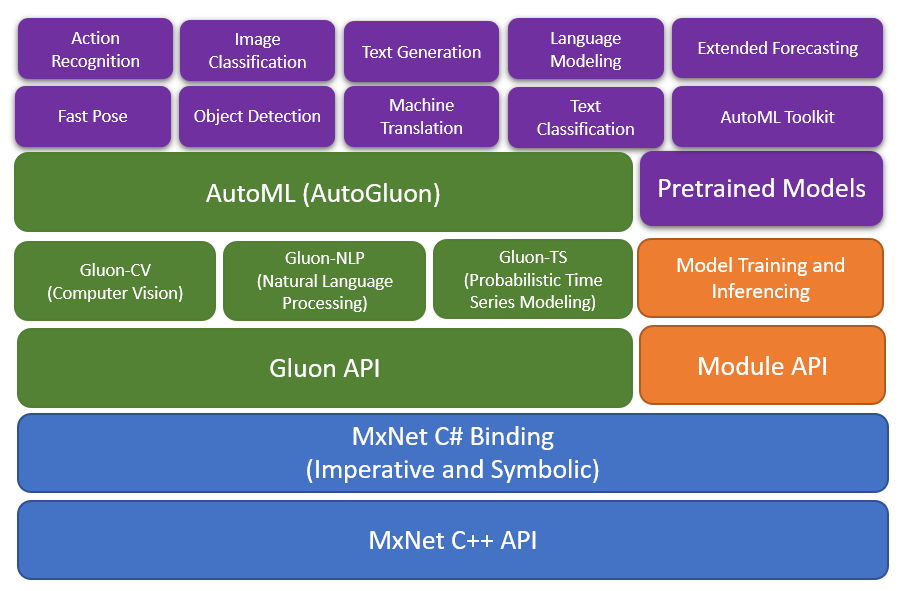
MxNet.Sharp is a CSharp binding coving all the Imperative, Symbolic and Gluon API's with an easy to use interface. The Gluon library in Apache MXNet provides a clear, concise, and simple API for deep learning. It makes it easy to prototype, build, and train deep learning models without sacrificing training speed.
High Level Arch
A New NumPy Interface for MxNet#
The MXNet community is pleased to announce a new NumPy interface for MXNet that allows developers to retain the familiar syntax of NumPy, while leveraging performance gains from accelerated computing on GPUs and asynchronous execution on CPUs and GPUs, in addition to automatic differentiation for differentiable NumPy ops through MxNet.Autograd.
The new NumPy interface from MXNet, MxNet.Numpy, is intended to be a drop-in replacement for NumPy, as such mxnet.numpy supports many familiar numpy.ndarray operations necessary for developing machine learning or deep learning models and operations are continually being added.
Work List
- [x] Project prep work for v2
- [x] Adding numpy ndarray array object and properties
- [x] Implementing numpy creation function
- [x] Implementing numpy elementwise
- [x] Numpy basic indexing
- [ ] Numpy advance indexing
- [x] Nummy linear algebra functions
- [x] Numpy manipulation functions
- [x] Numpy search and sorting functions
- [ ] Numpy statistical functions
- [ ] Gluon updates with numpy ops
- [x] Implement numpy extension functions for neural network
- [ ] Gluon probability
- [ ] Mxnet 2 Onnx and Onnx 2 Mxnet
- [ ] More examples
- [ ] Unit testing
- [x] CI Builds
MxNet.Numpy Vs NumPy Performance
Lets consider simple test to see the performance difference. I will keep adding more scenarios and with GPU test as well.
Scenario 1
using MxNet;
using MxNet.Numpy;
using System;

namespace PerfTest
{
    class Program
    {
        static void Main(string[] args)
        {
            DateTime start = DateTime.Now;
            var x = np.random.uniform(size: new Shape(3000, 3000));
            var y = np.random.uniform(size: new Shape(3000, 3000));
            var d = np.dot(x, y);
            npx.waitall();
            Console.WriteLine(d.shape);
            Console.WriteLine("Duration: " + (DateTime.Now - start).TotalMilliseconds / 1000);
        }
    }
}
import numpy as np
import time

start_time = time.time()
x = np.random.uniform(0, 1, (3000, 1000))
y = np.random.uniform(0, 1, (3000, 3000))
d = np.dot(x, y);
#d = 0.5 * np.sqrt(x) + np.sin(y) * np.log(x) - np.exp(y)
print(d.shape)
print("--- %s sec ---" % (time.time() - start_time))
Scenario 2
using MxNet;
using MxNet.Numpy;
using System;

namespace PerfTest
{
    class Program
    {
        static void Main(string[] args)
        {
            DateTime start = DateTime.Now;
            var x = np.random.uniform(size: new Shape(30000, 10000));
            var y = np.random.uniform(size: new Shape(30000, 10000));
            var d = 0.5f * np.sqrt(x) + np.sin(y) * np.log(x) - np.exp(y);
            npx.waitall();
            Console.WriteLine(d.shape);
            Console.WriteLine("Duration: " + (DateTime.Now - start).TotalMilliseconds / 1000);
        }
    }
}
import numpy as np
import time

start_time = time.time()
x = np.random.uniform(0, 1, (30000, 10000))
y = np.random.uniform(0, 1, (30000, 10000))
d = 0.5 * np.sqrt(x) + np.sin(y) * np.log(x) - np.exp(y)
print(d.shape)
print("--- %s sec ---" % (time.time() - start_time))
| Scenario|MxNet CPU|NumPy| | --- |--- |---| | 1| 1.2247| 145.4460| | 2| 24.4994| 14.3616|
Nuget
Install the package: Install-Package MxNet.Sharp
https://www.nuget.org/packages/MxNet.Sharp
Add the MxNet redistributed package available as per below.
Important: Make sure your installed CUDA version matches the CUDA version in the nuget package.
Check your CUDA version with the following command:
nvcc --version
You can either upgrade your CUDA install or install the MXNet package that supports your CUDA version.
MxNet Version Build: https://github.com/apache/incubator-mxnet/releases/tag/1.5.0
Win-x64 Packages
| Type | Name | Nuget | |----------------|------------------------------------------|-------------------------------------------------| | MxNet-CPU | MxNet CPU Version | Install-Package MxNet.Runtime.Redist | | MxNet-MKL | MxNet CPU with MKL | Install-Package MxNet-MKL.Runtime.Redist | | MxNet-CU101 | MxNet for Cuda 10.1 and CuDnn 7 | Install-Package MxNet-CU101.Runtime.Redist | | MxNet-CU101MKL | MxNet for Cuda 10.1 and CuDnn 7 | Install-Package MxNet-CU101MKL.Runtime.Redist | | MxNet-CU100 | MxNet for Cuda 10 and CuDnn 7 | Install-Package MxNet-CU100.Runtime.Redist | | MxNet-CU100MKL | MxNet with MKL for Cuda 10 and CuDnn 7 | Install-Package MxNet-CU100MKL.Runtime.Redist | | MxNet-CU92 | MxNet for Cuda 9.2 and CuDnn 7 | Install-Package MxNet-CU100.Runtime.Redist | | MxNet-CU92MKL | MxNet with MKL for Cuda 9.2 and CuDnn 7 | Install-Package MxNet-CU92MKL.Runtime.Redist | | MxNet-CU80 | MxNet for Cuda 8.0 and CuDnn 7 | Install-Package MxNet-CU100.Runtime.Redist | | MxNet-CU80MKL | MxNet with MKL for Cuda 8.0 and CuDnn 7 | Install-Package MxNet-CU80MKL.Runtime.Redist |
Linux-x64 Packages
| Type | Name | Nuget | |----------------|------------------------------------------|---------------------------------------------------| | MxNet-CPU | MxNet CPU Version | Install-Package MxNet.Linux.Runtime.Redist | | MxNet-MKL | MxNet CPU with MKL | Install-Package MxNet-MKL.Linux.Runtime.Redist | | MxNet-CU101 | MxNet for Cuda 10.1 and CuDnn 7 | Yet to publish | | MxNet-CU101MKL | MxNet for Cuda 10.1 and CuDnn 7 | Yet to publish | | MxNet-CU100 | MxNet for Cuda 10 and CuDnn 7 | Yet to publish | | MxNet-CU100MKL | MxNet with MKL for Cuda 10 and CuDnn 7 | Yet to publish | | MxNet-CU92 | MxNet for Cuda 9.2 and CuDnn 7 | Yet to publish | | MxNet-CU92MKL | MxNet with MKL for Cuda 9.2 and CuDnn 7 | Yet to publish | | MxNet-CU80 | MxNet for Cuda 8.0 and CuDnn 7 | Yet to publish | | MxNet-CU80MKL | MxNet with MKL for Cuda 8.0 and CuDnn 7 | Yet to publish |
OSX-x64 Packages
| Type | Name | Nuget | |----------------|------------------------------------------|---------------------------------------------------| | MxNet-CPU | MxNet CPU Version | Yet to publish | | MxNet-MKL | MxNet CPU with MKL | Yet to publish | | MxNet-CU101 | MxNet for Cuda 10.1 and CuDnn 7 | Yet to publish | | MxNet-CU101MKL | MxNet for Cuda 10.1 and CuDnn 7 | Yet to publish | | MxNet-CU100 | MxNet for Cuda 10 and CuDnn 7 | Yet to publish | | MxNet-CU100MKL | MxNet with MKL for Cuda 10 and CuDnn 7 | Yet to publish | | MxNet-CU92 | MxNet for Cuda 9.2 and CuDnn 7 | Yet to publish | | MxNet-CU92MKL | MxNet with MKL for Cuda 9.2 and CuDnn 7 | Yet to publish | | MxNet-CU80 | MxNet for Cuda 8.0 and CuDnn 7 | Yet to publish | | MxNet-CU80MKL | MxNet with MKL for Cuda 8.0 and CuDnn 7 | Yet to publish |
Gluon MNIST Example
Demo as per: https://mxnet.apache.org/api/pyth
Related Skills
tmux
338.0kRemote-control tmux sessions for interactive CLIs by sending keystrokes and scraping pane output.
blogwatcher
338.0kMonitor blogs and RSS/Atom feeds for updates using the blogwatcher CLI.
Unla
2.1k🧩 MCP Gateway - A lightweight gateway service that instantly transforms existing MCP Servers and APIs into MCP servers with zero code changes. Features Docker deployment and management UI, requiring no infrastructure modifications.
github-trending
Multi-agent orchestration system for infrastructure monitoring, incident response, and load testing with autonomous AI agents
