
Pattern
Web mining module for Python, with tools for scraping, natural language processing, machine learning, network analysis and visualization.
Install / Use
/learn @clips/PatternREADME
Pattern




Pattern is a web mining module for Python. It has tools for:
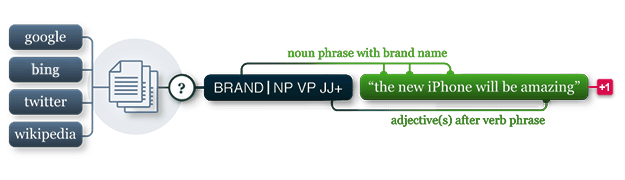
- Data Mining: web services (Google, Twitter, Wikipedia), web crawler, HTML DOM parser
- Natural Language Processing: part-of-speech taggers, n-gram search, sentiment analysis, WordNet
- Machine Learning: vector space model, clustering, classification (KNN, SVM, Perceptron)
- Network Analysis: graph centrality and visualization.
It is well documented, thoroughly tested with 350+ unit tests and comes bundled with 50+ examples. The source code is licensed under BSD.
Example
This example trains a classifier on adjectives mined from Twitter using Python 3. First, tweets that contain hashtag #win or #fail are collected. For example: "$20 tip off a sweet little old lady today #win". The word part-of-speech tags are then parsed, keeping only adjectives. Each tweet is transformed to a vector, a dictionary of adjective → count items, labeled WIN or FAIL. The classifier uses the vectors to learn which other tweets look more like WIN or more like FAIL.
from pattern.web import Twitter
from pattern.en import tag
from pattern.vector import KNN, count

twitter, knn = Twitter(), KNN()

for i in range(1, 3):
    for tweet in twitter.search('#win OR #fail', start=i, count=100):
        s = tweet.text.lower()
        p = '#win' in s and 'WIN' or 'FAIL'
        v = tag(s)
        v = [word for word, pos in v if pos == 'JJ'] # JJ = adjective
        v = count(v) # {'sweet': 1}
        if v:
            knn.train(v, type=p)

print(knn.classify('sweet potato burger'))
print(knn.classify('stupid autocorrect'))
Installation
Pattern supports Python 2.7 and Python 3.6. To install Pattern so that it is available in all your scripts, unzip the download and from the command line do:
cd pattern-3.6
python setup.py install
If you have pip, you can automatically download and install from the PyPI repository:
pip install pattern
If none of the above works, you can make Python aware of the module in three ways:
- Put the pattern folder in the same folder as your script.
- Put the pattern folder in the standard location for modules so it is available to all scripts:
c:\python36\Lib\site-packages\(Windows),/Library/Python/3.6/site-packages/(Mac OS X),/usr/lib/python3.6/site-packages/(Unix).
- Add the location of the module to
sys.pathin your script, before importing it:
MODULE = '/users/tom/desktop/pattern'
import sys; if MODULE not in sys.path: sys.path.append(MODULE)
from pattern.en import parsetree
Documentation
For documentation and examples see the user documentation.
Version
3.6
License
BSD, see LICENSE.txt for further details.
Reference
De Smedt, T., Daelemans, W. (2012). Pattern for Python. Journal of Machine Learning Research, 13, 2031–2035.
Contribute
The source code is hosted on GitHub and contributions or donations are welcomed.
Bundled dependencies
Pattern is bundled with the following data sets, algorithms and Python packages:
- Brill tagger, Eric Brill
- Brill tagger for Dutch, Jeroen Geertzen
- Brill tagger for German, Gerold Schneider & Martin Volk
- Brill tagger for Spanish, trained on Wikicorpus (Samuel Reese & Gemma Boleda et al.)
- Brill tagger for French, trained on Lefff (Benoît Sagot & Lionel Clément et al.)
- Brill tagger for Italian, mined from Wiktionary
- English pluralization, Damian Conway
- Spanish verb inflection, Fred Jehle
- French verb inflection, Bob Salita
- Graph JavaScript framework, Aslak Hellesoy & Dave Hoover
- LIBSVM, Chih-Chung Chang & Chih-Jen Lin
- LIBLINEAR, Rong-En Fan et al.
- NetworkX centrality, Aric Hagberg, Dan Schult & Pieter Swart
- spelling corrector, Peter Norvig
Acknowledgements
Authors:
- Tom De Smedt (tom@organisms.be)
- Walter Daelemans (walter.daelemans@ua.ac.be)
Contributors (chronological):
- Frederik De Bleser
- Jason Wiener
- Daniel Friesen
- Jeroen Geertzen
- Thomas Crombez
- Ken Williams
- Peteris Erins
- Rajesh Nair
- F. De Smedt
- Radim Řehůřek
- Tom Loredo
- John DeBovis
- Thomas Sileo
- Gerold Schneider
- Martin Volk
- Samuel Joseph
- Shubhanshu Mishra
- Robert Elwell
- Fred Jehle
- Antoine Mazières + fabelier.org
- Rémi de Zoeten + closealert.nl
- Kenneth Koch
- Jens Grivolla
- Fabio Marfia
- Steven Loria
- Colin Molter + tevizz.com
- Peter Bull
- Maurizio Sambati
- Dan Fu
- Salvatore Di Dio
- Vincent Van Asch
- Frederik Elwert
Related Skills
claude-opus-4-5-migration
82.0kMigrate prompts and code from Claude Sonnet 4.0, Sonnet 4.5, or Opus 4.1 to Opus 4.5
model-usage
333.3kUse CodexBar CLI local cost usage to summarize per-model usage for Codex or Claude, including the current (most recent) model or a full model breakdown. Trigger when asked for model-level usage/cost data from codexbar, or when you need a scriptable per-model summary from codexbar cost JSON.
mcp-for-beginners
15.6kThis open-source curriculum introduces the fundamentals of Model Context Protocol (MCP) through real-world, cross-language examples in .NET, Java, TypeScript, JavaScript, Rust and Python. Designed for developers, it focuses on practical techniques for building modular, scalable, and secure AI workflows from session setup to service orchestration.
TrendRadar
49.7k⭐AI-driven public opinion & trend monitor with multi-platform aggregation, RSS, and smart alerts.🎯 告别信息过载,你的 AI 舆情监控助手与热点筛选工具!聚合多平台热点 + RSS 订阅,支持关键词精准筛选。AI 智能筛选新闻 + AI 翻译 + AI 分析简报直推手机,也支持接入 MCP 架构,赋能 AI 自然语言对话分析、情感洞察与趋势预测等。支持 Docker ,数据本地/云端自持。集成微信/飞书/钉钉/Telegram/邮件/ntfy/bark/slack 等渠道智能推送。
