
DBCV
Python implementation of Density-Based Clustering Validation
Install / Use
/learn @christopherjenness/DBCVREADME
DBCV
Python implementation of Density-Based Clustering Validation
Source
Moulavi, Davoud, et al. "Density-based clustering validation." Proceedings of the 2014 SIAM International Conference on Data Mining. Society for Industrial and Applied Mathematics, 2014.
What is DBCV
How do you validate clustering assignmnets from unsupervised learning algorithms? A common method is the Silhoette Method, which provides an objective score between -1 and 1 on the quality of clustering. The silhouette value measures how well an object is classified in its own cluster instead of neighboring clusters. The silhouette (and most other popular methods) work very well on globular clusters, but can fail on non-glubular clusters such as:
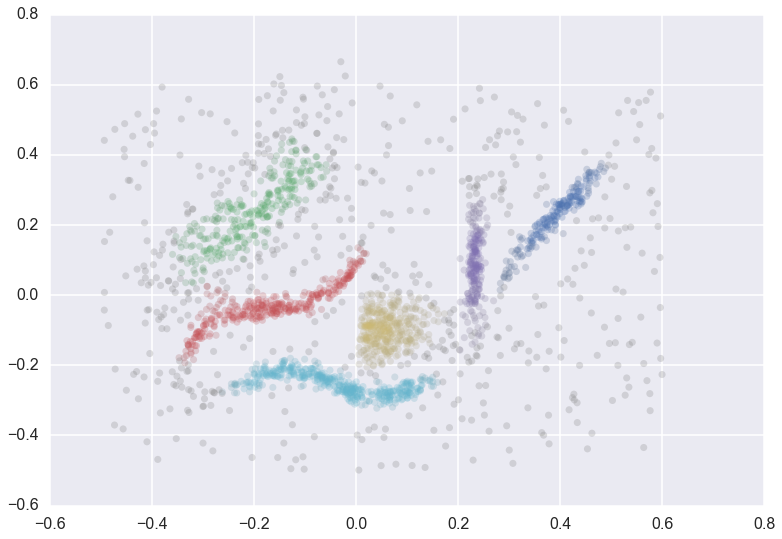
Here, we implement DBCV which can validate clustering assignments on non-globular, arbitrarily shaped clusters (such as the example above). In essence, DBCV computes two values:
- The density within a cluster
- The density between clusters
High density within a cluster, and low density between clusters indicates good clustering assignments.
Example
Here, I deliberately picked an example of clusters that density based clustering works well on.
from sklearn import datasets
import matplotlib.pyplot as plt
import seaborn as sns

n_samples=150
noisy_moons = datasets.make_moons(n_samples=n_samples, noise=.05)
X = noisy_moons[0]
plt.scatter(X[:,0], X[:,1])
plt.show()

What happens when we try K-means clustering on these non-globular clusters?
from sklearn.cluster import KMeans

kmeans =  KMeans(n_clusters=2)
kmeans_labels = kmeans.fit_predict(X)
plt.scatter(X[:,0], X[:,1], c=kmeans_labels)
plt.show()

...Not so great. What about HDBSCAN, a density based clustering method?
import hdbscan

hdbscanner = hdbscan.HDBSCAN()
hdbscan_labels = hdbscanner.fit_predict(X)
plt.scatter(X[:,0], X[:,1], c=hdbscan_labels)

That's pretty good. To assess the quality of clustering, using Density-Based Clustering Validation, we call DBCV
from scipy.spatial.distance import euclidean

kmeans_score = DBCV(X, kmeans_labels, dist_function=euclidean)
hdbscan_score = DBCV(X, hdbscan_labels, dist_function=euclidean)
print(kmeans_score, hdbscan_score)
K means returns a DBCV score of -0.71, and HDBSCAN returns a score of 0.60.
Related Skills
proje
Interactive vocabulary learning platform with smart flashcards and spaced repetition for effective language acquisition.
YC-Killer
2.7kA library of enterprise-grade AI agents designed to democratize artificial intelligence and provide free, open-source alternatives to overvalued Y Combinator startups. If you are excited about democratizing AI access & AI agents, please star ⭐️ this repository and use the link in the readme to join our open source AI research team.
best-practices-researcher
The most comprehensive Claude Code skills registry | Web Search: https://skills-registry-web.vercel.app
groundhog
400Groundhog's primary purpose is to teach people how Cursor and all these other coding agents work under the hood. If you understand how these coding assistants work from first principles, then you can drive these tools harder (or perhaps make your own!).
