
Blessed
A high-level terminal interface library for node.js.
Install / Use
/learn @chjj/BlessedREADME
blessed
A curses-like library with a high level terminal interface API for node.js.
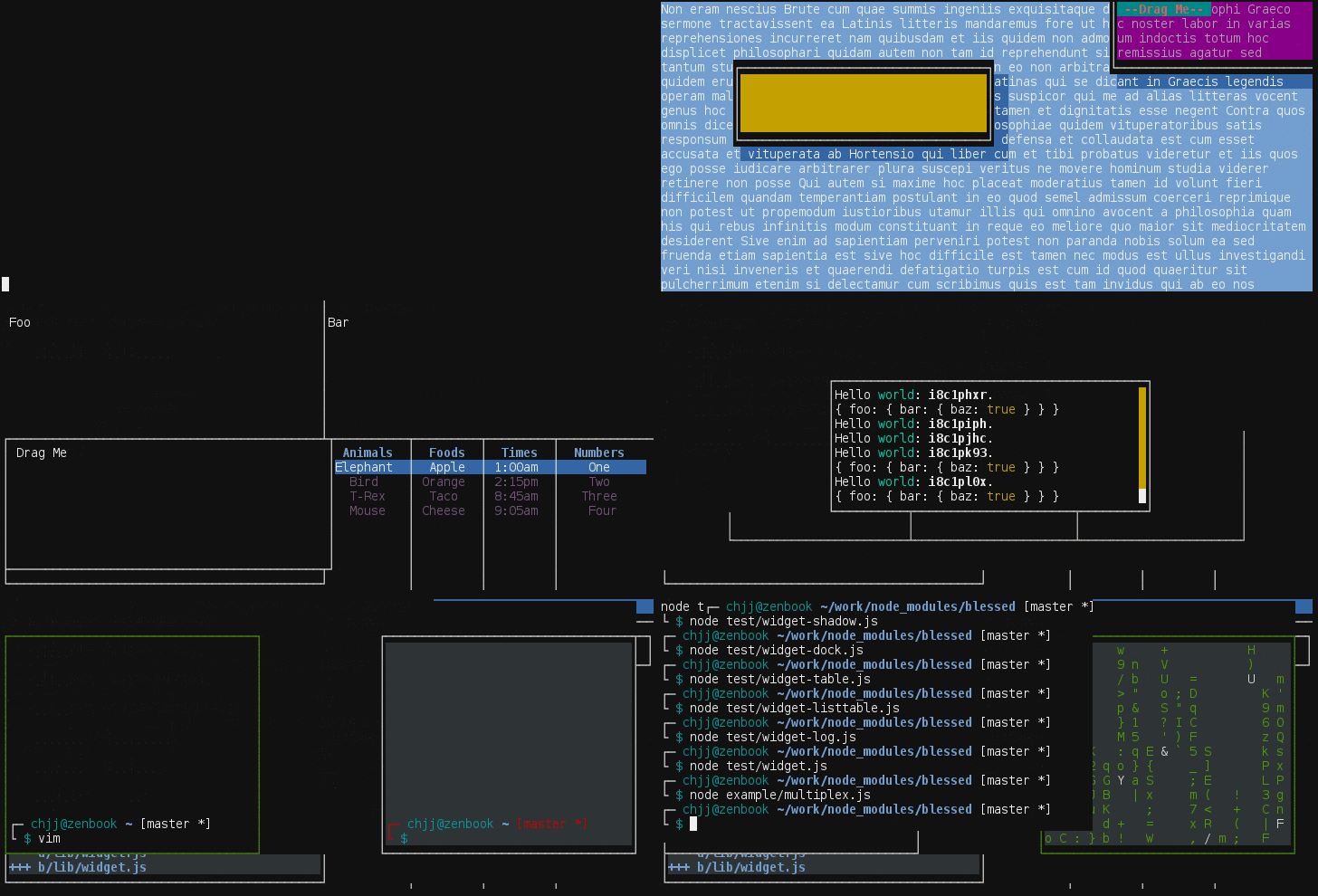
Blessed is over 16,000 lines of code and terminal goodness. It's completely implemented in javascript, and its goal consists of two things:
-
Reimplement ncurses entirely by parsing and compiling terminfo and termcap, and exposing a
Programobject which can output escape sequences compatible with any terminal. -
Implement a widget API which is heavily optimized for terminals.
The blessed renderer makes use of CSR (change-scroll-region), and BCE (back-color-erase). It draws the screen using the painter's algorithm and is sped up with smart cursor movements and a screen damage buffer. This means rendering of your application will be extremely efficient: blessed only draws the changes (damage) to the screen.
Blessed is arguably as accurate as ncurses, but even more optimized in some ways. The widget library gives you an API which is reminiscent of the DOM. Anyone is able to make an awesome terminal application with blessed. There are terminal widget libraries for other platforms (primarily [python][urwid] and [perl][curses-ui]), but blessed is possibly the most DOM-like (dare I say the most user-friendly?).
Blessed has been used to implement other popular libraries and programs. Examples include: the [slap text editor][slap] and [blessed-contrib][contrib]. The blessed API itself has gone on to inspire [termui][termui] for Go.
Install
$ npm install blessed
Example
This will render a box with line borders containing the text 'Hello world!',
perfectly centered horizontally and vertically.
NOTE: It is recommend you use either smartCSR or fastCSR as a
blessed.screen option. This will enable CSR when scrolling text in elements
or when manipulating lines.
var blessed = require('blessed');

// Create a screen object.
var screen = blessed.screen({
  smartCSR: true
});

screen.title = 'my window title';

// Create a box perfectly centered horizontally and vertically.
var box = blessed.box({
  top: 'center',
  left: 'center',
  width: '50%',
  height: '50%',
  content: 'Hello {bold}world{/bold}!',
  tags: true,
  border: {
    type: 'line'
  },
  style: {
    fg: 'white',
    bg: 'magenta',
    border: {
      fg: '#f0f0f0'
    },
    hover: {
      bg: 'green'
    }
  }
});

// Append our box to the screen.
screen.append(box);

// Add a png icon to the box
var icon = blessed.image({
  parent: box,
  top: 0,
  left: 0,
  type: 'overlay',
  width: 'shrink',
  height: 'shrink',
  file: __dirname + '/my-program-icon.png',
  search: false
});

// If our box is clicked, change the content.
box.on('click', function(data) {
  box.setContent('{center}Some different {red-fg}content{/red-fg}.{/center}');
  screen.render();
});

// If box is focused, handle `enter`/`return` and give us some more content.
box.key('enter', function(ch, key) {
  box.setContent('{right}Even different {black-fg}content{/black-fg}.{/right}\n');
  box.setLine(1, 'bar');
  box.insertLine(1, 'foo');
  screen.render();
});

// Quit on Escape, q, or Control-C.
screen.key(['escape', 'q', 'C-c'], function(ch, key) {
  return process.exit(0);
});

// Focus our element.
box.focus();

// Render the screen.
screen.render();
Documentation
Widgets
- Base Nodes
- Boxes
- Box
- Text
- Line
- ScrollableBox (deprecated)
- ScrollableText (deprecated)
- BigText
- Lists
- Forms
- Prompts
- Data Display
- Special Elements
Other
Mechanics
- Content & Tags
- Style
- Events
- Poisitioning
- Rendering
- Artificial Cursors
- Multiple Screens
- Server Side Usage
Notes
Widgets
Blessed comes with a number of high-level widgets so you can avoid all the nasty low-level terminal stuff.
Base Nodes
Node (from EventEmitter)
The base node which everything inherits from.
Options:
- screen - The screen to be associated with.
- parent - The desired parent.
- children - An arrray of children.
Properties:
- Inherits all from EventEmitter.
- type - Type of the node (e.g.
box). - options - Original options object.
- parent - Parent node.
- screen - Parent screen.
- children - Array of node's children.
- _data, , $ - An object for any miscellanous user data.
- index - Render index (document order index) of the last render call.
Events:
- Inherits all from EventEmitter.
- adopt - Received when node is added to a parent.
- remove - Received when node is removed from it's current parent.
- reparent - Received when node gains a new parent.
- attach - Received when node is attached to the screen directly or somewhere in its ancestry.
- detach - Received when node is detached from the screen directly or somewhere in its ancestry.
Methods:
- Inherits all from EventEmitter.
- prepend(node) - Prepend a node to this node's children.
- append(node) - Append a node to this node's children.
- remove(node) - Remove child node from node.
- insert(node, i) - Insert a node to this node's children at index
i. - insertBefore(node, refNode) - Insert a node to this node's children before the reference node.
- insertAfter(node, refNode) - Insert a node from node after the reference node.
- detach() - Remove node from its parent.
- emitDescendants(type, args..., [iterator]) - Emit event for element, and recursively emit same event for all descendants.
- get(name, [default]) - Get user property with a potential default value.
- set(name, value) - Set user property to value.
Screen (from Node)
The screen on which every other node renders.
Options:
- program - The blessed
Programto be associated with. Will be automatically instantiated if none is provided. - smartCSR - Attempt to perform CSR optimization on all possible elements (not just full-width ones, elements with uniform cells to their sides). This is known to cause flickering with elements that are not full-width, however, it is more optimal for terminal rendering.
- fastCSR - Do CSR on any element within 20 cols of the screen edge on
either side. Faster than
smartCSR, but may cause flickering depending on what is on each side of the element. - useBCE - Attempt to perform
back_color_eraseoptimizations for terminals that support it. It will also work with terminals that don't support it, but only on lines with the default background color. As it stands with the current implementation, it's uncertain how much terminal performance this adds at the cost of overhead within node. - resizeTimeout - Amount of time (in ms) to redraw the screen after the terminal is resized (Default: 300).
- tabSize - The width of tabs within an element's content.
- autoPadding - Automatically position child elements with border and padding in mind (NOTE: this is a recommended option. It may become default in the future).
- cursor.artificial - Have blessed draw a custom cursor and hide the terminal cursor (experimental).
- cursor.shape - Shape of the cursor. Can be: block, underline, or line.
- cursor.blink - Whether the cursor blinks.
- cursor.color - Color of the color. Accepts any valid color value (
nullis default). - log - Create a log file. See
logmethod. - dump - Dump all output and input to desired file. Can be used together
with
logoption if set as a boolean. - debug - Debug mode. Enables usage of the
debugmethod. Also creates a debug console which will display when pressing F12. It will display all log and debug messages. - ignoreLocked - Array of keys in their full format (e.g.
C-c) to ignore when keys are locked or grabbed. Useful for creating a key that will always exit no matter whether the keys are locked. - dockBorders - Automatically "dock" borders with other elements instead of overlapping, depending on position (experimental). For example: These border-overlap
Related Skills
node-connect
347.0kDiagnose OpenClaw node connection and pairing failures for Android, iOS, and macOS companion apps
frontend-design
107.8kCreate distinctive, production-grade frontend interfaces with high design quality. Use this skill when the user asks to build web components, pages, or applications. Generates creative, polished code that avoids generic AI aesthetics.
openai-whisper-api
347.0kTranscribe audio via OpenAI Audio Transcriptions API (Whisper).
qqbot-media
347.0kQQBot 富媒体收发能力。使用 <qqmedia> 标签,系统根据文件扩展名自动识别类型(图片/语音/视频/文件)。
