
Tspiral
A python package for time series forecasting with scikit-learn estimators.
Install / Use
/learn @cerlymarco/TspiralREADME
tspiral
A python package for time series forecasting with scikit-learn estimators.
tspiral is not a library that works as a wrapper for other tools and methods for time series forecasting. tspiral directly provides scikit-learn estimators for time series forecasting. It leverages the benefit of using scikit-learn syntax and components to easily access the open source ecosystem built on top of the scikit-learn community. It easily maps a complex time series forecasting problems into a tabular supervised regression task, solving it with a standard approach.
Overview
tspiral provides 4 optimized forecasting techniques:
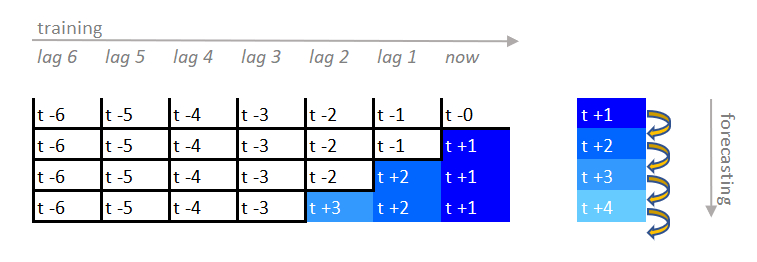
- Recursive Forecasting
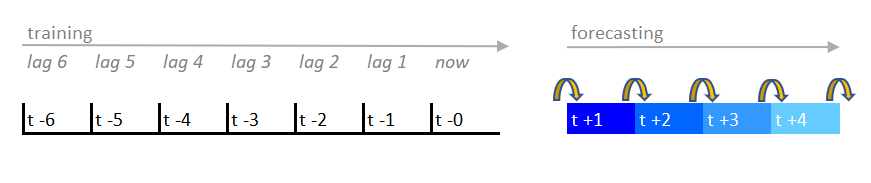
Lagged target features are combined with exogenous regressors (if provided) and lagged exogenous features (if specified). A scikit-learn compatible regressor is fitted on the whole merged data. The fitted estimator is called iteratively to predict multiple steps ahead.
Which in a compact way we can summarize in:
- Direct Forecasting
A scikit-learn compatible regressor is fitted on the lagged data for each time step to forecast.
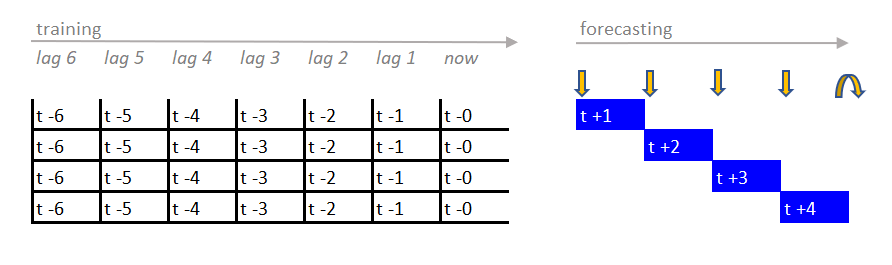
Which in a compact way we can summarize in:

It's also possible to mix recursive and direct forecasting by predicting directly some future horizons while using recursive on the remaining.

- Stacking Forecasting
Multiple recursive time series forecasters are fitted and combined on the final portion of the training data with a meta-learner.
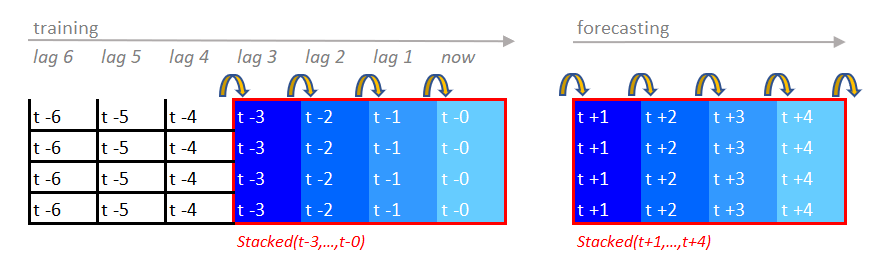
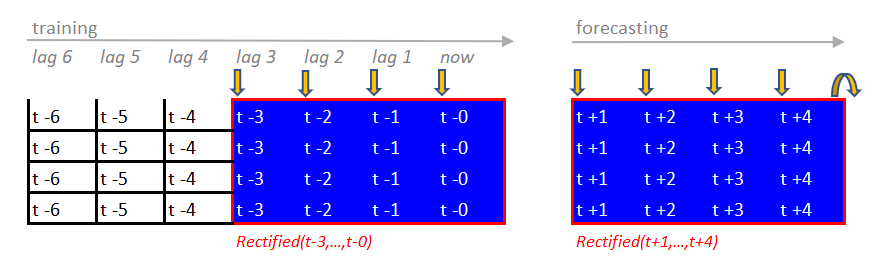
- Rectified Forecasting
Multiple direct time series forecasters are fitted and combined on the final portion of the training data with a meta-learner.
GLOBAL and MULTIVARIATE time series forecasting are natively supported for all the forecasting methods available. For GLOBAL forecasting, use the groups parameter to specify the column of the input data that contains the group identifiers. For MULTIVARIATE forecasting, pass a target with multiple columns when calling fit.
Installation
pip install --upgrade tspiral
The module depends only on NumPy, Pandas, and Scikit-Learn (>=0.24.2). Python 3.6 or above is supported.
Media
- How to Improve Recursive Time Series Forecasting
- Time Series Forecasting with Feature Selection: Why you may need it
- Forecast Time Series with Missing Values: Beyond Linear Interpolation
- Time Series Forecasting with Conformal Prediction Intervals: Scikit-Learn is All you Need
- Hitting Time Forecasting: The Other Way for Time Series Probabilistic Forecasting
- Hitchhiker’s Guide to MLOps for Time Series Forecasting with Sklearn
Usage
- Recursive Forecasting
import numpy as np
from sklearn.linear_model import Ridge
from tspiral.forecasting import ForecastingCascade
timesteps = 400
e = np.random.normal(0,1, (timesteps,))
y = np.concatenate([
    2*np.sin(np.arange(timesteps)*(2*np.pi/24))+e,
    2*np.cos(np.arange(timesteps)*(2*np.pi/24))+e,
])
X = [[0]]*timesteps+[[1]]*timesteps
model = ForecastingCascade(
    Ridge(),
    lags=range(1,24+1),
    groups=[0],
).fit(X, y)
forecasts = model.predict([[0]]*80+[[1]]*80)
- Direct Forecasting
import numpy as np
from sklearn.linear_model import Ridge
from tspiral.forecasting import ForecastingChain
timesteps = 400
e = np.random.normal(0,1, (timesteps,))
y = np.concatenate([
    2*np.sin(np.arange(timesteps)*(2*np.pi/24))+e,
    2*np.cos(np.arange(timesteps)*(2*np.pi/24))+e,
])
X = [[0]]*timesteps+[[1]]*timesteps
model = ForecastingChain(
    Ridge(),
    n_estimators=24,
    lags=range(1,24+1),
    groups=[0],
).fit(X, y)
forecasts = model.predict([[0]]*80+[[1]]*80)
- Stacking Forecasting
import numpy as np
from sklearn.linear_model import Ridge
from sklearn.tree import DecisionTreeRegressor
from tspiral.forecasting import ForecastingStacked
timesteps = 400
e = np.random.normal(0,1, (timesteps,))
y = np.concatenate([
    2*np.sin(np.arange(timesteps)*(2*np.pi/24))+e,
    2*np.cos(np.arange(timesteps)*(2*np.pi/24))+e,
])
X = [[0]]*timesteps+[[1]]*timesteps
model = ForecastingStacked(
    [Ridge(), DecisionTreeRegressor()],
    test_size=24*3,
    lags=range(1,24+1),
    groups=[0],
).fit(X, y)
forecasts = model.predict([[0]]*80+[[1]]*80)
- Rectified Forecasting
import numpy as np
from sklearn.linear_model import Ridge
from sklearn.tree import DecisionTreeRegressor
from tspiral.forecasting import ForecastingRectified
timesteps = 400
e = np.random.normal(0,1, (timesteps,))
y = np.concatenate([
    2*np.sin(np.arange(timesteps)*(2*np.pi/24))+e,
    2*np.cos(np.arange(timesteps)*(2*np.pi/24))+e,
])
X = [[0]]*timesteps+[[1]]*timesteps
model = ForecastingRectified(
    [Ridge(), DecisionTreeRegressor()],
    n_estimators=24*3,
    test_size=24*3,
    lags=range(1,24+1),
    groups=[0],
).fit(X, y)
forecasts = model.predict([[0]]*80+[[1]]*80)
More examples in the notebooks folder.
Related Skills
node-connect
337.3kDiagnose OpenClaw node connection and pairing failures for Android, iOS, and macOS companion apps
claude-opus-4-5-migration
83.2kMigrate prompts and code from Claude Sonnet 4.0, Sonnet 4.5, or Opus 4.1 to Opus 4.5
frontend-design
83.2kCreate distinctive, production-grade frontend interfaces with high design quality. Use this skill when the user asks to build web components, pages, or applications. Generates creative, polished code that avoids generic AI aesthetics.
model-usage
337.3kUse CodexBar CLI local cost usage to summarize per-model usage for Codex or Claude, including the current (most recent) model or a full model breakdown. Trigger when asked for model-level usage/cost data from codexbar, or when you need a scriptable per-model summary from codexbar cost JSON.
