
GeoNames
GeoNames cities search service powered by Algolia
Install / Use
/learn @benjbaron/GeoNamesREADME
GeoNames city search
This project is a city search service powered by Algolia using gazetteer data from GeoNames. This document details the rationale behind the design and implementation of the city search service. The url of this service is the following: https://benjbaron.github.io/GeoNames/. The page shows a search input, just start typing the name of a city and the search box will automatically suggest relevant cities. The source code for the web client is under a different branch of this repository available at this link.
The GeoNames dataset
The data is downloaded from the GeoNames data repository. The GeoNames dataset consists of multiple files, including the following files that are important for the purpose of the service:
allCountries: all countries combined in one file,alternateNamesV2: alternate names with language codes andgeonameId.
Note that, according to the GeoNames documentation, the field alternatenames in the GeoNames dataset (allCountries) is a short version of the alternateNamesV2 dataset. As such, they imply that both are equivalent. For the rest of this project, I will not consider the alternateNamesV2 dataset and instead use the alternatenames field in the GeoNames dataset.
Remark: the field 'alternatenames' in the table 'geoname' is a short version of the 'alternatenames' table without links and postal codes but with ascii transliterations. You probably don't need both. If you don't need to know the language of a name variant, the field 'alternatenames' will be sufficient. If you need to know the language of a name variant, then you will need to load the table 'alternatenames' and you can drop the column in the geoname table.
The postal codes are made available in a different data repository.
While each GeoName feature is identified by a unique id (geonameid), the postal codes are not directly associated to the different GeoNames features. The main challenge in implementing this service is to link the different postal codes features with individual GeoNames features.
Data processing pipeline
A general picture of the data processing pipeline is depicted in the figure below. The pipeline is divided in three main stages:
- Preliminary filtering of the two datasets,
- Matching the Postal Code features with GeoNames features by joining and aggregating the two datasets,
- Preparation of the final dataset by joining to get all the feature attributes.
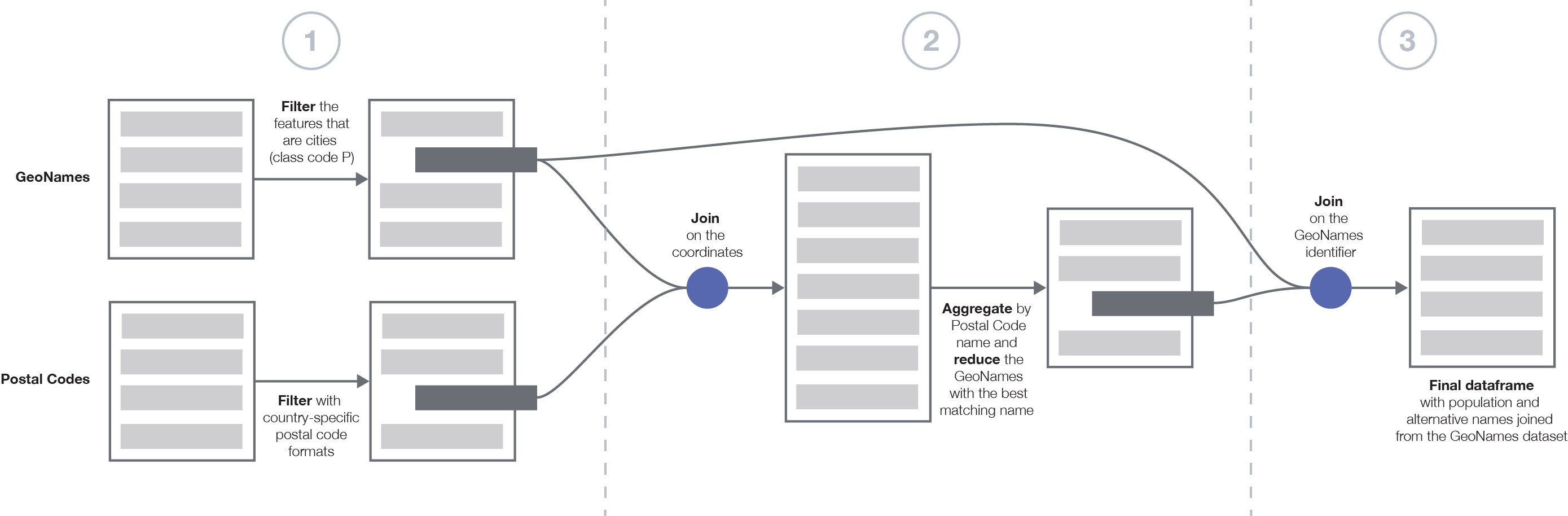
The data processing pipeline was written in a Jupyter notebook. The resulting files of the pipeline are given in the output folder.
1. Preliminary filtering
Filter cities. First, I processed the features of the GeoNames dataset in order to filter those that correspond to cities. According to the documentation of the GeoNames dataset, city features are given by the feature class P, which correspond to populated places such as cities, villages, etc. This reduces the size of the dataset from 11,816,412 features in the GeoNames dataset to 4,697,045 features in the filtered GeoNames dataset.
Filtering postal codes. There are a few caveats when linking postal codes with cities. The first one is the fact that some countries do not have postal codes. Since the GeoNames dataset covers the whole world, it spans countries that do not have postal codes, therefore the association with the cities cannot be made.
Furthermore, the postal codes follow well-defined patterns specific to each country. In order to filter the postal codes that do not match the defined patterns, I reported these patterns in a CSV file into regex formats and used this file to filter the postal codes that do not match the patterns. This has been useful to detect and remove the "CEDEX" postal codes in France as well as the DOM/TOM territories. This first filter step allowed to remove some features, from 1,264,592 postal code features to 1,249,933 filtered ones.
2. Matching postal codes to GeoNames cities
Without loss of generality, the goal is to match the postal codes features with a single GeoNames feature. Matching the features of both datasets is made challenging because no common key is shared between the two datasets. The fields shared between the two datasets such as the name, country codes, administrative codes, and coordinates cannot be used as keys for the join. In the following, I detail the reasons why these fields cannot be used as keys for an exact match of the two datasets.
Problem with the names. The name given in the postal codes dataset does not necessarily exactly match the name associated to the GeoNames features. For instance, “Trois-Bassins” (-21.1, 55.3) in the postal codes dataset matches to the GeoNames feature “Les Trois-Bassins” (-21.1, 55.3).
Problem with the administrative codes. Features in both datasets are associated to several hierarchical administrative areas of varying sizes. For instance, Paris 08 (75008) is in the country France of code FR, the first-level administrative area 11 (Île-de-France), the second-level administrative area 75 (Paris), and the third-level administrative area 751 (Paris). However, while the administrative codes given in both datasets may match for certain countries such as France, they do not necessarily match for other countries such as Mexico, see for instance this instance for Tampico, Mexico.
Postal Codes dataset.
+---+---+---+--------------+-------+--------+-----+
|AC1|AC2|AC3|          NAME|    LAT|     LON|   PC|
+---+---+---+--------------+-------+--------+-----+
|TAM|038| 10|       Tampico|22.2553|-97.8686|89137|
|TAM|038| 10|Ignacio Romero|22.2553|-97.8686|89137|
+---+---+---+--------------+-------+--------+-----+
GeoNames dataset.
+---+---+----+-------+--------+--------+-------+
|AC1|AC2| AC3|   NAME|     LAT|     LON|   GNID|
+---+---+----+-------+--------+--------+-------+
| 28|038|null|Tampico|22.24484|-97.8352|3516355|
+---+---+----+-------+--------+--------+-------+
Problem with the coordinates. For instance, the coordinates associated with “Saint-Denis” (-20.8823, 55.4504) in the postal codes dataset do not exactly match those associated with the GeoNames feature “Saint-Denis” (-20.88231, 55.4504). While they are very close, they do not match, making the exact coordinate matching challenging.
Proposed solution: Loose coordinate matching. Each feature in both datasets is associated to coordinates that consist of a longitude and a latitude given in the WGS84 coordinate system. The coordinates are more or less precise depending on the feature. The precision of the coordinates is given by the number of decimal places given in the latitude and longitude float number. According to this Wikipedia page, the physical length that can be measured depends on the precision of the coordinates as per the number of decimal places. As such, a precision of one decimal place corresponds to a length of 7.871 kilometers at 45 degrees N/S (this does depend on the latitude). Therefore, comparing coordinates at this precision level would be precise enough to absorb the difference between the coordinates in both datasets, while avoiding overlap on multiple cities. As an illustration, I represent the area covered by the different coordinate precision as a function of the decimal place.

Reducing the GeoNames features using string similarity. I join the two GeoNames and Postal Codes datasets based on the coordinates of the features using a precision of one decimal place. When aggregating on the postal code name, for a given postal code there are multiple GeoNames features that match (all the GeoNames cities that are within range of the coordinate precision). I further need to aggregate the resulting dataset by reducing the GeoNames feature to select the one that best matches the postal code feature. I match the two features based on their name. As I have discussed above the names loosely match one another, as such I perform a string match based on the cosine distance of the two name strings. In particular, it removes the special characters, tokenizes the string into words, and then compares the words shared between two strings. If the distance between the name in the GeoNames dataset and the one in the Postal Codes dataset is more than 20%, the two names will be matched.
3. Final dataset preparation
Finally, the other features of the GeoNames dataset (population and alternative names) are joined to the aggregated and reduced dataset using the GeoNames identifier.
Algolia index ranking
In the final phase of this project, I used the Python API developed by Algolia to send the data I processed for each country in batch mode.
Ranking the search results. I used the ranking options offered by Algolia through their dashboard to rank the different cities using the default ranking as well as their population and **geo
