
accessflow
Open-source database, API access & deployment governance platform A SQL, NoSQL, and API proxy that puts review, approval, and audit between your team and production data and services.
Install / Use
claude mcp add bablsoft -- npx -y github:bablsoft/accessflowIf the server publishes to npm under a different name, use that package instead — check the repo README.
MCP Server
Model Context Protocol server
Quality Score
Category
SecuritySupported Platforms
Our assessment of accessflow
accessflow scores 75/100 on our quality scale, 1045th of 1,123 Security skills we index.
Its MCP Server is 59 KB long, well organised into 17 sections with 10 code examples: long enough that it reads more like full documentation than a focused instruction file, which agents can find harder to follow.
It has 10 GitHub stars, so there is little community track record yet; judge it on its content.
Maintenance, license and trust
- The repository was last updated today, so accessflow is actively maintained.
- Our last check on 2026-08-24 found the source still online.
- It is released under the Apache-2.0 license, a permissive license that allows use, modification and commercial use with attribution.
- Its trust signals score 97/100, with no cautions. These come from repository metadata, not a code audit — read the skill file before letting an agent act on it.
accessflow compared with similar skills
All 4 of these similar skills score higher than accessflow; compare them before choosing.
| Skill | Score | Stars | Updated | Format |
|---|---|---|---|---|
| accessflow (this skill)by bablsoft | 75 | 10 | today | MCP Server |
| claude-memby thedotmack | 100 | 97.7k | today | CLAUDE.md |
| Agent-Reachby Panniantong | 100 | 93.2k | today | CLAUDE.md |
| headroomby headroomlabs-ai | 100 | 74.6k | today | CLAUDE.md |
| CowAgentby zhayujie | 100 | 47.3k | today | CLAUDE.md |
Frequently asked questions
- How do I install accessflow?
- Run
claude mcp add bablsoft -- npx -y github:bablsoft/accessflow. The install tabs above show the steps for each supported agent. - Which AI agents does accessflow work with?
- It is written for Claude Code and Claude Desktop, as a MCP Server file. Other agents that read the same format can often use it too.
- Is accessflow safe to use?
- It is Apache-2.0-licensed and scores 97/100 on trust signals. Skills are instructions an agent will follow, so read the file before installing it and do not approve commands you do not understand.
- Is accessflow still maintained?
- The repository was last updated today, so accessflow is actively maintained.
Skill content
View source on GitHubAccessFlow sits as a full query proxy in front of your databases — the relational engines PostgreSQL, MySQL, MariaDB, Oracle, and Microsoft SQL Server are supported out of the box via a declarative connector catalog (additional engines such as ClickHouse install with one click), any other JDBC-compatible engine can be added by uploading its driver JAR, the NoSQL document engines MongoDB and Couchbase (SQL++), the NoSQL key-value engine Redis, the NoSQL wide-column engines Apache Cassandra (CQL) and ScyllaDB (CQL-compatible), the NoSQL search engines Elasticsearch and OpenSearch, the NoSQL key-value engine Amazon DynamoDB (PartiQL), the NoSQL graph engine Neo4j (Cypher over Bolt), and the cloud data warehouses Snowflake, Google BigQuery (GoogleSQL), and Databricks SQL install the same way through on-demand native engine plugins. The catalog separates the SQL (relational) family, the cloud data-warehouse family, and the NoSQL umbrella of native engine-managed connectors. Every query a user submits — SQL, a MongoDB shell / JSON command, a Couchbase SQL++ statement, a Redis command, a Cassandra/ScyllaDB CQL statement, an Elasticsearch/OpenSearch query, a DynamoDB PartiQL statement, a Neo4j Cypher statement, or a Snowflake / BigQuery / Databricks warehouse SQL statement — is parsed, classified, optionally analyzed by AI, and routed through a configurable human-approval workflow before it ever reaches live data. The same governance extends beyond databases: outbound REST, SOAP, GraphQL, and gRPC calls against registered API connectors run through that identical pipeline — AI risk scoring, attribute-based routing, multi-stage approval — with response masking and immutable, downloadable response snapshots. Every request, decision, and execution is captured in a tamper-evident metadata audit log. Authentication is JWT (RS256) with optional SAML 2.0 SSO and OAuth 2.0 / OIDC sign-in (built-in templates for Google, GitHub, GitHub Enterprise Server, Microsoft, GitLab, and self-managed GitLab), and SCIM 2.0 provisioning lets the identity provider drive user & group lifecycle end to end. AccessFlow ships as a single open-source product under Apache 2.0 and is designed to run entirely inside your own infrastructure.
Why AccessFlow
Most teams pick one of two extremes for database access:
- Shared production credentials — anyone with the password can run
DELETE. Fast, but a single mistake is unbounded and there is no record of who did what. - Ticket-driven DBA access — every change goes through a manual DBA queue. Safe, but slow enough that engineers route around it.
AccessFlow provides the missing middle: governed, self-service access where every query is reviewable, every approval is traceable, and AI catches the obvious problems before a human ever sees the request.
See it in action
A glance at the day-to-day flows engineers and approvers actually use.
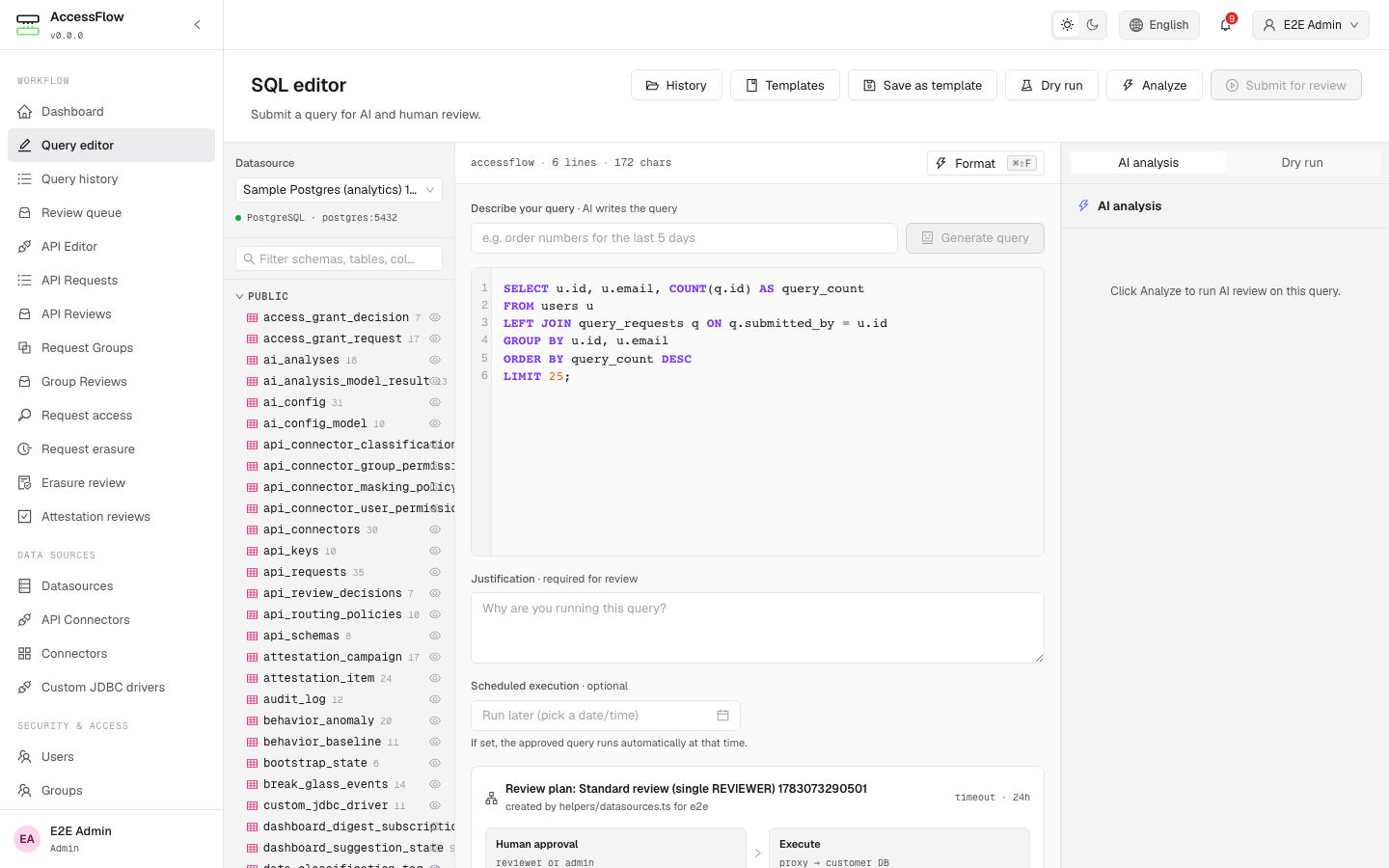
Submit a query — CodeMirror 6 with dialect-aware highlighting, live schema autocomplete, and an inline review-plan preview that shows exactly which approvals the submission will trigger.
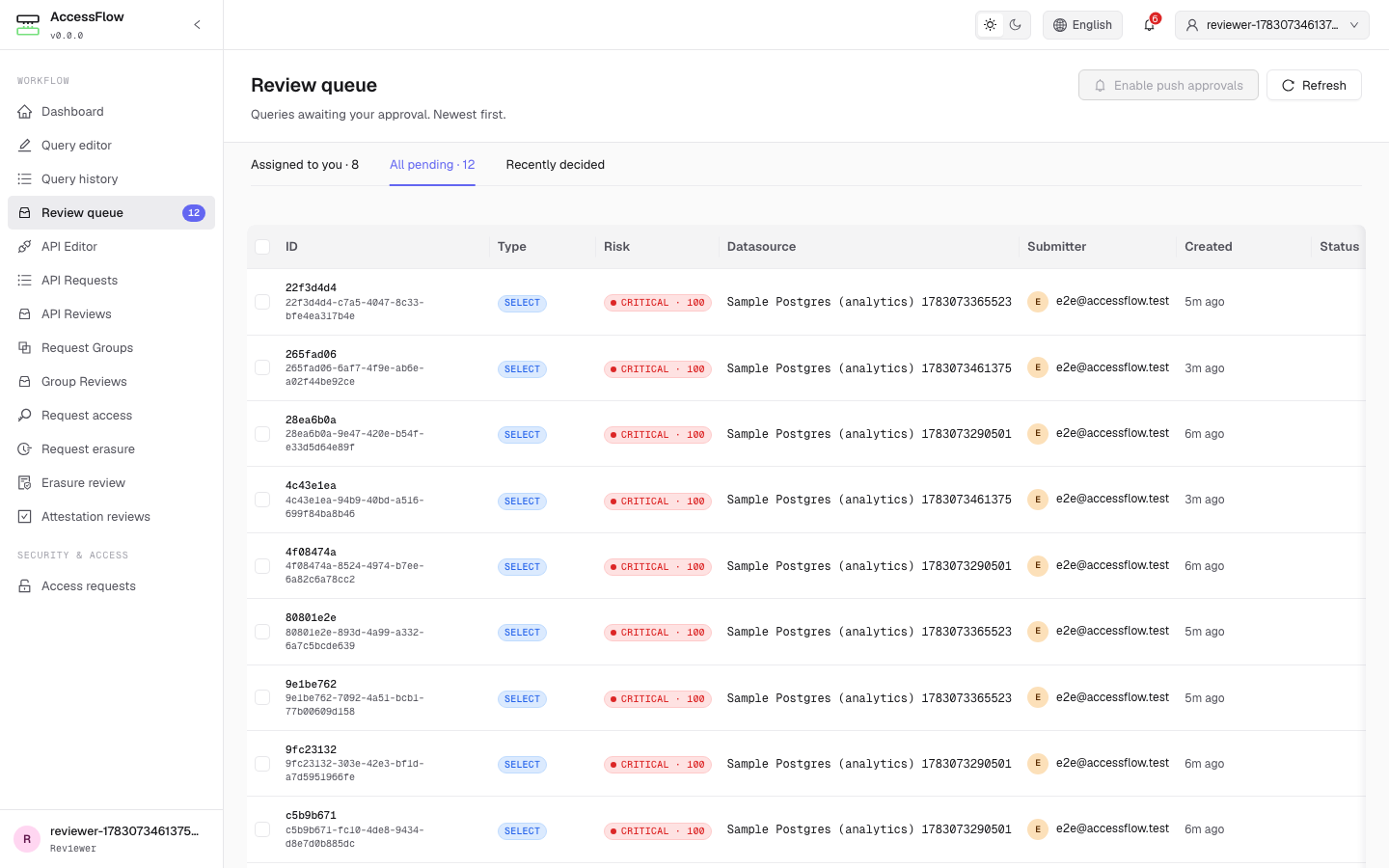
Approve or reject pending writes from one place — the queue is scoped to queries assigned to you, with risk score, query type, and submitter at a glance. A user can never approve their own query.
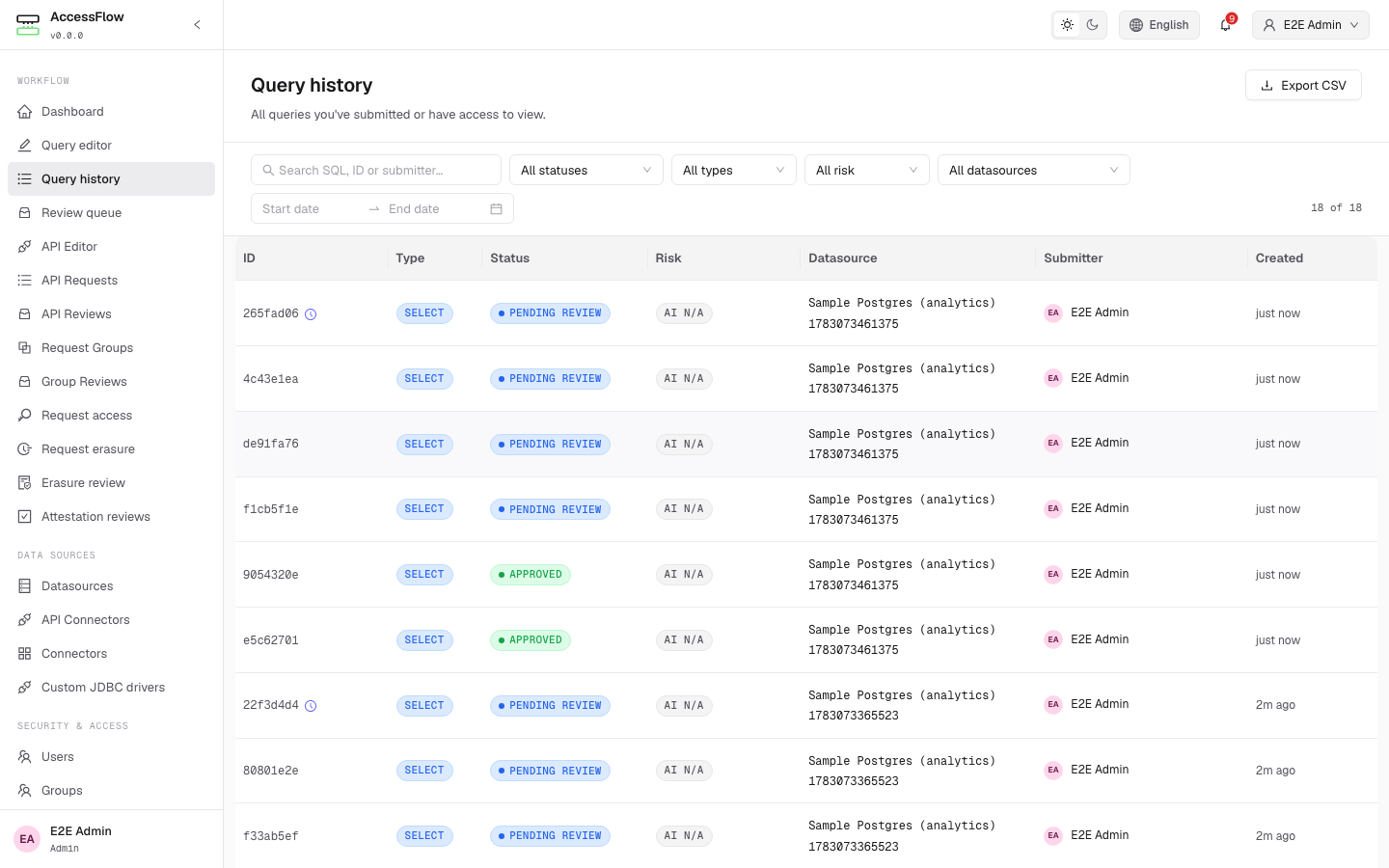
Searchable, filterable history of every query — by status, type, risk, datasource, submitter, or date range — with CSV export. Each row links to the full request, AI analysis, approval timeline, and result set.
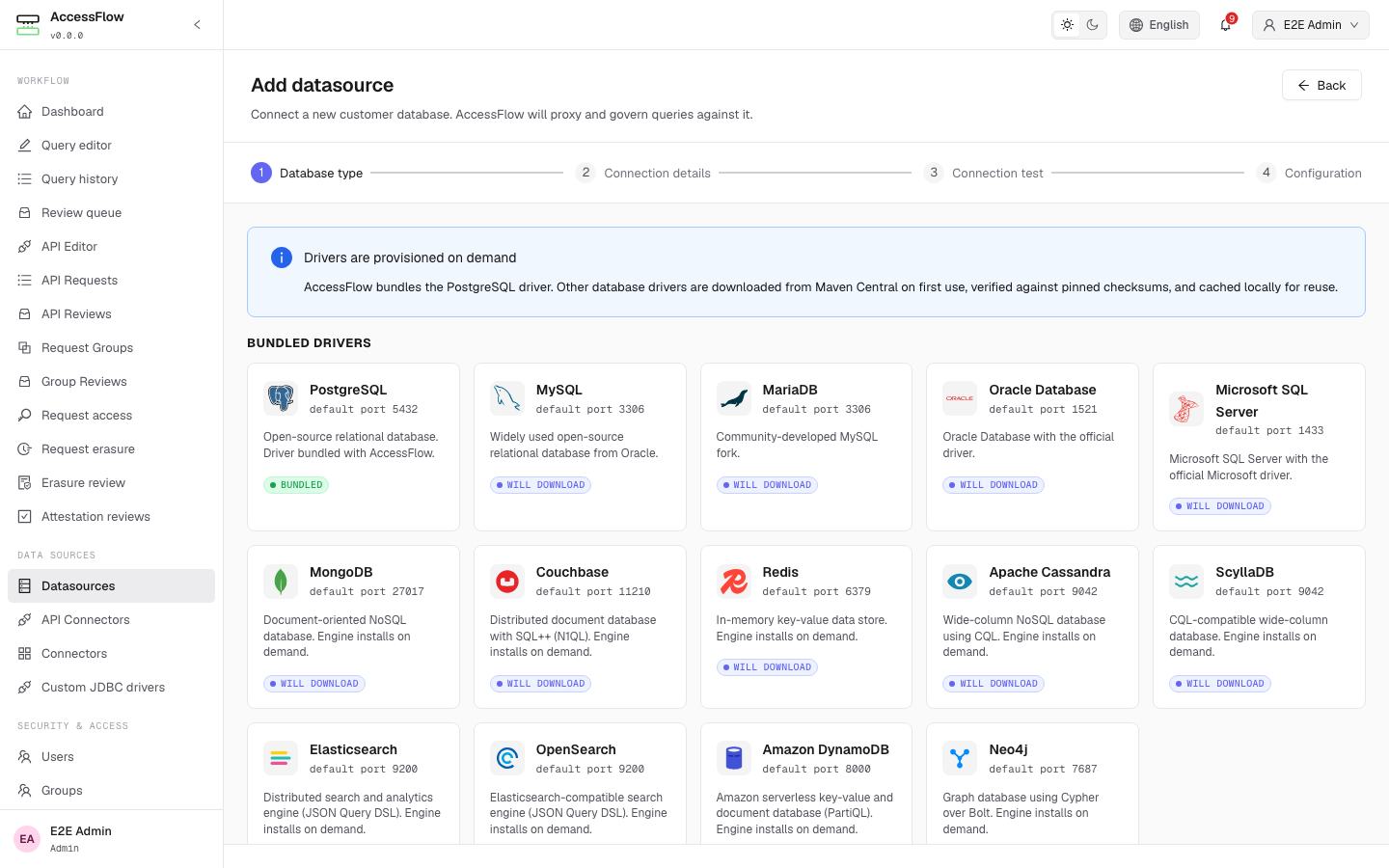
Connect a database in the admin UI — credentials are AES-256-GCM encrypted at rest, the proxy holds them, and end users never see them.
More walkthroughs — Review plans, AI provider configuration, notification channels (Email, Slack, Discord, Telegram, Teams, PagerDuty, ServiceNow, Jira, webhooks), OAuth 2.0 / OIDC sign-in, SAML 2.0 SSO, users & invitations, and system SMTP all have step-by-step screenshots on the public documentation site.
Features
- Proxy-first execution — no user ever holds production credentials; the proxy holds them encrypted and opens connections only after approval. Single SQL statements run with autocommit; multi-statement INSERT/UPDATE/DELETE batches wrapped in
BEGIN; … COMMIT;execute atomically inside one JDBC transaction (mixed SELECT/DML batches are rejected at parse time), with homogeneous INSERT runs collapsed into JDBCexecuteBatch()for bulk-load throughput. Optional multi-replica read load balancing: attach any number of replica endpoints to a datasource and SELECT traffic round-robins across the healthy ones — per-node health checks with circuit-breaker failover skip downed replicas, and only full replica-set exhaustion falls back to the primary (with an audit row). Optional SELECT result caching: opt a datasource into a Redis-backed result cache (per-datasource TTL) keyed over the security-rewritten query — masking and row-level security still apply — and invalidated on any proxied write to a referenced table. - Configurable review workflows — per-datasource review plans, multi-stage sequential approval chains, optional auto-approve for reads, approval timeouts with auto-reject. Reviewers can be scoped per-datasource (directly or via groups) so different teams see only the queues that belong to them. Reviewers going away can set an out-of-office delegation naming a colleague to cover their review duty for a window — across queries, governed API calls, and grouped requests — with every decision recording both identities. A delegate can never act on the delegator's own requests, delegation never grants a permission they lack, and it does not chain. Plans can also escalate a request that nobody has decided on to the reviewers at its current stage plus your admins before the approval timeout auto-rejects it, and nudge those same reviewers on a cadence — both optional, both notify-only, so waiting never changes who may approve.
- Policy-as-code routing — ordered, attribute-based routing policies decide a query's path after AI analysis and before reviewers see it: auto-approve, auto-reject, require N approvals, or escalate. Conditions match on query type, referenced tables (glob), AI risk level / score, requester role or group, time-of-day / day-of-week, WHERE / LIMIT presence, the transactional flag, and the submission client context — source IP / CIDR, user-agent, time-since-last-approval, and CI/CD origin (API key or
X-AccessFlow-CIheader) — combined with AND / OR / NOT. Client-context conditions fail closed (missing context never auto-approves), so an off-network or stale-approval query escalates to stricter review instead. First match by priority wins; on no match the query falls through to the datasource's review plan. Every automated decision is recorded in the audit log. - Just-in-time (JIT) access requests — users self-request temporary, scoped access to a datasource (read/write/DDL, optional schema/table scope) or an API connection (read/write, optional operation allow-list) for an ISO-8601 duration. Requests flow through the same approval engine, a time-boxed permission is granted on approval, and a clustered scheduler auto-revokes it on expiry (admins can also revoke early). A grant can opt into query pre-approval: while it is active, queries it covers skip human review and are auto-approved with the grant recorded as the approval provenance — routing policies, high-risk AI verdicts, and behavioural anomalies still override.
- Break-glass / emergency access — a gated emergency path for when production is on fire and approvers are asleep. A per-user/per-datasource
can_break_glasspermission (required for everyone, including admins; time-boxed) lets a query execute immediately, bypassing review — still through every proxy guard (allow-list, masking, row-level security, row caps). Compensating controls: a mandatory justification, instant fanout to all org admins (incl. PagerDuty), a prominently-tagged audit row, and a mandatory retro-review an admin (never the submitter) must acknowledge on the/admin/break-glasslog. - Dynamic data masking — per-column masking policies (full, partial last-N, stable hash, email-preserving, format-preserving) with role / group / user reveal conditions evaluated per requester. Masking is applied at result-read time before results are serialized or stored, so unmasked values never persist; applied policy ids are recorded in the audit log. Extends the static
restricted_columnsmasking. - Row-level security — per-table row predicates the proxy injects into the parsed SQL so a scoped user only sees (SELECT) or affects (UPDATE/DELETE) the rows they are authorised for. Admins author a structured
column operator valuepredicate where the value is a fixed literal or a:user.*variable (built-in id / email / role / groups, or an admin-set per-user attribute). Values are bound as JDBC parameters — never concatenated; predicates that can't be safely applied are rejected, never run unfiltered. Composes with column masking and the schema/table allow-list. - Data classification tagging — tag tables and columns as PII, PCI, PHI, GDPR, FINANCIAL, or SENSITIVE right in the schema explorer. Tagging a column auto-applies a masking policy, the AI analyzer raises a query's risk score when it touches a tagged object, and a derivation preview suggests a stricter review posture. Tags are audited and queryable org-wide as the evidence base for compliance reporting.
- Automated sensitive-data discovery — an opt-in per-datasource scanner samples column data through the same governed sampling path, detects sensitive values with local regex + checksum detectors (emails, credit-card PANs with Luhn, SSNs, IBANs, phone numbers) and optionally your bound AI analyzer (which only ever sees column names, types, and redacted samples), and proposes classification tags in a review worklist. Confirming a finding applies the tag —
Truncated for display — read the full file on GitHub.
Related Skills
claude-mem
97.7kPersistent Context Across Sessions for Every Agent – Captures everything your agent does during sessions, compresses it with AI, and injects relevant context back into future sessions. Works with Claude Code, OpenClaw, Codex, Gemini, Hermes, Copilot, OpenCode + More
Agent-Reach
93.2kGive your AI agent eyes to see the entire internet. Read & search Twitter, Reddit, YouTube, GitHub, Bilibili, XiaoHongShu — one CLI, zero API fees.
headroom
74.6kCompress tool outputs, logs, files, and RAG chunks before they reach the LLM. 20% fewer tokens for coding agents, 60-95% fewer tokens for JSON, same answers. Library, proxy, MCP server.
CowAgent
47.3kOpen-source personal AI assistant & Agent Harness. Plans tasks, runs tools and skills, self-evolves with memory and knowledge. Multi-agent, multi-model, multi-channel. Lightweight, extensible, one-line install.

Languages
Trust signals
From repository metadata: license, adoption, age and documentation. Not a code audit — see the Safety scan above for what the skill file itself contains.