
Market Basket Analysis
Association rule mining is a technique to identify underlying relations between different items.
Install / Use
npx skills add ashishpatel26/Market-Basket-AnalysisInstalls into whichever agent you are using.
README
Market Basket Analysis of Store Data
Dataset Description
- Different products given 7500 transactions over the course of a week at a French retail store.
- We have library(apyori) to calculate the association rule using Apriori.
Import the Library
import numpy as np
import pandas as pd
import matplotlib.pyplot as plt
from apyori import apriori
Read data and Display
store_data = pd.read_csv("store_data.csv", header=None)
display(store_data.head())
print(store_data.shape)
(7501, 20)
Preprocessing on Data
- Here we need a data in form of list for Apriori Algorithm.
records = []
for i in range(1, 7501):
    records.append([str(store_data.values[i, j]) for j in range(0, 20)])
print(type(records))
<class 'list'>
Apriori Algorithm
- Now time to apply algorithm on data.
- We have provide
min_support,min_confidence,min_lift, andmin lengthof sample-set for find rule.
Measure 1: Support.
This says how popular an itemset is, as measured by the proportion of transactions in which an itemset appears. In Table 1 below, the support of {apple} is 4 out of 8, or 50%. Itemsets can also contain multiple items. For instance, the support of {apple, beer, rice} is 2 out of 8, or 25%.
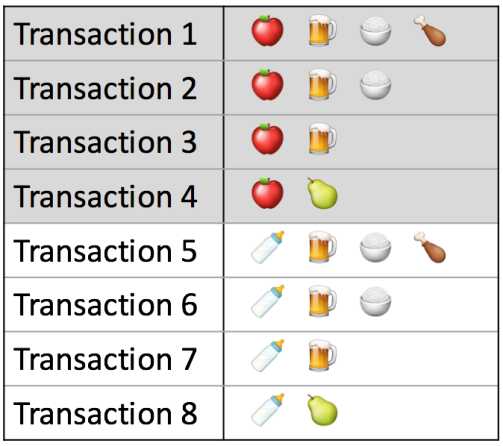
If you discover that sales of items beyond a certain proportion tend to have a significant impact on your profits, you might consider using that proportion as your support threshold. You may then identify itemsets with support values above this threshold as significant itemsets.
Measure 2: Confidence.
This says how likely item Y is purchased when item X is purchased, expressed as {X -> Y}. This is measured by the proportion of transactions with item X, in which item Y also appears. In Table 1, the confidence of {apple -> beer} is 3 out of 4, or 75%.

One drawback of the confidence measure is that it might misrepresent the importance of an association. This is because it only accounts for how popular apples are, but not beers. If beers are also very popular in general, there will be a higher chance that a transaction containing apples will also contain beers, thus inflating the confidence measure. To account for the base popularity of both constituent items, we use a third measure called lift.
Measure 3: Lift.
This says how likely item Y is purchased when item X is purchased, while controlling for how popular item Y is. In Table 1, the lift of {apple -> beer} is 1,which implies no association between items. A lift value greater than 1 means that item Y is likely to be bought if item X is bought, while a value less than 1 means that item Y is unlikely to be bought if item X is bought.

association_rules = apriori(records, min_support=0.0045, min_confidence=0.2, min_lift=3, min_length=2)
association_results = list(association_rules)
How many relation derived
print("There are {} Relation derived.".format(len(association_results)))
There are 48 Relation derived.
Association Rules Derived
for i in range(0, len(association_results)):
    print(association_results[i][0])
frozenset({'light cream', 'chicken'})
frozenset({'escalope', 'mushroom cream sauce'})
frozenset({'escalope', 'pasta'})
frozenset({'herb & pepper', 'ground beef'})
frozenset({'tomato sauce', 'ground beef'})
frozenset({'olive oil', 'whole wheat pasta'})
frozenset({'shrimp', 'pasta'})
frozenset({'nan', 'light cream', 'chicken'})
frozenset({'shrimp', 'chocolate', 'frozen vegetables'})
frozenset({'cooking oil', 'spaghetti', 'ground beef'})
frozenset({'escalope', 'mushroom cream sauce', 'nan'})
frozenset({'escalope', 'pasta', 'nan'})
frozenset({'spaghetti', 'ground beef', 'frozen vegetables'})
frozenset({'milk', 'olive oil', 'frozen vegetables'})
frozenset({'shrimp', 'mineral water', 'frozen vegetables'})
frozenset({'spaghetti', 'olive oil', 'frozen vegetables'})
frozenset({'shrimp', 'spaghetti', 'frozen vegetables'})
frozenset({'spaghetti', 'frozen vegetables', 'tomatoes'})
frozenset({'spaghetti', 'ground beef', 'grated cheese'})
frozenset({'herb & pepper', 'ground beef', 'mineral water'})
frozenset({'herb & pepper', 'nan', 'ground beef'})
frozenset({'herb & pepper', 'spaghetti', 'ground beef'})
frozenset({'milk', 'ground beef', 'olive oil'})
frozenset({'nan', 'tomato sauce', 'ground beef'})
frozenset({'shrimp', 'spaghetti', 'ground beef'})
frozenset({'milk', 'spaghetti', 'olive oil'})
frozenset({'soup', 'mineral water', 'olive oil'})
frozenset({'nan', 'olive oil', 'whole wheat pasta'})
frozenset({'shrimp', 'nan', 'pasta'})
frozenset({'spaghetti', 'pancakes', 'olive oil'})
frozenset({'shrimp', 'chocolate', 'frozen vegetables', 'nan'})
frozenset({'cooking oil', 'nan', 'spaghetti', 'ground beef'})
frozenset({'nan', 'spaghetti', 'ground beef', 'frozen vegetables'})
frozenset({'milk', 'spaghetti', 'mineral water', 'frozen vegetables'})
frozenset({'milk', 'nan', 'olive oil', 'frozen vegetables'})
frozenset({'shrimp', 'nan', 'mineral water', 'frozen vegetables'})
frozenset({'nan', 'spaghetti', 'olive oil', 'frozen vegetables'})
frozenset({'shrimp', 'nan', 'spaghetti', 'frozen vegetables'})
frozenset({'nan', 'spaghetti', 'frozen vegetables', 'tomatoes'})
frozenset({'nan', 'spaghetti', 'ground beef', 'grated cheese'})
frozenset({'herb & pepper', 'nan', 'ground beef', 'mineral water'})
frozenset({'herb & pepper', 'nan', 'spaghetti', 'ground beef'})
frozenset({'milk', 'nan', 'ground beef', 'olive oil'})
frozenset({'shrimp', 'nan', 'spaghetti', 'ground beef'})
frozenset({'milk', 'nan', 'spaghetti', 'olive oil'})
frozenset({'nan', 'soup', 'mineral water', 'olive oil'})
frozenset({'nan', 'spaghetti', 'pancakes', 'olive oil'})
frozenset({'milk', 'frozen vegetables', 'nan', 'spaghetti', 'mineral water'})
Rules Generated
for item in association_results:
    # first index of the inner list
    # Contains base item and add item
    pair = item[0]
    items = [x for x in pair]
    print("Rule: " + items[0] + " -> " + items[1])

    # second index of the inner list
    print("Support: " + str(item[1]))

    # third index of the list located at 0th
    # of the third index of the inner list

    print("Confidence: " + str(item[2][0][2]))
    print("Lift: " + str(item[2][0][3]))
    print("=====================================")
Rule: light cream -> chicken
Support: 0.004533333333333334
Confidence: 0.2905982905982906
Lift: 4.843304843304844
=====================================
Rule: escalope -> mushroom cream sauce
Support: 0.005733333333333333
Confidence: 0.30069930069930073
Lift: 3.7903273197390845
==========================
Related Skills
mcp
Use the `mcp_perplexity-ask_perplexity_search` tools to answer questions. You should use this instead of the `web_search` tool because it is a lot more accurate.
practical-power-systems-synthesis
This skill enables synthesis in the domain of power-systems (engineering). It represents research-level-level expertise and is designed for production use in research, industry, and educational contexts. Use this skill when you need to perform synthesis operations related to power-systems.
semi-supervised-optogenetics-testing
This skill enables testing in the domain of optogenetics (neuroscience). It represents intermediate-level expertise and is designed for production use in research, industry, and educational contexts. Use this skill when you need to perform testing operations related to optogenetics.
data-mining-interpretation-fundamental
This skill enables interpretation in the domain of data-mining (data-science). It represents fundamental-level expertise and is designed for production use in research, industry, and educational contexts. Use this skill when you need to perform interpretation operations related to data-mining.
