
Varray
Resizable arrays with O(ᵏ√N) insertion and deletion (Tiered Vectors)
Install / Use
/learn @art-w/VarrayREADME
Tiered Vectors: Efficient Dynamic Arrays for Rank-Based Sequences [243ko pdf]
by Michael T. Goodrich and John G. Kloss II
WADS 1999. Lecture Notes in Computer Science, vol 1663 https://doi.org/10.1007/3-540-48447-7_21
This library provides an implementation of variable sized arrays, which are also called resizable arrays, dynamic arrays or even "vectors" in C++ and "ArrayList" in Java. Just like an array, accessing any element by its index is constant time, but one can also efficiently insert and delete at any location (with the array resizing automatically to meet the need).
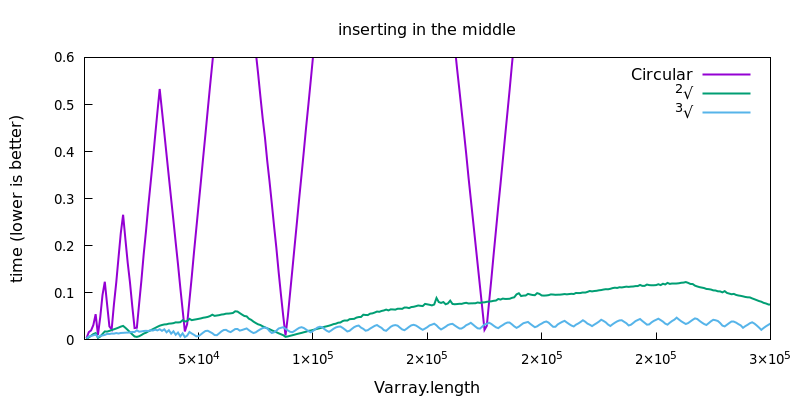
Following the above paper, the family of tiered vectors yields a nice compromise between random access and resizing:
| Module Circular | get, set | {push,pop}_{back,front} | insert_at, pop_at | Memory overhead |
|-------------------------------|-------------:|:-------------------------:|:----------------------------------:|:-----------------------:|
| Circular | O(1) | O(1) amortized | O(N) | O(N) |
| Root(Circular) | O(1) | O(1) amortized | O(√N) | O(√N) |
| Root<sup>k-1</sup>(Circular) | O(k) | O(k) amortized | O(k<sup>2</sup> × <sup>k</sup>√N) | O(N<sup>k-1 / k</sup>) |
In other words, each instantiation of the Root functor leads to slower random
access into the array, but it also makes insertion and deletion faster!
You can expect the following constant factors on random access:
| | Array | Circular | Root | Root<sup>2</sup> | Root<sup>3</sup> | Root<sup>4</sup> | Root<sup>5</sup> | |----:|------:|---------:|-----:|-----------------:|-----------------:|-----------------:|-----------------:| | get | 1x | 3x | 8x | 17x | 27x | 31x | 33x | | set | 1x | 2x | 4x | 8x | 12x | 14x | 15x |
The memory usage is competitive:
push_front,push_backand their respectivepop, are amortized constant time, since they frequently need to allocate small chunks of O(<sup>k</sup>√N) up to O(k <sup>k</sup>√N) memory as the varray grows or shrinks.- The growth strategy is incremental: the worst case slowdown following a resize is also O(k <sup>k</sup>√N) which is unobtrusive for k>1. There is no "stop the world while every elements is moved to a larger array".
- The amount of memory used for bookkeeping and allocated in anticipation of a
growth is pretty tight. In particular for k=2, the O(√N) memory overhead is
optimal if random access and
push_backare to be O(1).
If you only care about fast random access and resizing at the right end with
{push,pop}_back, then the pre-existing libraries provide smaller constant
factors : (in alphabetical order) BatDynArray from Batteries, CCVector from
Containers, RES as a standalone library or even vector as a single module.
Related Skills
node-connect
339.1kDiagnose OpenClaw node connection and pairing failures for Android, iOS, and macOS companion apps
frontend-design
83.8kCreate distinctive, production-grade frontend interfaces with high design quality. Use this skill when the user asks to build web components, pages, or applications. Generates creative, polished code that avoids generic AI aesthetics.
openai-whisper-api
339.1kTranscribe audio via OpenAI Audio Transcriptions API (Whisper).
commit-push-pr
83.8kCommit, push, and open a PR
