
HartreeFock
A program implementing the Hartree–Fock (also post-HF: MP2, CCSD(T), CIS and TDHF/RPA)/self-consistent field method (also DIIS) with Gaussian orbitals
Install / Use
/learn @aromanro/HartreeFockREADME
HartreeFock
A program implementing the Hartree–Fock/self-consistent field method (and more, see the README at the end)
Description is available here: http://compphys.go.ro/the-hartree-fock-program/
Some Hartree-Fock theory here: http://compphys.go.ro/the-hartree-fock-method/
Some things more general (Schrödinger equation, Born-Oppenheimer approximation, variational principle), here: http://compphys.go.ro/how-to-solve-a-quantum-many-body-problem/
TOOLS
The project compiles on Windows with Visual Studio 2026 (the code can be compiled with older versions starting with VS 2015, but it's currently maintained with VS 2026 and C++ 17 or higher).
LIBRARIES
Besides mfc and other typical VC++ runtime libraries, the program uses GDI+ for drawing. Eigen 5 is also used. It worked with an older version as well, but I recommend using ver 5 because it has some fixed issues.
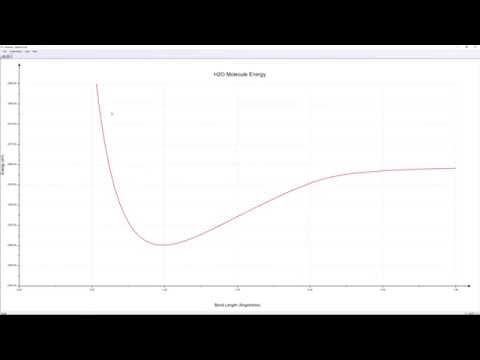
PROGRAM IN ACTION
HOW TO COMPUTE
Here are some things about usage:
Using the classes should be easy. Here is how to grab some atoms from the 'basis':
	Systems::AtomWithShells H1, H2, O, N, C, He, Li, Ne, Ar;

	for (auto &atom : basis.atoms)
	{
		if (atom.Z == 1) H1 = H2 = atom;
		else if (atom.Z == 2) He = atom;
		else if (atom.Z == 3) Li = atom;
		else if (atom.Z == 8) O = atom;
		else if (atom.Z == 6) C = atom;
		else if (atom.Z == 7) N = atom;
		else if (atom.Z == 10) Ne = atom;
		else if (atom.Z == 18) Ar = atom;
	}
Here is how to set the H2O molecule with the coordinates from the 'Mathematica Journal' (referenced in the code):
	H1.position.X = H2.position.X = O.position.X = 0;

	H1.position.Y = 1.43233673;
	H1.position.Z = -0.96104039;
	H2.position.Y = -1.43233673;
	H2.position.Z = -0.96104039;

	O.position.Y = 0;
	O.position.Z = 0.24026010;

	Systems::Molecule H2O;

	H2O.atoms.push_back(H1);
	H2O.atoms.push_back(H2);
	H2O.atoms.push_back(O);

	H2O.Init();
And here is how you calculate:
HartreeFock::RestrictedHartreeFock HartreeFockAlgorithm;
HartreeFockAlgorithm.alpha = 0.5;
HartreeFockAlgorithm.initGuess = 0;

HartreeFockAlgorithm.Init(&H2O);
double result = HartreeFockAlgorithm.Calculate();
You can do computation for a single atom, too, for now by putting it into a dummy molecule with a single atom in it. For example for He:
  Systems::Molecule Heatom;
  Heatom.atoms.push_back(He);
  Heatom.Init();
LATEST ADDITIONS
I added more basis sets, it's not limited to STO-nG. While doing that, I found and fixed a bug in the integrals repository that manifested for orbitals having L > 1. Now it seems to work fine.
Basis sets added:
- Split valence orbitals: 3-21G, 6-21G, 6-31G
- Besides 'split valence', polarization on heavy atoms: 6-31G*
- 'Split valence', polarization on heavy atoms and hydrogen and diffusion functions on heavy atoms: 6-31+G**
You may add more of them, the parsed format is nwchem.
Tutorials from Crawford Group
Most of those are already implemented:
https://github.com/CrawfordGroup/ProgrammingProjects
Projects for MP2, DIIS, CCSD(T), CIS and TDHF/RPA are implemented. DIIS and MP2 are implemented for both the restricted and unrestricted methods.
Projects 1 and 2 are not implemented here, maybe I'll add a python workbook for those in the python repository, 3 was already implemented obviously before finding this. Project 7 is also not implemented, also 9 and 13.
Related Skills
node-connect
328.6kDiagnose OpenClaw node connection and pairing failures for Android, iOS, and macOS companion apps
frontend-design
80.9kCreate distinctive, production-grade frontend interfaces with high design quality. Use this skill when the user asks to build web components, pages, or applications. Generates creative, polished code that avoids generic AI aesthetics.
openai-whisper-api
328.6kTranscribe audio via OpenAI Audio Transcriptions API (Whisper).
commit-push-pr
80.9kCommit, push, and open a PR
